Unmasking QTFY: U.S. DOJ and FBI Seize State-Sponsored Infrastructure Tied to Chinese Cyber Espionage
Executive Overview
In a coordinated enforcement action that underscores the escalating cyber conflicts between global superpowers, the U.S. Department of Justice (DOJ) and the Federal Bureau of Investigation (FBI) announced the seizure of several domain names utilized by a sophisticated state-sponsored Chinese hacking collective known as "QTFY." This aggressive interagency maneuver highlights a multi-year campaign targeting the nerve center of the United States federal government, critical infrastructure, and cutting-edge research facilities.
According to federal affidavits and official disclosures released on Wednesday, the cyber intrusion campaign traced back to at least 2018. It successfully compromised high-profile government institutions, including the Federal Reserve, the Department of Energy, the Department of Justice, the Department of Health and Human Services, the National Institutes of Health (NIH), NASA, and the United States Senate.
The infrastructure dismantled by U.S. law enforcement relied on two primary malware strains—dubbed QTRouter and QScan—which weaponized thousands of Internet of Things (IoT) devices globally to form an advanced botnet. This sprawling network served as an impenetrable "obfuscation layer," masking the origin of malicious traffic directed at American networks. While Beijing has historically maintained a policy of blanket denial regarding state-sponsored cyber operations against Western targets, this latest action reveals deep operational ties between QTFY and entities like the People’s Republic of China (PRC) Ministry of State Security (MSS), painting a vivid picture of modern state-backed cyber warfare.
Detailed Chronology of the Investigation
The multi-year digital manhunt that culminated in the seizure of domains such as qtproxy.xyz, qt-proxy.org, and qt-team.com began long before the public became aware of the extent of the threat. Federal investigators traced the roots of the modern digital incursion back through a meticulous trail of digital breadcrumbs, spanning half a decade of counter-intelligence work.
2019: The NASA Breach and Early Indicators
The foundational phase of the investigation kicked off in 2019 when cybersecurity teams and FBI investigators analyzed a major system intrusion at the National Aeronautics and Space Administration (NASA). The attackers leveraged a known vulnerability cataloged as CVE-2019-11510—a critical flaw that was subsequently patched across affected systems.
Rather than treating the incident as an isolated event, FBI cyber agents dug deeper into the telemetry of the attack. Their forensic work tied the unauthorized access back to specific indicators of compromise: two distinct Gmail accounts and a telephone number registered with a +86 country code, the international dialing code for the People’s Republic of China. This initial nexus provided the first solid thread in an unraveling web of state-backed espionage.
2022–2024: Infrastructure Scaling and Domain Acquisition
As years progressed, the threat actors behind QTFY refined their operational security. To shield their true identities and locations, the group began renting commercial infrastructure, utilizing platforms provided by hosting companies like Hostwinds. However, their aggressive scanning and intrusion operations triggered a steady stream of abuse complaints to Hostwinds’ administrators, inadvertently creating valuable investigative logs for federal authorities.
Between 2022 and 2024, the actors solidified their command-and-control capabilities by registering three vital domains:
qtproxy.xyzqt-proxy.orgqt-team.com
These domains were registered using commercial domain registrars, notably Namecheap, and funded via anonymous or obfuscated PayPal transactions. Despite these layers of commercial insulation, continuous monitoring by the FBI and DOJ allowed investigators to unmask the underlying network topology, mapping out how the actors routed traffic through compromised assets.
Wednesday’s Enforcement Action
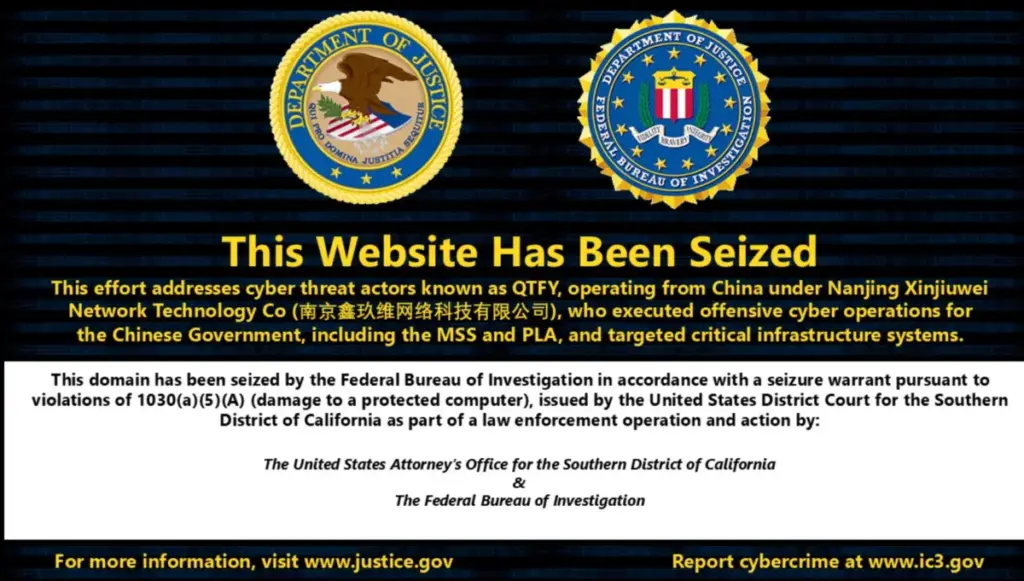
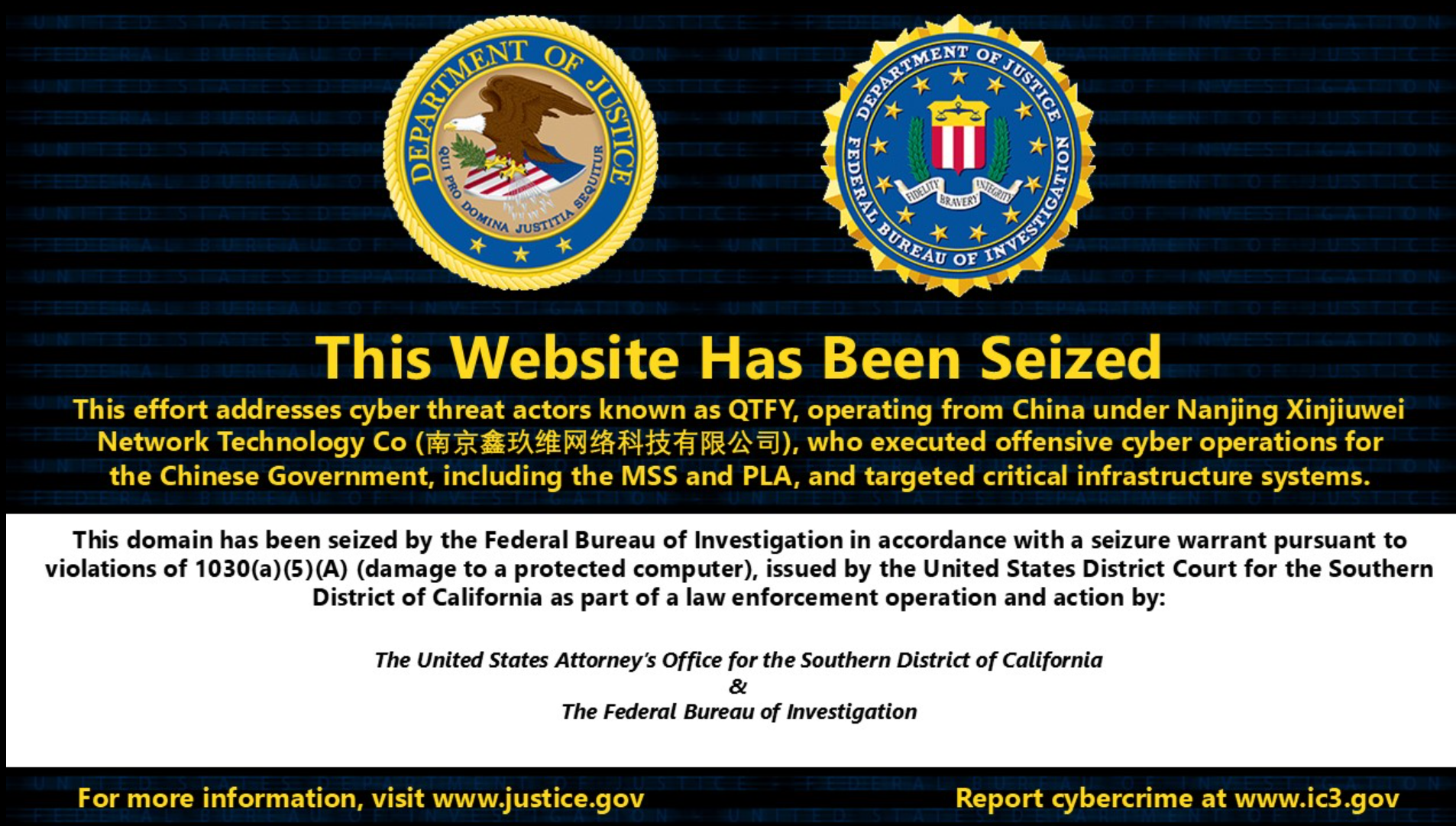
The culmination of this extensive intelligence-gathering operation materialized on Wednesday when the DOJ and FBI executed simultaneous seizure orders. The targeted domains were successfully impounded and redirected to official U.S. government seizure notices—a stark visual warning to adversarial actors that American cyberspace is actively defended.

Technical Anatomy: How QScan and QTRouter Fuel the QTFY Botnet
Understanding the threat posed by QTFY requires examining the mechanics of their operations. The U.S. government’s technical disclosures reveal a highly automated, resilient infrastructure designed to scale continuous reconnaissance and exploitation against Western targets.
The Proliferation of QScan
At the heart of the group’s initial discovery phase is QScan, a malicious scanning utility engineered to automatically identify, probe, and infect thousands of vulnerable IoT devices worldwide. Unlike traditional targeted spear-phishing campaigns, QScan operates like a vacuum cleaner, sweeping across internet-connected hardware—such as routers, IP cameras, and connected smart devices—searching for unpatched firmware vulnerabilities and weak default credentials.
Once a vulnerable device is identified, QScan executes automated scripts to compromise the hardware, instantly coopting it into a growing pool of infected nodes.
QTRouter and the "Obfuscation Layer"
The devices hijacked by QScan are systematically integrated into the QTRouter network. While functionally operating as a botnet, the Justice Department emphasizes its primary utility as an obfuscation layer.
In advanced persistent threat (APT) operations, attribution is the greatest hurdle. By bouncing malicious traffic through thousands of legitimate, hijacked residential and commercial IoT devices scattered across the globe, QTFY effectively masked the true geographic and digital origins of their attacks. When security analysts or federal investigators traced incoming packets, the trail invariably ended at an innocent third-party router in a completely different country, making direct attribution exceedingly difficult without deep, transnational intelligence cooperation.
According to court affidavits, this sophisticated infrastructure has been actively leveraged to compromise U.S. critical infrastructure continuously since 2018.
Supporting Context & Metrics: The Scale of Chinese Cyber Espionage
The disruption of QTFY’s infrastructure does not occur in a vacuum; it is part of an escalating campaign by Western intelligence agencies to blunt a relentless wave of state-sponsored cyber espionage originating from China.
A Who’s Who of Compromised Federal Agencies
The breadth of institutions targeted by QTFY highlights the comprehensive nature of Beijing’s intelligence requirements, which span economic, scientific, military, and legislative domains:
- The Federal Reserve: Targeted for economic intelligence, monetary policy insights, and financial tracking data.
- The Department of Energy: A prime target for intelligence regarding domestic power grids, nuclear research, and energy independence initiatives.
- The Department of Justice & U.S. Senate: Key political and legal nerve centers, offering visibility into federal investigations, policy formulation, and legislative strategy.
- Health and Human Services & NIH: Critical repositories of biomedical research, epidemiological data, and public health infrastructure.
- NASA: A premier target for aerospace engineering data, satellite communications, and advanced exploratory research.
The Broader Ecosystem: Nanjing Xinjiuwei and the MSS Connection
Federal filings link the collective to an organization identified as the Nanjing Xinjiuwei Network Technology Company. While independent open-source intelligence and public registries have yielded sparse verified information regarding this specific entity—pointing to the shell-company nature of modern cyber-mercenary firms—the U.S. government maintains that its ultimate benefactors are clear.
Crucially, the DOJ press release notes that the PRC Ministry of State Security (MSS) was among QTFY’s primary paying customers. This dynamic illustrates a growing trend among modern nation-state actors: outsourcing the development and maintenance of offensive cyber tools to private contractors and proxy networks, thereby providing the state with plausible deniability while leveraging commercial infrastructure to maintain operations.
Official Statements and Diplomatic Fallout
The public disclosure of the QTFY takedown has reignited diplomatic tensions between Washington and Beijing, set against a backdrop of increasingly brazen cyber activities that have plagued Western infrastructure in recent years.
The U.S. Government Stance
In their joint announcements, representatives from the DOJ and FBI stressed that the United States will use every tool at its disposal to dismantle state-sponsored cyber threats. Law enforcement officials emphasized that civilian infrastructure, academic research facilities, and government networks are sovereign assets that will be fiercely defended against foreign interference.
"The seizure of these domains marks a significant blow to the operational capabilities of state-sponsored actors attempting to cloak their malicious activities behind layers of compromised global hardware," a federal law enforcement official noted in the wake of the announcement. "We are committed to exposing and disrupting these clandestine networks wherever they operate."
Shifting Geopolitical Realities
Historically, Beijing has categorically denied any involvement in state-sponsored cyberattacks targeting the United States or its allies, routinely dismissing such claims as politically motivated smears. However, the facade of total deniability has begun to crack under the weight of overwhelming forensic evidence.
Of particular note is a series of confidential diplomatic exchanges late last year. According to reports from The Wall Street Journal, Chinese officials in secret meetings reportedly acknowledged a measure of responsibility for targeted attacks on U.S. critical infrastructure. This admission coincided with an alarming disclosure in 2024 involving the compromise of 30-year-old lawful intercept (wiretap) systems deployed by the U.S. government within major domestic telecommunication and internet service providers—a breach that experts similarly attributed to Chinese state actors exploiting legacy legal compliance backdoors.
Future Outlook: The Ongoing War for Cyberspace
The dismantling of the QTFY domains—qtproxy.xyz, qt-proxy.org, and qt-team.com—represents a tactical victory for U.S. law enforcement, but cybersecurity experts warn that it is far from the end of the war.
Advanced persistent threat groups backed by nation-states are notoriously resilient. When one set of command-and-control domains is seized or exposed, operators quickly pivot, spinning up new infrastructure, registering fresh domains through alternative registrars, and refactoring their malware to bypass updated signatures.
Key Takeaways for Network Defense:
- IoT Hardening: The weaponization of devices via QScan and QTRouter highlights the critical need for robust IoT security. Consumers and enterprises alike must prioritize changing default credentials, disabling unnecessary remote-management interfaces, and applying firmware updates promptly.
- Supply Chain Visibility: As state actors increasingly rely on front companies like Nanjing Xinjiuwei and commercial hosting providers like Hostwinds, vetting third-party digital supply chains is more critical than ever.
- Proactive Disruption: Traditional defensive postures—simply blocking IP addresses or patching individual vulnerabilities—are insufficient. The DOJ and FBI’s aggressive strategy of seizing infrastructure demonstrates that proactive disruption of botnets and proxy layers is essential to raising the operational costs for state-sponsored hackers.
As the geopolitical landscape becomes increasingly digitized, actions like the QTFY takedown serve as both a defensive shield and a diplomatic warning. The digital battlefield is no longer confined to hidden dark web forums; it is actively fought across the domains, routers, and institutional networks that power modern society.