
Thirty Years of GORE and GLORY: id Software, Quake’s Legacy, and the "Dawn of the Machine"
Executive Overview
Thirty years after its seismic arrival in the summer of 1996, id Software’s Quake continues to cast an impossibly long shadow over the first-person shooter genre. To celebrate three decades of gothic-industrial nightmares, rocket-jumping physics, and groundbreaking true-3D architecture, developer MachineGames has unleashed a massive new expansion titled Quake: Dawn of the Machine. Revealed at QuakeCon alongside a landmark anniversary panel featuring studio co-founder John Romero, this fresh content drop breathes new life into a generational touchstone.
Yet, this milestone celebration arrives against a backdrop of stark industry turbulence. While the retro-FPS community rejoices over 19 brand-new levels, devious weapon variants, and a treasure trove of never-before-seen archival material, id Software itself navigates an existential crossroads. Recent corporate restructuring and sweeping layoffs orchestrated by parent company Microsoft have cast a heavy pall over the studio’s legacy. As the original architects of Quake—including Romero, John Carmack, Adrian Carmack, and Tom Hall—reunite on stage to honor their creation, the gaming world is forced to reconcile the triumphant history of the genre’s foundational titan with the precarious realities facing its developers today.
Detailed Chronology: From 1996 Revolution to Modern Expansion
The Genesis of a True 3D Nightmare
When Quake hit store shelves in June 1996, it did not merely follow up id Software’s monumental Doom franchise; it obliterated the boundaries of what video games could achieve. Spearheaded by a legendary, albeit fractured, core team—John Romero, John Carmack, Adrian Carmack, Sandy Petersen, American McGee, and Michael Abrash—Quake abandoned the pseudo-3D raycasting of its predecessors in favor of a revolutionary full-3D engine.
Complete with polygonal environments, dynamic lighting, and a brooding, industrial-ambient soundtrack composed by Trent Reznor of Nine Inch Nails, Quake birthed an aesthetic that married dark fantasy with sci-fi dread. Players assumed the role of "Ranger," navigating dimension-hopping portals to rid a military installation of otherworldly horrors.
However, the game’s triumphant birth coincided with its internal undoing. The crunch-heavy, highly pressurized development cycle laid bare deep philosophical and creative fractures among the studio’s leadership. Immediately following Quake’s completion, an exodus began. John Romero, American McGee, and several other key pillars departed id Software, setting off shockwaves across the industry. As level designer Sandy Petersen famously remarked decades later, the grueling ordeal of Quake fundamentally "ruined id Software" as an independent, counter-culture collective of pioneering rebels.
Surviving the Fallout and Evolving the Formula
Despite the fracturing of its original creative nucleus, id Software persevered. The studio transitioned into its next era, delivering critically acclaimed sequels like Quake II and Quake III Arena, which transformed multiplayer LAN parties forever. Over the ensuing decades, id weathered corporate acquisitions by ZeniMax Media and, subsequently, Microsoft, while continuing to shape the industry through the triumphant revival of the Doom franchise under Marty Stratton and Hugo Martin.
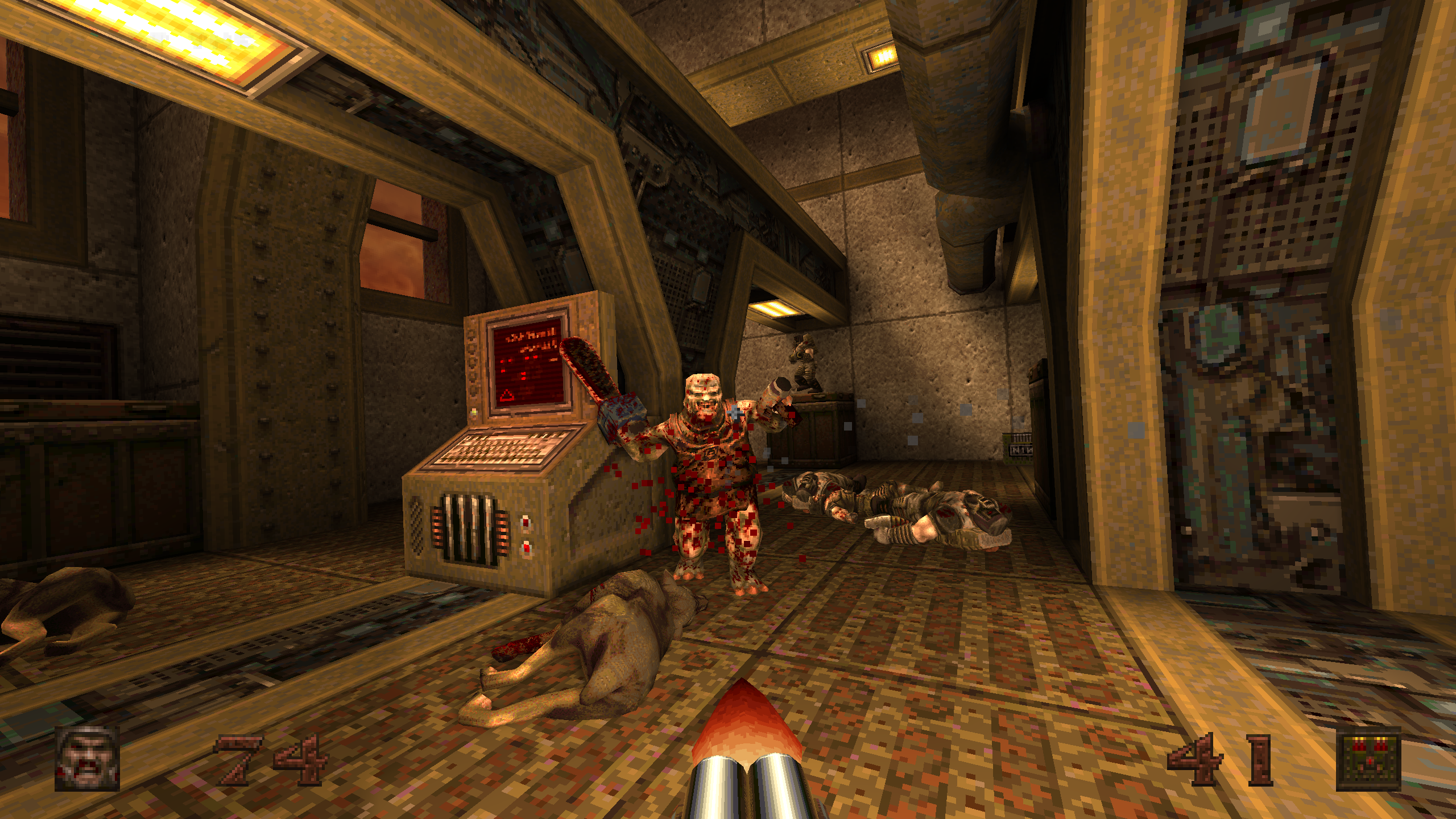
The classic Quake title itself experienced a renaissance in recent years, thanks largely to Nightdive Studios and MachineGames. Following stellar modern remasters and expansions like Dimension of the Past and Dimension of the Machine, MachineGames has returned with its most ambitious offering yet: Dawn of the Machine.
Inside Dawn of the Machine
Dropping players once more into the boots of Ranger, Dawn of the Machine plunges the protagonist into "a dimension of endless illusion" spanning 19 meticulously crafted new levels. True to MachineGames’ reverence for the source material, the expansion blends classic labyrinthine design with modern encounter pacing.
Most thrilling for longtime veterans are the introduction of game-changing weapon variants:
- The Super Axe: A devastating melee tool that unleashes crackling lightning arcs upon successive strikes, transforming close-quarters combat into a high-voltage spectacle.
- The Laser Cannon: A precision heavy weapon that fires ricocheting projectiles capable of bouncing off walls to eviscerate enemies from blind angles and complex geometry.
Beyond the campaign, Dawn of the Machine acts as a digital museum. The update features an expansive archival gallery filled with early, unfinished development builds that offer a raw, unvarnished look at id Software’s 1995-1996 creative process. Among the playable relics are prototype levels carrying unassuming, hyper-pragmatic internal naming conventions like "Tim," "Tim10A," and "Tim14." Accompanying developer notes provide a charmingly candid window into the trial-and-error methodology of early 3D level design: "Lots of tight hallways make navigation tough, and similarly there are many dead ends that were not completed, so it is not entirely clear what the idea was."
Supporting Context & Metrics: The Scale of an Era
To understand the cultural weight of Quake’s 30th-anniversary celebration, one must examine the metrics of its enduring footprint:
- The 1996 Paradigm Shift: Quake popularized "true 3D" rendering in consumer PCs, single-handedly accelerating the global adoption of 3D accelerator graphics cards (such as the 3DFX Voodoo).
- Multiplayer Roots: The game popularized WASD-plus-mouse configurations, custom client modifications (like QuakeC), and competitive clan culture, laying the direct infrastructure for modern eSports.
- The MachineGames Legacy: Since taking over stewardship of classic id properties, MachineGames has added dozens of hours of official, canon-adjacent single-player content, proving that old-school "boomer shooters" retain massive, unyielding commercial and critical viability.
- The Cost of Progress: While id Software’s intellectual properties remain globally celebrated, the studio’s internal headcount has been deeply impacted by macro-economic tech contractions, raising questions about the future autonomy of legendary development houses under massive tech conglomerates.
Official Statements and Industry Reactions
The timing of the Dawn of the Machine announcement carries rich, albeit bittersweet, irony. Speaking at QuakeCon during a celebratory panel, John Romero noted with a wry laugh that the reveal coincided not with the exact calendar anniversary of Quake’s June 1996 launch, but with the exact 30-year anniversary of the day he officially walked out of id Software’s doors for the final time.

This bittersweet sentiment was echoed by fellow co-founder John Carmack, whose recent reflections on the studio’s status underscore a growing anxiety within the games industry. Following massive layoffs executed by Microsoft as part of its overarching strategy to restructure its Xbox division and game publishing pipeline, Carmack pulled back the curtain on the sobering mood surrounding the brand:
"This is certainly going to dampen the mood of the founder reunion at QuakeCon next month," Carmack remarked candidly following the layoffs.
Despite the corporate turbulence, id Software management has issued statements of reassurance, insisting that the studio "still has the crew we need to build the games and tech we’re known for." Yet, the juxtaposition of multi-billion-dollar corporate downsizing with nostalgic anniversary panels highlights a profound cultural disconnect in modern AAA gaming.
Future Outlook: Preserving the Past, Facing the Unknown
As the dust settles on QuakeCon, the historic upcoming Saturday panel—featuring John Romero, John Carmack, Adrian Carmack, and Tom Hall together on one stage—promises to be a watershed moment. It is a rare, perhaps final, opportunity for these industry-altering pioneers to reflect publicly on the friendships, technical breakthroughs, and creative friction that forever changed the DNA of interactive entertainment.
The release of Quake: Dawn of the Machine proves that while corporations restructure and studios face systemic hardships, the art forged by passionate creators outlives its corporate masters. Quake was born from chaos, speed, and uncompromising technical ambition in a Dallas office park in the mid-1990s. Thirty years later, through new fan-focused expansions and archival deep-dives, that same chaotic spark refuses to be extinguished.
Whether id Software can weather its current corporate storm to build the technological marvels of tomorrow remains to be seen. But as long as players can pick up a nailgun, hear the iconic low-pitched grunt of Ranger taking damage, and let loose with a well-timed rocket jump, the legacy of Quake—and the wild, untamed spirit of its creators—will endure.