The Return of Sunbird Messaging: Can the Controversial Android-to-iMessage Bridge Overcome Its Past?
By Stevie Bonifield
Published August 5, 2026
Executive Overview
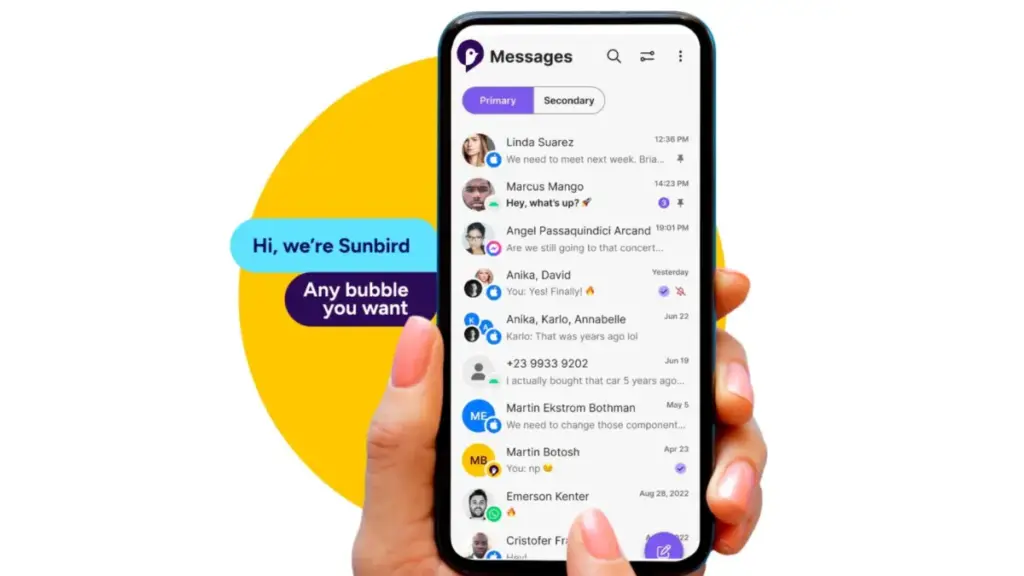
Nearly three years after a catastrophic security failure abruptly shuttered its operations, Sunbird Messaging is attempting a high-stakes market comeback. The company has officially returned to the Google Play Store, promising Android users the coveted "blue bubble" privilege of Apple’s iMessage ecosystem—complete with support for native message reactions, high-resolution media sharing, and group chat synchronization.
However, entering the market in 2026 comes with significantly higher expectations. While Apple and Google have made tremendous strides in bridging cross-platform communication divides through the widespread adoption of Rich Communication Services (RCS), the social friction of green bubbles in iMessage group chats stubbornly persists. For a monthly subscription fee of $2.99, Sunbird aims to alleviate these frictions once and for all.
Yet, the elephant in the room remains Sunbird’s history. In late 2023, the platform was forced to suspend its services indefinitely after cybersecurity researchers uncovered glaring vulnerabilities that exposed thousands of user chat logs, media files, and login credentials. This time around, leadership insists that the architecture has been thoroughly overhauled from the ground up. Backed by independent security audits, a new commitment to zero-retention data policies, and cutting-edge encryption standards, Sunbird is betting that users are willing to give a fallen innovator a second chance.
This article explores the technical rebirth of Sunbird Messaging, examines the mechanics of its new security framework, analyzes the shifting landscape of cross-platform messaging, and asks whether privacy advocates and everyday consumers can finally trust the app to bridge the iOS-Android divide safely.
Detailed Chronology: From Promising Startup to Sudden Shutdown and Revival
The Rise and Fall of Sunbird (2022–2023)
When Sunbird first entered the consumer tech sphere, it captured massive media attention. For years, the inability of Android users to seamlessly participate in Apple’s proprietary iMessage ecosystem was a persistent pain point, giving rise to social stratification colloquially known as "blue bubble shame." Numerous developers attempted to crack the code, but most solutions required cumbersome workarounds, such as routing messages through dedicated Mac servers kept in users’ homes or relying on third-party relay devices.
Sunbird promised a more elegant cloud-based solution. By utilizing a network of repurposed Mac hardware hosted remotely, Sunbird allowed Android users to log in with their Apple IDs and send encrypted iMessages directly from an Android handset. The app gained viral traction, particularly among tech enthusiasts eager to bridge the divide.
However, the bubble burst in November 2023. Shortly after a high-profile partnership with Nothing (which integrated Sunbird’s technology into the Nothing Chats application), independent cybersecurity researchers—notably engineers from text-messaging app Beeper and security firm CipherLaw—began dissecting Sunbird’s backend infrastructure.
The findings were alarming. Researchers discovered that Sunbird was storing plain-text credentials, access tokens, and unencrypted media files in cloud buckets that lacked basic access controls. Malicious actors could theoretically intercept sensitive user data, access personal photos, and impersonate users across the iMessage network. Facing mounting public scrutiny and a barrage of safety warnings, Sunbird pulled the plug on its service overnight, leaving thousands of users stranded and sparking intense skepticism regarding the viability of unofficial cross-platform bridges.
The Rebuilding Years (2024–2025)
For nearly three years, Sunbird operated in a state of self-imposed exile. While competitors like Beeper navigated their own turbulent paths with Apple—experiencing a high-stakes cat-and-mouse game where Apple repeatedly blocked and unblocked unauthorized access methods—Sunbird went dark to completely restructure its engineering approach.
According to company executives, the hiatus was not spent iterating on cosmetic features, but rather completely re-architecting the backend from the code up. The firm dismantled its legacy infrastructure, severed ties with vulnerable cloud storage pipelines, and enlisted outside cybersecurity experts to vet every layer of the new application stack.
The 2026 Relaunch
In August 2026, Sunbird made its quiet yet calculated return to the Google Play Store. Rebranded with a stronger emphasis on privacy controls and fortified data hygiene, the new application introduces a streamlined user interface, a subscription model priced at $2.99 per month, and a promise that the past vulnerabilities have been structurally eliminated.
Supporting Context & Metrics: The Shifting Messaging Landscape
To understand why Sunbird’s return matters, one must examine how the mobile messaging landscape has evolved since 2023.
The RCS Revolution and Its Limits
The most significant development in cross-platform communication over the past several years has been the global rollout of Rich Communication Services (RCS). Driven by regulatory pressure from the European Union, antitrust scrutiny in the United States, and a strategic pivot by Apple—which finally adopted RCS support into iOS—texting between Android and iPhone users has become vastly superior to traditional SMS and MMS.
Today, users across both major operating systems can enjoy read receipts, typing indicators, high-resolution media sharing, and Wi-Fi-based messaging without downloading a third-party app.
However, RCS has not entirely solved the "iMessage problem." Apple has deliberately maintained a distinct visual and functional barrier: green bubbles remain green, and core iMessage features—such as inline message replies, specific tapback reactions (rather than emoji translations), and mini-app integrations—continue to behave unpredictably or break entirely within large iOS-dominated group chats. For millions of users living in regions where iMessage is the undisputed social standard (particularly in North America), these friction points maintain a persistent market demand for native or bridge-based solutions.

Subscription Economics and Feature Expansion
Sunbird’s decision to implement a $2.99 monthly subscription fee marks a strategic shift from its earlier, ad-supported or free-tier models. Running a distributed network of secure servers and maintaining compliance audits requires ongoing capital, and a subscription model signals to consumers that the company is monetizing its service directly rather than trading on user data.
Furthermore, Sunbird is no longer positioning itself solely as an iMessage bridge. The platform is expanding into a unified inbox ecosystem:
- Google Messages & SMS Integration: Consolidating traditional text messaging alongside iMessage threads.
- Upcoming Platform Integrations: Support for WhatsApp and Facebook Messenger slated for rollout later in the year.
- Agentic AI Assistant: An integrated artificial intelligence layer designed to summarize long chat threads, prioritize important conversations, and draft context-aware replies.
Official Statements and Technical Transparency
In the wake of its previous security failures, Sunbird leadership understands that user trust must be earned through radical transparency and verifiable technical controls.
Addressing the 2023 Flaws
When asked how the new application prevents the data leaks that crippled the 2023 launch, Sunbird representatives pointed to a multi-layered security overhaul. In a statement provided to industry publications, the company outlined its new data lifecycle policy:
"Any message moving through our infrastructure is protected in transit and released once it’s delivered. Media you send or receive is deleted typically within 48 hours and never longer than 72 hours."
Encryption Protocols and Credential Management
To alleviate fears regarding interception, Sunbird has published a detailed breakdown of its cryptographic pipeline:
- Client-Side Encryption: Messages are encrypted directly on the user’s Android device before transmission, utilizing strong AES-256 encryption.
- In-Transit Protection: Data moves across certificate-pinned connections, preventing man-in-the-middle attacks.
- At-Rest Security: Stored data on the device is secured using local device-level encryption.
- Apple’s End-to-End Encryption: On the final leg of delivery to an iPhone, the message is protected by Apple’s native iMessage end-to-end encryption, which Sunbird claims it “never modifies, intercepts, or weakens.”
Sunbird CEO Danny Mizrahi also addressed the sensitive issue of Apple ID authentication, a primary vector of concern during the 2023 shutdown. According to Mizrahi, when a user connects iMessage to the app, their Apple ID password is used precisely once to establish the initial session token and is then permanently destroyed.
"We do not store the password, and we do not keep an authentication token that would let us sign in as them later," Mizrahi told Android Authority. Furthermore, he noted that “an independent security auditing firm tested its rebuilt Sunbird app and reported no critical vulnerabilities.”
Despite these assurances, privacy advocates note that independent cryptographic verification remains essential. While third-party audits provide a strong baseline of confidence, the fundamental architecture of cloud-bridging inherently requires trusting an intermediary service with session handshakes—a architectural reality that privacy purists will continue to scrutinize.
Future Outlook: Will Consumers and Apple Embrace Sunbird?
As Sunbird re-enters the market, it faces two massive existential questions: Will privacy-conscious consumers forgive and forget its past? And how will Apple respond?
The Consumer Trust Deficit
In the cybersecurity world, a brand that suffers a high-profile data breach carries a permanent scar. Consumers are increasingly wary of applications that promise the impossible—especially when those applications interface with closed, highly proprietary ecosystems like Apple’s.
For Sunbird, convincing users to hand over their Apple ID credentials—even if performed via a one-time token handshake—will be an uphill marketing battle. The company must prove consistently over months and years that its zero-retention data policies are strictly enforced and that its independent security audits remain transparent and ongoing.
The Apple Factor
Apple has historically taken an aggressive stance against unauthorized third-party clients accessing its messaging infrastructure. When Beeper Mini launched in late 2023, Apple engaged in a rapid sequence of technical blocks, effectively playing whack-a-mole with developers until unauthorized clients were rendered temporarily or permanently unusable.
While Apple’s adoption of RCS has somewhat reduced its legal and regulatory vulnerability regarding interoperability claims, the tech giant remains fiercely protective of iMessage’s exclusivity and security boundaries. If Sunbird scales rapidly, Apple engineers may implement new backend protocols or security handshakes that disrupt Sunbird’s relay servers, sparking a renewed cat-and-mouse game.
Conclusion
Sunbird Messaging’s 2026 relaunch is one of the most fascinating consumer tech narratives of the year. It represents a collision between relentless consumer demand for cross-platform unity and the stubborn reality of walled-garden tech ecosystems.
If Sunbird’s newly minted security architecture holds up under the rigorous scrutiny of the global hacker and security research community, the app could finally deliver on its long-standing promise: allowing Android users to participate seamlessly in the iMessage ecosystem without sacrificing privacy. However, one misstep could spell the permanent end for a company that has already burned its second chance. For now, the digital world watches, waits, and tests the blue bubbles.