Nearly two decades after its initial commercial debut, Sony’s PlayStation Portable (PSP) continues to defy obsolescence. In a landscape where legacy hardware is typically relegated to digital preservation societies or retro-gaming novelty shelves, the PSP’s homebrew community is experiencing a staggering renaissance. Fuelled by a renewed wave of developer engagement and the high-profile return of industry veterans like Wololo, the scene has reached a watershed moment.
Rumours that have swirled across esoteric developer forums and Discord channels for months have finally been substantiated: the two crown jewels of the PSP’s modern software ecosystem—Adrenaline (the definitive Custom Emulated Firmware for the PlayStation Vita) and ARK (the premier native Custom Firmware for physical PSP hardware)—are preparing for massive, synchronized deployment cycles. ARK is leaping to Version 5, while Adrenaline is advancing to Version 8.
This is not a routine maintenance patch or a minor bug-fix update. Rather, ARK-5 and Adrenaline-8 represent a monumental philosophical and architectural convergence. For years, the development teams behind ARK and Adrenaline operated in parallel, sharing concepts organically but maintaining distinct codebases. Today, those boundaries are dissolving.
Through a deep structural unification of their shared code, the integration of a modern and actively maintained PSP Software Development Kit (SDK), the total elimination of redundant compatibility layers, and revolutionary breakthroughs in hardware-accelerated XMB (XrossMediaBar) rendering, the two platforms are effectively becoming two sides of the same coin. This comprehensive report investigates the technical blueprints, structural refactoring, and long-term implications of this historic co-development initiative.
Detailed Chronology: Unifying the Ecosystem
To understand the magnitude of the upcoming Version 8 and Version 5 releases, one must examine the historical friction points of PSP and PS Vita ePSP development. Historically, creating Custom Firmware and compatible user-space plugins required developers to rely on aging, disparate toolchains. The fundamental extension package required for CFW software construction—historically known as the M33SDK—was a relic of a bygone era. While functional, it suffered from code stagnation and compatibility hurdles when attempting to interface with modern build environments.
The Unified API and the Rise of psp-cfw-sdk
The first major pillar of the ARK-5 and Adrenaline-8 synergy is a complete overhaul of the development toolchain. Over the past several release cycles, developers from both camps quietly pooled their resources, knowledge, and source code. The breakthrough came with the decision to anchor all modern software development to the newest, actively maintained iteration of the official/community PSP SDK.
To support this transition, the aging M33SDK has been officially retired and spiritually succeeded by psp-cfw-sdk. Crucially, this new CFW extension package is no longer a separate, troublesome download that developers must manually source and configure; it is now bundled and installed by default directly within the core PSPSDK. This democratization of the toolchain dramatically lowers the barrier to entry for new developers wishing to code for the platform, ensuring that plugins, loaders, and the firmware itself are compiled against a standardized, future-proof API.
The Pentazemin Refactor: Eliminating Code Duplication
Perhaps the most critical engineering hurdle overcome during this development cycle relates to the Pentazemin module. When ARK-4 was originally engineered to run inside the Adrenaline environment on the PlayStation Vita, it required a bespoke compatibility layer to bridge the gap between native hardware emulation and the ePSP environment. That compatibility layer was named Pentazemin.
In practice, Pentazemin was effectively a stripped-down, simplified derivative of Adrenaline’s proprietary SystemControl module—the beating heart of the custom firmware. However, because Pentazemin was forked years ago and frozen in time, it rapidly grew obsolete as Adrenaline continued to receive independent updates, security patches, and performance optimizations. ARK was effectively running on a fossilized snapshot of Adrenaline’s core architecture.
The engineering teams solved this through an aggressive architectural refactor:
Repatriation: The Pentazemin module has been moved directly back into Adrenaline itself.
Upstream Synchronicity: Because Pentazemin is now natively integrated into Adrenaline, ARK is mathematically guaranteed to always leverage the absolute newest, most optimized code pulled straight from the Adrenaline source tree.
Erased Redundancy: All historical duplicated codebases between Pentazemin and Adrenaline’s SystemControl have been ruthlessly excised. Adrenaline now utilizes Pentazemin directly, streamlining memory usage, reducing firmware footprint, and eliminating unpredictable behavioral discrepancies between physical PSP units running ARK and Vita handhelds running Adrenaline.
The Birth of "EPI" (Epinephrine)
For end-users, the most tangible manifestation of this code unification is how Adrenaline handles loading custom environments. Historically, Adrenaline relied on external loaders to invoke ARK or other custom payloads, and its internal Custom Emulated Firmware (CEF) was fundamentally anchored to the legacy TN-CEF framework—a system that had remained largely untouched since the days of Adrenaline Version 7.
With Adrenaline-8, those external training wheels have been cast aside. Adrenaline is now natively capable of booting ARK directly from scratch, completely eliminating the need for external loader binaries. To facilitate this, the user-facing Adrenaline Settings Menu has been updated with a seamless toggle switch allowing users to jump dynamically between EPI and ARK.
EPI—an acronym derived from Epinephrine, the primary chemical compound of adrenaline—is the brand-new moniker assigned to Adrenaline’s deeply modernized Custom Emulated Firmware. This is not merely a cosmetic rebranding; EPI represents a wholesale rewrite of the legacy TN-CEF foundations. The internal API functions have been modernized to match the rigorous, contemporary standards established by ARK-4. Furthermore, EPI has fully adopted the modern PLUGINS.TXT configuration syntax. The net result is absolute plugin parity: developers can now write a plugin knowing with absolute certainty that it will execute flawlessly across both ARK-5 and Adrenaline-8 without requiring platform-specific workarounds or branching logic.
Supporting Context & Metrics: Re-Engineering the XMB
User interface design on the PSP has long been constrained by the limitations of its 2005-era hardware. Traditionally, when a user invoked custom firmware options by pressing the SELECT button, the system would launch the ubiquitous VSH Menu (Virtual Shell Menu).
The Death of the Legacy VSH Menu
While functional, the traditional VSH Menu was an archaeological artifact. It relied on software-based pixel drawing routines that consumed valuable CPU cycles, resulting in a sluggish interface that looked jarringly primitive against the sleek, vector-based aesthetics of Sony’s native XrossMediaBar (XMB). Aside from minor variable patches over the decades, the underlying codebase of the classic VSH Menu remained fundamentally static.
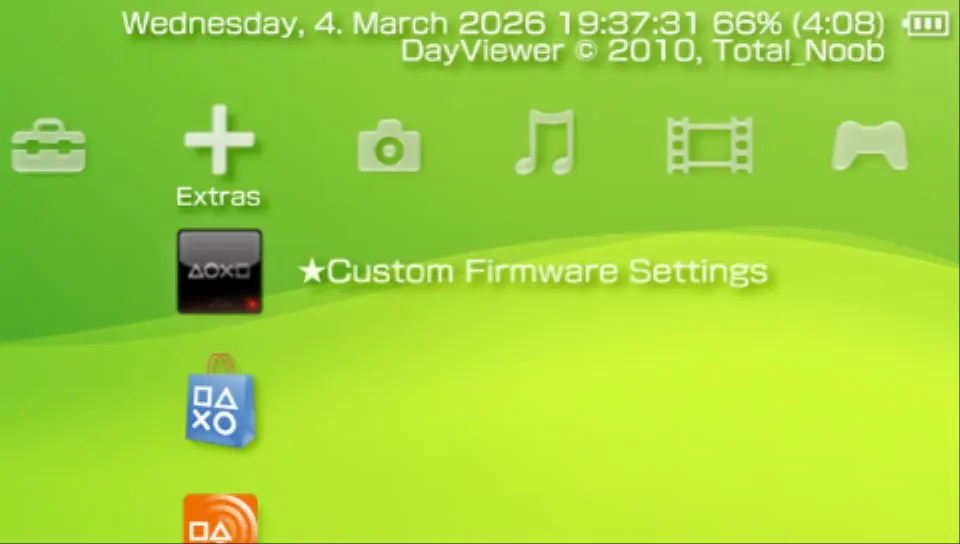
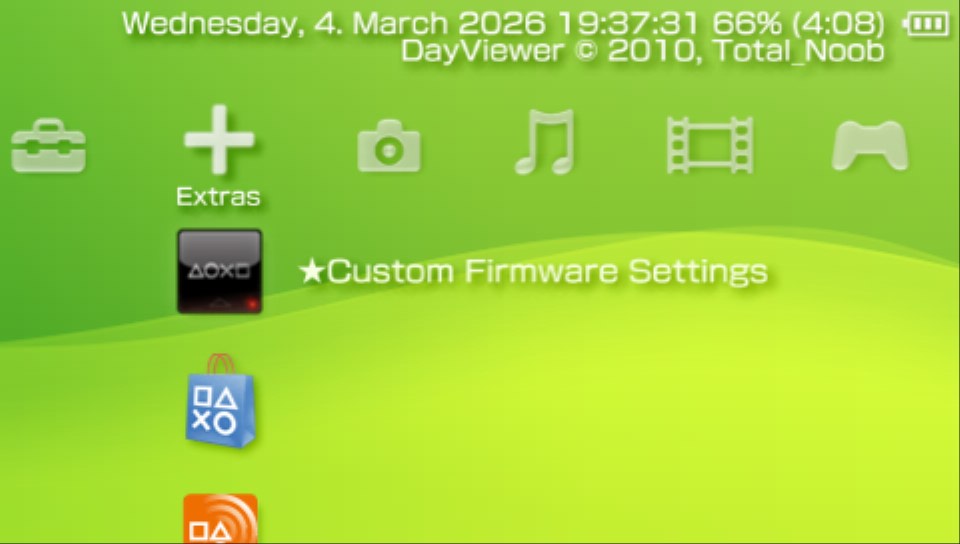
The structural antidote to this problem was originally conceptualized by the legendary developer Total_Noob (subsequently known to the scene as TheFl0w). Total_Noob engineered XMBControl, a brilliant initiative that integrated custom configuration options directly and natively into the fabric of the XMB rather than drawing a clumsy overlay on top of it. Building upon this foundational philosophy, the ARK-5 and Adrenaline-8 teams have refined and expanded the concept, completely deprecating the old software-rendered VSH Menu in favor of deeply integrated, native XMB configuration modules.
Hardware-Accelerated 3D Graphics on the XMB
Pushing the envelope even further, developer m-cid achieved what many considered impossible within the constraints of the PSP’s display architecture: true hardware-accelerated 3D graphics rendering directly on top of the native XMB interface.
Rather than relying on sluggish software blitting, m-cid’s breakthrough leverages the PSP’s dedicated Graphics Processing Unit (Gu/Ge) to render complex, real-time 3D geometry seamlessly within the system menu. ARK-5 ships with a stunning demonstration of this capability—a fully interactive, hardware-accelerated 3D spinning cube that dynamically replaces the archaic aesthetic of the old VSH Menu.
By baking this hardware-acceleration pipeline directly into the core firmware, the developers have exposed a lightweight, high-performance API for third-party homebrew developers. Creators of VSH plugins no longer need to reinvent the wheel or struggle with inefficient rendering hacks; they can now tap directly into the firmware’s native graphics pipeline to draw crisp user interfaces, custom HUDs, and visualizers with minimal performance overhead.
Official Statements & Community Sentiment
The underground developer community has greeted the announcement of ARK-5 and Adrenaline-8 with a mixture of awe and vindication. Industry luminaries who stepped away from active development years ago have watched in fascination as current maintainers achieved architectural milestones that were previously thought blocked by closed-source hardware limitations.
"When we began conceptualizing this update cycle, our primary goal was simply to stop reinventing the wheel," noted an anonymous core contributor close to the ARK development pipeline. "For over a decade, ARK and Adrenaline were solving the exact same security bugs, rewriting the same memory hooks, and maintaining parallel compatibility layers. By unifying our toolchains around psp-cfw-sdk and returning Pentazemin to its rightful home inside Adrenaline, we’ve effectively doubled our engineering manpower. What you are seeing in Version 5 and Version 8 is the dividend of collaboration over fragmentation."
The return of community figures like Wololo to the active blogging sphere has further catalyzed enthusiasm. In his recent dispatches, Wololo emphasized that the enduring vitality of the PSP platform is not an accident of history, but a direct consequence of persistent, obsessive engineering by developers who refuse to let legacy hardware die a quiet death. The consensus among the community is clear: ARK-5 and Adrenaline-8 represent the absolute pinnacle of PSP software engineering—a mature, unified framework that bridges physical hardware and modern emulation environments with unprecedented elegance.
Future Outlook: Beyond the Horizon
While the imminent deployment of ARK-5 and Adrenaline-8 dominates contemporary discussions, the engineering vanguard within the PSP community is already casting its gaze toward even more ambitious horizons. The breakthrough refactors of this current update cycle have unlocked investigative pathways that were previously deemed too complex to pursue.
Emerging Frontiers in PSP Homebrew
XMB Optimization Plugins: New utility plugins are currently in late-stage testing that promise to drastically reduce game scanning and cataloging times within the XMB, solving a persistent quality-of-life bottleneck for users with massive high-capacity MicroSD storage arrays housed in Memory Stick adapters.
Advanced Architectural Ports: Talented community programmers continue to push the envelope of software emulation, spearheading sophisticated native ports of complex Nintendo 64 titles—such as Perfect Dark and The Legend of Zelda: Ocarina of Time—directly to the PSP’s MIPS architecture.
Media Engine & VME Exploration: Perhaps most excitingly for hardware enthusiasts, fresh research is currently being conducted into the PSP’s notoriously secretive Media Engine (ME) and Virtual Mobile Engine (VME) co-processors. Unlocking the full, undocumented potential of these auxiliary processing units could yield unprecedented multimedia performance gains.
The Overclocking Frontier: Hardware researchers are actively probing the limits of the PSP’s primary CPU clock speed, investigating safe, stable methodologies to push processing frequencies comfortably beyond the long-standing 333MHz hardware ceiling established by Sony.
As ARK-5 and Adrenaline-8 prepare to land on devices worldwide, they stand not as a swan song for the PlayStation Portable, but as a roaring testament to what is possible when a passionate community refuses to accept technological obsolescence. The PSP is alive, well, and evolving faster than ever.