The Evolution of Concealment: How FAKE ME and MECCHA CHAMELEON Are Reinventing the Prop-Hunt Paradigm
Executive Overview
The landscape of multiplayer party games has long been dominated by iterations of classic formulas, with hide-and-seek variants serving as a reliable staple of casual gaming communities. However, the recent viral success of MECCHA CHAMELEON on Steam—which introduced an ingenious, hands-on mechanic centered around painting oneself into the environment—demonstrated that players are hungry for creative disruptions to traditional stealth-action gameplay. Capitalizing on this momentum, an emerging title titled FAKE ME is poised to push the envelope even further. By transitioning from the two-dimensional coloring mechanics of its predecessor into full three-dimensional structural remodeling, FAKE ME asks players to sculpt their own camouflage on the fly.
This investigative piece explores the mechanics, design philosophies, and potential industry impact of FAKE ME. We will examine how this new title builds upon the groundwork laid by MECCHA CHAMELEON, analyze the delicate balance between casual accessibility and complex gameplay mechanics, and evaluate whether user-generated geometry can successfully anchor a thriving party game ecosystem. Furthermore, we will contextualize these developments within the broader trends of Steam’s independent game scene, exploring how niche stealth concepts are evolving into sophisticated multiplayer experiences, complete with considerations for cross-platform accessibility such as Proton and Wine compatibility.
Detailed Chronology: From Pixelated Hide-and-Seek to Dynamic 3D Sculpting
To understand the current trajectory of social stealth games, one must first trace the evolutionary steps that led to the development of FAKE ME. For over a decade, the "Prop Hunt" subgenre relied on a static library of pre-existing environmental assets. Players dropped into maps as standard objects—ranging from soda cans to grand pianos—and attempted to blend into the scenery while hunters sought them out. While endlessly entertaining, the formula occasionally suffered from predictability; seasoned hunters quickly memorized map layouts and noticed the slight anomalies of misplaced objects or missing collision boxes.
The paradigm shifted dramatically with the sudden, viral ascent of MECCHA CHAMELEON on the Steam platform. MECCHA CHAMELEON stripped away the pre-fabricated asset library, forcing hiders to manually paint patterns, textures, and colors directly onto their avatars to match background surfaces. This introduced a frantic, hands-on creative element that leveled the playing field between seasoned veterans and casual players. The pressure of rapid, imperfect artistic execution created moments of genuine hilarity and tension, proving that mechanics involving player-created visual deception possessed massive commercial and streaming appeal.
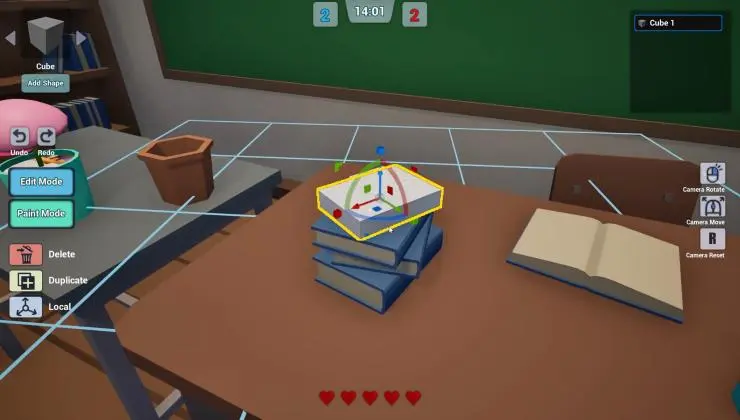
Recognizing the potency of this formula, the developers behind FAKE ME set out to take the concept into the third dimension. Instead of merely painting a flat or pre-formed surface, participants in FAKE ME begin each round as a rudimentary, amorphous square block. From this humble geometric origin, players must actively adjust their size, scale, and shape in real-time, molding their avatars to seamlessly integrate with the architectural geometry of the surrounding map. Once the transformation period elapses, the hunters—referred to in-game as Seekers—are unleashed into the arena, armed with projectile spheres to pepper any object, corner, or shadow that looks suspicious.
This chronological leap from static props to dynamic, user-sculpted concealment represents a significant milestone in asymmetrical multiplayer design. It shifts the primary skill expression from map memorization and twitch-reflex shooting to spatial awareness, adaptive modeling, and artistic improvisation under pressure.
Supporting Context & Metrics: The Asymmetrical Party Game Ecosystem on Steam
The arrival of FAKE ME and MECCHA CHAMELEON occurs within a highly competitive ecosystem on Valve’s Steam platform. Asymmetrical multiplayer games have seen a steady rise in popularity, driven largely by content creators, streamers, and communities seeking accessible, low-barrier-to-entry social experiences. Analyzing the underlying metrics and player behavior trends illuminates why these titles resonate so deeply with modern gamers.
The Streaming Phenomenon and Viral Loop
In the modern gaming landscape, titles that generate organic comedy and dramatic tension thrive on platforms like Twitch, YouTube, and TikTok. Games that rely on player imperfection—such as poorly painted chameleons or awkwardly proportioned geometric shapes masquerading as architectural pillars—create exceptional "clip potential." When a player spends precious seconds haphazardly stretching a square block into a crude approximation of a ventilation duct, only for a Seeker to casually bounce a ball off their face, the resulting emergent narrative is inherently shareable. This viral loop acts as the primary marketing engine for independent developers who lack multi-million-dollar advertising budgets.
Accessibility and Technical Performance
Beyond gameplay mechanics, the long-term viability of Steam releases increasingly hinges on technical optimization and cross-platform compatibility. Independent titles must cater to a diverse hardware ecosystem, ensuring smooth frame rates and low latency for seamless multiplayer synchronization.
Significantly, early documentation for FAKE ME highlights official and community-driven compatibility with Proton / Wine, ensuring that Linux and Steam Deck users can participate in the action without friction. As the Steam Deck continues to capture a substantial share of the handheld gaming market, ensuring robust Proton compatibility is no longer an afterthought for developers; it is a vital metric for maximizing player base retention and fostering inclusive community engagement.
| Feature Comparison | Traditional Prop Hunt | MECCHA CHAMELEON | FAKE ME |
|---|---|---|---|
| Asset Origin | Pre-made map objects | Player-painted skins | Player-sculpted 3D geometry |
| Primary Skill | Map memorization & hiding spots | Quick 2D color matching | Spatial scaling & 3D remodeling |
| Seeker Mechanics | Weapon fire / probing | Paint / tagging | Projectile ballistics |
| Platform Focus | PC / Consoles | PC (Steam) | PC (Steam / Proton compatible) |
Official Statements and Design Philosophy
While independent developers often operate with leaner public relations apparatuses than major publishers, early developer diaries, Steam community posts, and preview insights provide a clear window into the design philosophy driving FAKE ME.
The core design challenge, as articulated by early industry observers and playtesters, revolves around a delicate paradox: How far can you push creative complexity before a casual party game collapses under its own weight?
Developers of titles in this subgenre frequently emphasize that the secret to their success lies in maintaining an equilibrium between mechanical depth and instant accessibility. A representative from the independent development community noted during a recent roundtable on party game design:
"The magic of these games isn’t found in photorealism or precise professional tools; it is found in the frantic panic of inadequacy. When everyone in the lobby is struggling to make something that vaguely resembles a prop, the playing field levels out. Perfection is the enemy of fun in a social party game."
This philosophy directly addresses concerns that 3D modeling might be "too involved" for casual gamers. While many players may possess anxieties regarding their artistic or technical proficiency—often joking, "I was terrible at painting in MECCHA CHAMELEON so I imagine I’ll be just as awful at 3D modelling"—the developers of FAKE ME have intentionally designed the scaling and shaping tools to be forgiving, fast, and responsive. The goal is not to produce museum-quality 3D assets, but rather to encourage frantic, seat-of-the-pants adaptation where primitive shapes successfully fool paranoid opponents through sheer audacity and clever placement.
Future Outlook: Can FAKE ME Sustain Its Momentum?
As FAKE ME moves closer to its official release and broader community testing phases, several critical questions remain regarding its long-term viability and potential impact on the party game genre.
Balancing the Learning Curve
The primary obstacle facing FAKE ME is onboarding. While the concept of starting as a simple square block and molding oneself into the environment is conceptually brilliant, execution speed will dictate whether casual players stick around. If the learning curve for the 3D manipulation tools proves too steep, lobbies may become dominated by a small cadre of power-users who master the geometry engine, alienating newcomers. Developers must continuously refine the user interface, offering intuitive snapping tools, preset scaling options, and streamlined controls to ensure that players of all skill levels can participate effectively.
Expanding Content and Replayability
For any multiplayer party game to survive past its initial launch window, content variety is paramount. Relying solely on a single core mechanic, no matter how novel, risks rapid player fatigue. Future updates for FAKE ME will likely need to introduce:
- Diverse map themes that challenge players to adapt their modeling strategies to entirely different aesthetic environments.
- Modifier modes or special mutators (e.g., gravity shifts, time-limit crunches, or restricted toolsets) to keep matches feeling fresh.
- Robust customization options for both Hiders and Seekers, allowing for personal expression beyond the standard square starting block.
Conclusion: A Promising Addition to the Social Gaming Pantheon
Whether FAKE ME ultimately surpasses its spiritual predecessor or carves out its own distinct niche, its contribution to the evolution of multiplayer hide-and-seek is undeniable. By challenging players to step beyond passive concealment and actively sculpt their own survival, the title bridges the gap between creative sandbox tools and frantic party gaming.
As the Steam community eagerly awaits its full rollout—with reliable Proton compatibility ensuring wide accessibility—FAKE ME stands as a testament to the boundless creativity thriving within the independent development scene. It reminds us that the best multiplayer experiences are often born not from hyper-realistic graphics or multi-million dollar budgets, but from simple, brilliant ideas executed with a sense of playful chaos.