
PAYDAY: Aces High Headed to Valve’s Steam Frame: A New Era for VR Heisting
Executive Overview
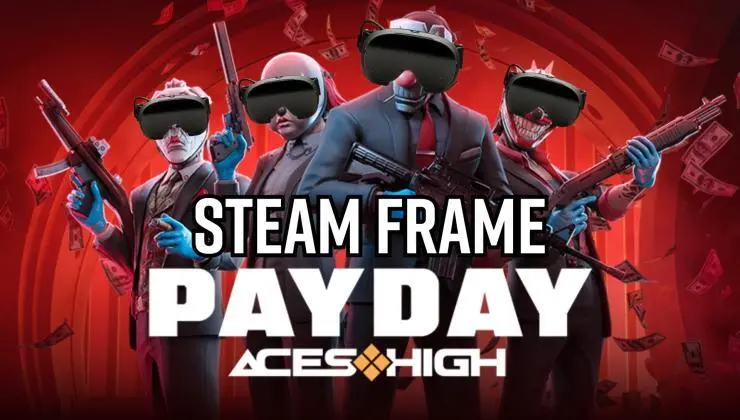
The landscape of virtual reality gaming is poised for a significant paradigm shift. Fast Travel Games, in strategic partnership with franchise heavyweight Starbreeze Entertainment, has officially confirmed that PAYDAY: Aces High—a full-scale, standalone virtual reality spin-off of the globally renowned cooperative shooter franchise—is actively being developed for Valve’s highly anticipated, upcoming wireless VR hardware ecosystem, known provisionally as the Steam Frame.
This announcement, initially detailed via an official Steam community broadcast, marks a major milestone for both the PAYDAY intellectual property and the broader standalone VR market. For years, the PAYDAY franchise has defined the standard for cooperative, high-stakes tactical shooter gameplay, immersing players in meticulously planned heists, chaotic police shootouts, and high-adrenaline escapes. By translating this signature formula into a dedicated, wireless virtual reality experience tailored for Valve’s next-generation hardware platform, the development team is promising to deliver a level of physical immersion previously unattainable on tethered or legacy standalone platforms.
However, the announcement also arrives amid a cloud of speculative industry anticipation. With Valve keeping precise technical specifications and consumer release timelines for the Steam Frame tightly under wraps, PAYDAY: Aces High occupies a fascinating space on the horizon of interactive entertainment. It stands as a flagship title designed to showcase the capabilities of next-generation wireless PCVR, yet its ultimate commercial debut remains intrinsically linked to a hardware release date that Valve has yet to officially formalize.
This comprehensive report examines the strategic partnership behind PAYDAY: Aces High, the technical and conceptual implications of bringing the franchise to the Steam Frame, the broader industry context surrounding wireless VR, and the official commentary from key industry leaders driving the project forward.
Detailed Chronology: From Flat-Screen Roots to Wireless VR Ambitions
To fully understand the gravity of the PAYDAY: Aces High announcement, one must trace the evolutionary trajectory of the PAYDAY franchise. Created initially by Overkill Software and published by Starbreeze Entertainment, the original PAYDAY: The Heist launched in 2011, establishing a cult following with its intense, wave-based cooperative shooting mechanics. Its successor, PAYDAY 2, released in 2013, became a monumental commercial and cultural phenomenon, enjoying years of post-launch content updates, community loyalty, and eventual adaptations across multiple gaming generations.
While the core PAYDAY series has always adhered to traditional first-person flat-screen gaming paradigms, the franchise’s DNA has long flirted with spatial computing and virtual reality. Historically, developers experimented with VR iterations—such as the VR compatibility patch for PAYDAY 2—which allowed players to experience the chaotic gunfights and bank vaults through a headset. However, these implementations were largely treated as complementary modes rather than bespoke, ground-up virtual reality experiences.
The inception of PAYDAY: Aces High represents a clean break from retrofitted VR patches. Developed from the ground up as a standalone entry by Fast Travel Games—a studio renowned for its mastery of immersive VR game design—the project was conceptualized to treat virtual reality not as an alternative viewing mode, but as the foundational pillar of the gameplay experience.
The announcement cycle for PAYDAY: Aces High began with early promotional teasers and trailers that immediately captured the attention of both veteran heisters and the broader VR community. The reception was described by developers as overwhelmingly warm, validating the decision to lean heavily into fast-paced, explosive action.
The timeline escalated significantly with the recent confirmation regarding the Steam Frame. By officially declaring that PAYDAY: Aces High is being built specifically to leverage the architectural and wireless capabilities of Valve’s upcoming headset, the collaboration bridges two of PC gaming’s most influential ecosystems: Steam’s sprawling digital storefront and Valve’s cutting-edge hardware engineering. As the community adds the title to their digital wishlists, the gaming world now waits with bated breath for both the game’s completion and Valve’s official unveiling of the Steam Frame hardware.
Supporting Context & Metrics: The Intersection of VR and Cooperative Shooters
The decision to channel the PAYDAY universe into a standalone VR title is underpinned by shifting paradigms in hardware capability and market demand. For years, standalone virtual reality headsets—championed by devices like the Meta Quest series—have dominated market share due to their accessibility and lack of cumbersome cables. Yet, a persistent compromise has existed between the untethered freedom of standalone hardware and the graphical fidelity, processing power, and ecosystem openness of PC-driven virtual reality.
Valve’s upcoming Steam Frame aims to bridge this chasm. While official hardware specifications remain heavily guarded secrets, industry analysts and hardware enthusiasts anticipate a device that marries the untethered convenience of modern standalone headsets with the robust processing capabilities, SteamOS integration, and vast software library native to Valve’s ecosystem.
For a fast-paced shooter like PAYDAY, hardware latency and tracking precision are paramount. Traditional heists require split-second accuracy during gunfights, fluid manual reloading mechanics under pressure, and seamless spatial awareness while coordinating with teammates. A wireless VR headset capable of rendering complex urban environments and dynamic police AI without the restriction of a tether opens up unprecedented avenues for physical agency. Players can physically duck behind cover, blind-fire around corners with intuitive gestures, and manage complex inventory systems attached directly to their virtual tactical vests.
Furthermore, the economic and community metrics surrounding the PAYDAY franchise provide a fertile ground for a VR spin-off. With a dedicated player base numbering in the millions across PC and console platforms, the potential conversion rate into the VR sector represents a substantial commercial opportunity. Fast Travel Games is capitalizing on this built-in audience, offering a familiar thematic playground—complete with masks, drills, bags of cash, and relentless law enforcement waves—reimagined entirely through spatial interaction.
Official Statements: Insights from Studio Leadership
The strategic vision behind PAYDAY: Aces High has been articulated directly by the creative and executive leadership steering the project. The synergy between Fast Travel Games and Starbreeze Entertainment is built on a shared commitment to elevating the emotional and physical intensity of cooperative heisting.
Erik Odeldahl, Chief Creative Officer and Co-Founder at Fast Travel Games, emphasized the overwhelming positive feedback the project has garnered since its initial reveal:
"The reception since we first revealed PAYDAY: Aces High has been incredibly warm, from both longtime heisters and the VR community, and that means everything to our team."
Odeldahl’s comments highlight the delicate balancing act required when adapting a beloved multi-platform franchise into a dedicated platform spin-off. Ensuring that longtime fans feel respected while simultaneously appealing to the exacting standards of dedicated VR enthusiasts is no small feat, yet the early community response suggests that Fast Travel Games is striking the right chord.
Echoing this sentiment, Adolf Kristjansson, CEO at Starbreeze Entertainment, elaborated on how virtual reality inherently elevates the core design philosophy of the PAYDAY franchise:
"PAYDAY has always put you inside the heist, first person, and right in the middle of the chaos. VR takes that further, and Fast Travel Games are delivering with Aces High. We’re proud to have them shaping this corner of the universe, and we can’t wait to see how the community reacts."
Kristjansson’s perspective underscores a fundamental truth of immersive media: while flat-screen monitors place players in front of a virtual world, virtual reality places players inside it. By removing the glass barrier of the monitor, PAYDAY: Aces High transforms routine gameplay loops—such as planting a thermal drill, bagging loot under heavy fire, or trading hostages—into visceral, physically engaging scenarios that trigger genuine adrenaline responses.
Future Outlook: What Lies Ahead for PAYDAY: Aces High and the Steam Frame
As the gaming industry looks toward the horizon, PAYDAY: Aces High stands as a bellwether for the next generation of cooperative VR gaming. The convergence of Fast Travel Games’ expertise in spatial interaction design, Starbreeze Entertainment’s iconic intellectual property, and Valve’s pioneering hardware ecosystem creates a formidable trifecta of potential.
However, several critical milestones remain on the path to release. Chief among them is the official hardware announcement and rollout of the Steam Frame by Valve. As developers receive final dev kits and optimize their titles for the platform’s unique architectural strengths, consumers will be watching closely for concrete pricing, battery life specifications, field-of-view metrics, and software compatibility details.
For prospective players, the immediate course of action is clear: PAYDAY: Aces High is currently live on Steam for wishlisting. Fans of high-octane cooperative action, tactical shooters, and cutting-edge virtual reality hardware would do well to secure their spot on the digital docket.
Whether PAYDAY: Aces High ultimately redefines the standard for wireless PCVR cooperative shooters will depend heavily on the execution of its mechanics and the seamless integration with Valve’s hardware ecosystem. Yet, if the early enthusiasm from both developers and the community is any indication, the underworld of virtual heisting is about to get a whole lot louder, faster, and infinitely more immersive.