RetroArch 1.20.0 Unleashed: Revolutionizing Retro Emulation with BlurBusters CRT Simulation and Linux Illuminance Integration
Executive Overview
The emulation community has long grappled with a fundamental architectural paradox: how to faithfully recreate the visual idiosyncrasies of analog cathode-ray tube (CRT) displays on modern, high-refresh-rate digital panels without sacrificing peak performance, color vibrancy, or hardware longevity. Today, the Libretro team has answered that call with the official release of RetroArch 1.20.0. This major update represents a paradigm shift for software-based preservation and emulation, introducing a suite of bleeding-edge features designed to bridge the gap between vintage hardware characteristics and contemporary display technologies.
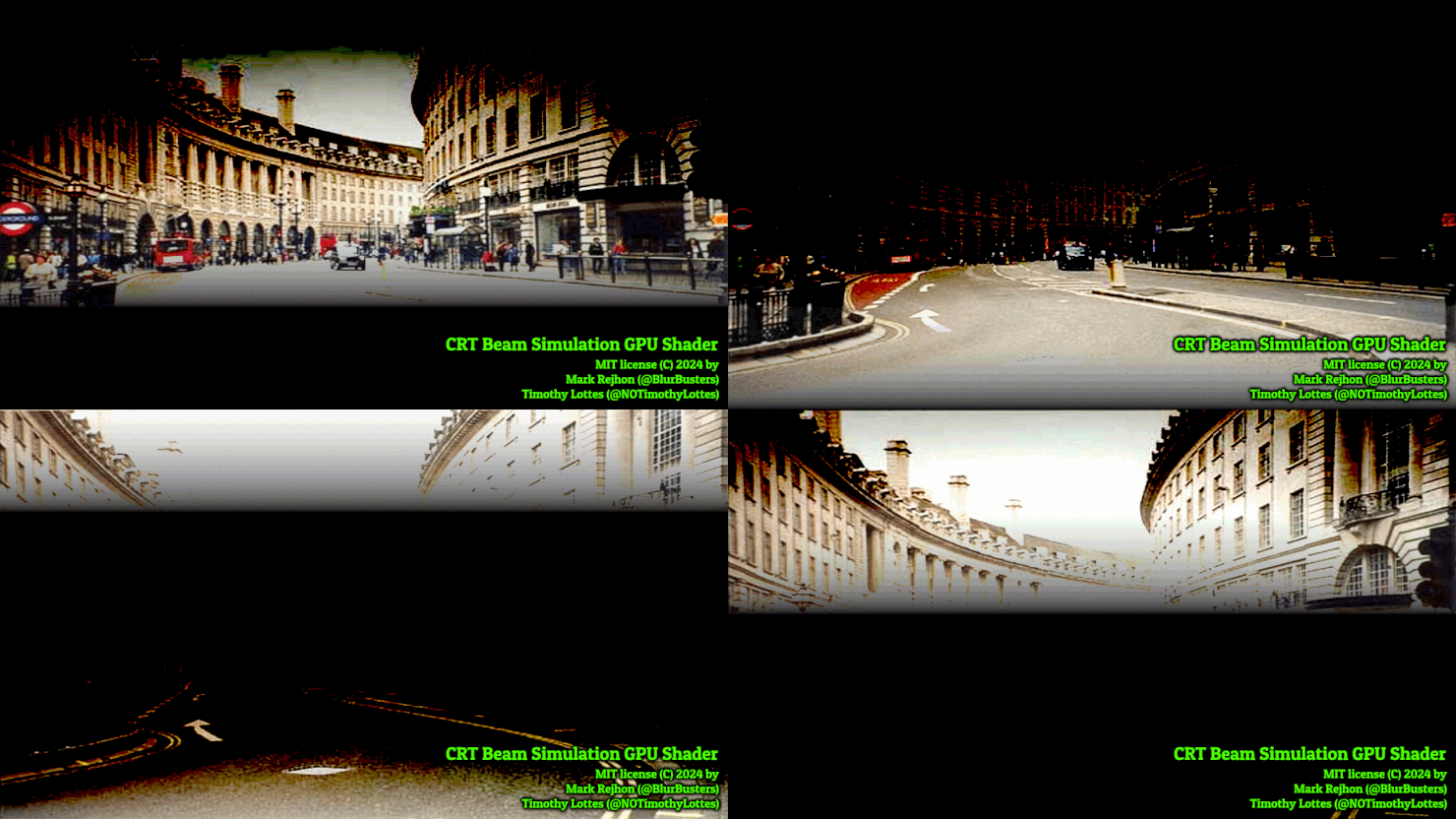
At the forefront of this release is the groundbreaking incorporation of a specialized CRT beam simulation shader. Developed in direct collaboration with Mark Rejhon of BlurBusters and Timothy Lottes—famed creator of the original FXAA algorithm and the foundational crt-lottes shaders—this new tool harnesses RetroArch’s newly engineered "subframe" shader capabilities. The result is a system that delivers unprecedented motion clarity on modern monitors and televisions, sidestepping the frustrating compromises historically inherent to traditional black-frame insertion (BFI) methods.
Beyond visual fidelity, RetroArch 1.20.0 extends its hardware-bridging capabilities into the physical realm. Thanks to developer Jesse Talavera, the new version introduces native illuminance (ambient light) sensor support for Linux-based systems. This opens the door for authentic sun-sensor gameplay mechanics in titles that historically relied on physical Game Boy Advance cartridges equipped with light diodes, such as Konami’s cult-classic Boktai series.
True to its foundational philosophy, RetroArch 1.20.0 arrives completely free of monetization SDKs, invasive in-app advertisements, and paywalled features. As the emulation landscape faces increasing commercialization pressures, the Libretro collective remains stubbornly committed to user-first development, entirely funded by community goodwill via Patreon, GitHub Sponsors, and official merchandise channels. This comprehensive report explores the technological marvels packed into RetroArch 1.20.0, the context of its development, and what this milestone means for the future of digital preservation.
Detailed Chronology & Technical Breakdown
To fully understand the magnitude of RetroArch 1.20.0, one must examine the iterative engineering milestones that paved the way for its flagship features. The journey toward subframe shaders and hardware sensor integration has been years in the making, reflecting the relentless dedication of open-source contributors striving to solve decades-old emulation hurdles.
The Evolution of Shader Subframes and BlurBusters Collaboration
Historically, emulating the visual experience of a CRT display involved static scanline overlays or post-processing filters that adjusted color saturation and curvature. While aesthetically pleasing in static screenshots, these filters failed to capture the dynamic, temporal reality of an electron beam painting phosphors line by line across a vacuum tube. When high-refresh-rate LCD and OLED monitors (120Hz, 240Hz, and beyond) entered the consumer market, developers attempted to mimic CRT motion clarity using Black-Frame Insertion (BFI).
However, BFI came with severe technical compromises:
- Luminance Degradation: Inserting black frames drastically cut overall display brightness, often requiring users to push their hardware backlight to uncomfortable limits.
- Color Desaturation: Rapid strobing frequently muddied color accuracy and introduced distracting flicker, particularly for users prone to optical fatigue.
- Image Persistence and Artifacting: Particularly on common LCD panels, aggressive BFI risked temporary image retention (ghosting) and exacerbated response-time smearing.
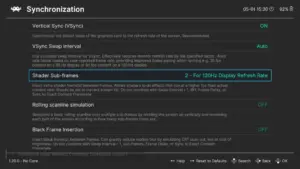
RetroArch 1.20.0 completely rewrites this script through the introduction of Shader Subframes. By dividing a single logical frame into multiple temporal sub-intervals, RetroArch can execute shader passes at a frequency that outpaces the display’s native refresh rate updates, effectively simulating the precise phosphor decay and electron beam sweeps of a vintage CRT.
The collaboration with Mark Rejhon (founder of BlurBusters, the authority on display motion blur and sample-and-hold display limitations) and Timothy Lottes brings professional-grade display science into the consumer emulation space. The new CRT beam simulation shader leverages this subframe architecture to trick the human eye into perceiving high-speed motion with the crispness of a CRT, while completely bypassing the traditional pitfalls of BFI. Brightness remains intact, colors pop with authentic vintage warmth, and modern high-refresh-rate panels can finally stretch their technical legs to render pixel art with absolute motion fidelity.
Linux Illuminance Sensor Support: Bringing Sunlight to the Steam Deck
While visual fidelity tackles how games look, interactive hardware integration addresses how they are played. RetroArch 1.20.0 introduces native illuminance sensor support for Linux environments—a feature spearheaded by contributor Jesse Talavera.
For nearly two decades, fans of Konami’s Boktai: The Sun Is in Your Hand (Game Boy Advance) and its sequels have faced a unique design hurdle. The game cartridges featured a physical photodiode (solar sensor) built directly onto the circuit board, requiring players to step outside into actual sunlight to charge their in-game weapons (solar guns) and defeat vampires. While previous emulation iterations attempted software workarounds—such as manual sliders or hotkeys to simulate daylight intensity—they fundamentally broke the immersive, real-world loop intended by Kojima Productions.
With the new Linux illuminance integration, devices equipped with ambient light sensors—most notably the Steam Deck (when paired with external sensor setups or compatible handheld hardware configurations)—can dynamically read real-world environmental lighting conditions and feed that data directly into the emulation core.
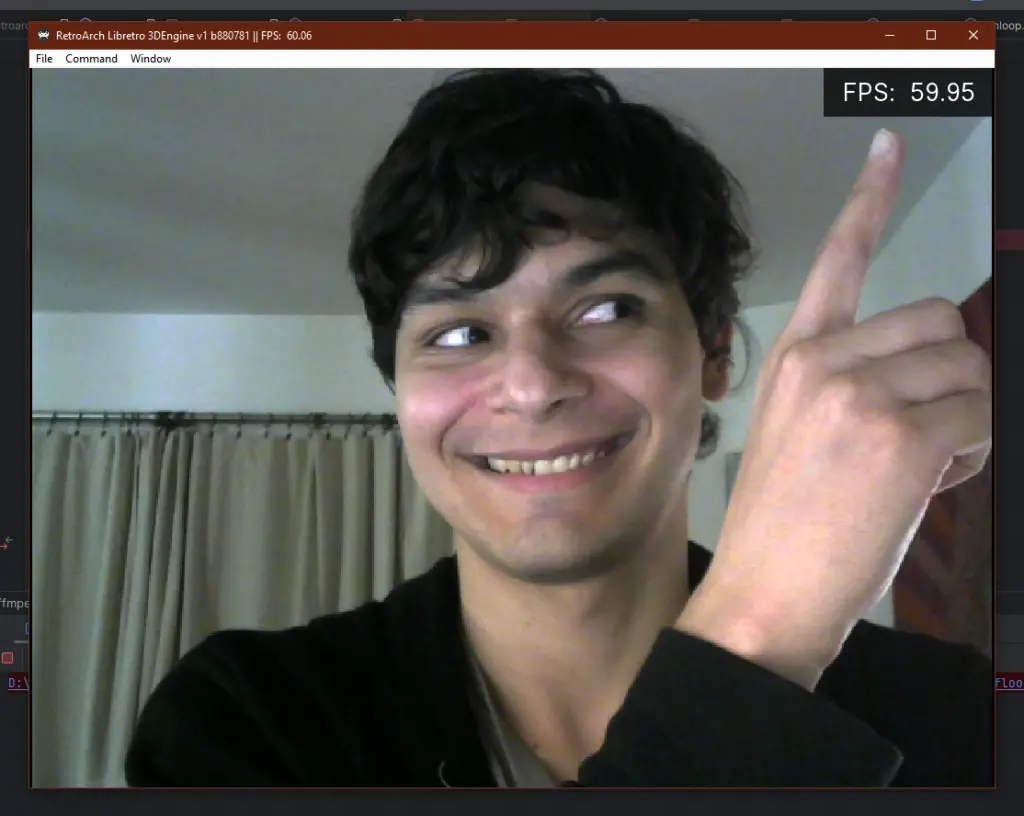
As demonstrated by Talavera running Lunar Knights (the spiritual successor to Boktai) on a Steam Deck, adjusting desk lamps or moving near a window instantly alters the in-game solar meter in real-time. This breakthrough coincides with upcoming updates to the melonDS core, which will introduce native solar sensor support, alongside plans to roll out comprehensive camera support for additional platforms in subsequent post-1.20.0 patches.
Supporting Context & Metrics: The Emulation Ecosystem in 2025
The release of RetroArch 1.20.0 arrives at a pivotal juncture in the history of video game preservation and software architecture. As commercial entities increasingly shutter digital storefronts—rendering countless games inaccessible—open-source projects like Libretro serve as the primary digital ark for interactive media.
The Cost of Free: The Libretro Economic Model
In an era where software monetization often relies on microtransactions, data harvesting, and subscription paywalls, the Libretro team maintains a fiercely independent stance. RetroArch is built around a modular library framework (Libretro) that standardizes input, audio, and video drivers across dozens of disparate platforms, ranging from high-end desktop PCs and Linux handhelds to obscure retro consoles and mobile phones.
Maintaining a project of this scale requires substantial infrastructural backing—hosting continuous integration (CI) servers, maintaining buildbots for over a dozen operating systems, and funding developer hardware for testing. Unlike commercial software companies that offset these costs by embedding tracking SDKs or restricting advanced features behind paywalls, RetroArch relies entirely on voluntary community support.
- Patreon Contributions: Providing steady monthly operational funding.
- GitHub Sponsors: Offering direct peer-to-peer developer backing.
- Teespring Merchandise: Providing physical apparel and collectible goods for community members to showcase their support.
This financial model ensures that features like the BlurBusters CRT shader and Linux illuminance sensor support remain universally accessible to all users on day one, regardless of their financial standing.
Cross-Platform Standardization and Hardware Demands
The integration of advanced subframe shaders and ambient sensor polling highlights a broader trend in modern emulation: the blurring lines between software environments and native hardware peripherals. While running a basic 8-bit or 16-bit emulator requires minimal processing power, executing complex subframe shader pipelines alongside accurate timing loops demands modern computing architectures.
Modern handhelds, such as Linux-powered ARM devices and x86 Steam Deck variants, are uniquely positioned to leverage these advancements. By optimizing the rendering pipeline to handle subframe calculations efficiently, RetroArch 1.20.0 ensures that users do not have to choose between advanced visual effects and stable frame rates.
Official Statements & Community Perspective
The release of version 1.20.0 has generated significant enthusiasm across the emulation and display technology communities. While official release notes emphasize technical specifications, the underlying philosophy of the project continues to resonate with preservationists worldwide.
Speaking on the motivations behind the BlurBusters partnership, core developers emphasized the importance of honoring the original artistic intent of game designers:
"Pixel art was never meant to be viewed as static, razor-sharp geometric blocks on a modern sample-and-hold LCD screen. It was designed to bleed, blend, and pulse across phosphor lines illuminated by a scanning electron beam. By partnering with Mark Rejhon and Timothy Lottes, we aren’t just applying a filter—we are mathematically and temporally recreating the physical interaction between hardware and light that defined an entire era of gaming."
Regarding the introduction of ambient light sensor support, the community response has been overwhelmingly positive, particularly among handheld enthusiasts. Jesse Talavera’s demonstration of Lunar Knights operating dynamically via environmental light changes on a Steam Deck has sparked renewed interest in hardware-accurate portable emulation.
Furthermore, the Libretro core team reiterated their unwavering commitment to user autonomy in their release manifesto:
"This project exists because of your support and belief in us to keep going doing great things. We have always prioritized the end-user’s experience, and unlike others, we have never emburdened them with in-app ads, monetization SDKs, or paywalled features, and we intend to continue to do so."
Future Outlook: What Lies Beyond Version 1.20.0
As RetroArch 1.20.0 establishes a new technological benchmark, the Libretro development roadmap points toward an even more integrated and immersive future. The successful implementation of Linux illuminance sensor support serves as a proof-of-concept for how non-traditional hardware inputs can be harmonized within the Libretro API.
Immediate Roadmap Priorities
- Expanded Core Integration: Following the 1.20.0 launch, core developers are actively updating emulators like melonDS to fully leverage the new solar sensor data pipelines, ensuring seamless plug-and-play functionality for sun-dependent titles.
- Broadened Camera and Sensor Support: Building upon the illuminance sensor framework, upcoming post-1.20.0 iterations will expand native camera and environmental sensor support across additional operating systems and host devices.
- Shader Subframe Optimization: As user feedback pours in from high-refresh-rate monitor owners utilizing the BlurBusters CRT beam simulation, further optimizations to the subframe pipeline will aim to reduce GPU overhead on mid-range hardware configurations.
- Sustaining Open-Source Independence: With hosting and development costs scaling alongside the project’s complexity, the core team continues to encourage community backing via Patreon, GitHub Sponsors, and the official merchandise store to guarantee that RetroArch remains free, open-source, and ad-free indefinitely.
Conclusion
RetroArch 1.20.0 is much more than a routine version increment; it is a masterclass in open-source software engineering and digital preservation. By uniting display industry pioneers like BlurBusters with passionate community developers, Libretro has once again pushed the boundaries of what is possible in software emulation. Whether you are seeking the ultimate visual authenticity of a glowing CRT monitor via advanced subframe shaders, or stepping out into the sunlight to charge your solar gun in Boktai, RetroArch 1.20.0 delivers an uncompromised, feature-rich experience that honors the past while fully embracing the capabilities of modern hardware.