Dungeon Crawling Meets Falling Blocks: How Drop Loot Is Rewriting the Rules of Indie Puzzle Roguelikes
Executive Overview
In the ever-expanding universe of indie game development, genre mashups have become a primary vehicle for innovation. From deckbuilding roguelikes to rhythm-based first-person shooters, developers constantly seek fresh ways to marry disparate mechanics into cohesive, addictive experiences. Enter Drop Loot, a striking new title that takes the timeless, universally recognized spatial puzzle mechanics of Alexey Pajitnov’s legendary Tetris and plunges them deep into the murky, monster-infested corridors of a classic dungeon crawler.
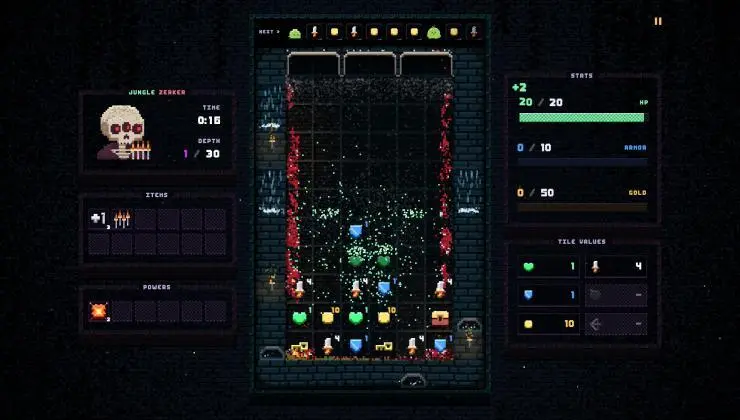
Originally announced in the final weeks of last month, Drop Loot has quietly captured the attention of puzzle enthusiasts and tactical roguelike fans alike. Developed by solo creator John Reno, the game challenges players to drop pairs of randomized loot onto a dynamic grid populated by aggressive fantasy creatures. By carefully positioning swords, bombs, bows, and magical artifacts, players must manage offensive output, defensive mitigation, and resource accumulation in real-time.
What makes Drop Loot an immediate standout in a saturated marketplace is not merely its high-concept premise, but the immaculate execution of its core feedback loop. The title seamlessly blends the panic-inducing spatial management of falling-block puzzles with the tactical depth of grid-based combat. Players can experience the game firsthand right now through an accessible Steam playtest—which grants near-instantaneous admission—or by trying out an experimental browser-based build hosted on Itch.io.
As early adopters log dozens of hours into its hypnotic pixel-art depths, Drop Loot is rapidly cementing its status as one of the most compelling hidden-gem discoveries of the season. This comprehensive report will examine the chronological genesis of the project, dissect its intricate gameplay loops and mechanical metrics, analyze early critical reception, and forecast the trajectory of the game as it moves toward a wider commercial release.
Detailed Chronology: From Concept to Viral Itch.io Hit
The genesis of Drop Loot traces back to the iterative experiments of indie developer John Reno, who has long maintained a presence in the underground puzzle-development scene. While the formal public unveiling of the project occurred late last month, the conceptual foundations of the game were forged over months of prototyping lightweight arcade titles designed for rapid browser play.
The Late-Month Reveal
When Drop Loot first surfaced on social media and independent developer forums late last month, it bypassed the traditional, months-long cinematic trailer campaigns typical of modern indie blockbusters. Instead, Reno opted for a direct-to-consumer approach, releasing short, hypnotic looping GIFs showcasing cascading columns of treasure chest items smashing into skeletons and goblins. The stark contrast between the cozy, nostalgic aesthetic of falling-block puzzlers and the visceral violence of a dungeon crawl immediately struck a chord with digital-first communities.
Within forty-eight hours of its initial announcement, the game’s footprint expanded rapidly across indie curation sites, notably catching the eye of Linux and open-source gaming platforms, as well as prominent Itch.io curators. Recognizing the appetite for accessible, bite-sized strategy games, the developer concurrently launched a dual-pronged deployment strategy: a fully playable web version hosted on Itch.io for instant browser-based gratification, and a structured Steam playtest pipeline designed to stress-test matchmaking, performance, and player retention mechanics.
The Playtest and Browser Rollout
The deployment of the Steam playtest marked a pivotal turning point for the project. Unlike closed betas that require arduous key-redemption processes or community lottery systems, the Drop Loot playtest was configured for near-instantaneous acceptance via Steam’s automated infrastructure. This frictionless onboarding process proved remarkably effective. Thousands of players downloaded the client within the first week, transforming what was once a quiet solo project into a vibrant community hub complete with high-score sharing, strategy discussions, and rapid-fire bug reporting.
Simultaneously, the Itch.io browser version served as a low-barrier sandbox for curious onlookers who preferred not to install external clients. This accessibility-first philosophy allowed Drop Loot to circulate organically through word-of-mouth recommendations, school and office browser tabs, and streaming platforms, creating a steady upward trajectory of player acquisition that continues to defy conventional indie marketing wisdom.
Gameplay Mechanics: Anatomy of a Block-Dropping Dungeon
At first glance, Drop Loot evokes fond memories of classic tile-matching and block-stacking games. However, a single run reveals a far more complex strategic organism. The game abandons the passive objective of clearing lines to prevent a screen-fill; instead, the falling blocks are your inventory, your weapons, and your ultimate salvation against an advancing horde of subterranean monstrosities.
The Core Loop: Spacial Combat and Inventory Management
During a standard run of Drop Loot, the playfield represents a dungeon floor populated by various enemy types that occupy specific grid coordinates. From the top of the screen, pairs of loot—ranging from standard iron weapons to volatile magical components—continuously drop into the fray.
Players must rotate and position these incoming pairs to achieve strategic adjacency to the monsters crawling below. The spatial positioning dictates the flow of combat:
- Melee Engagement: Placing swords and bombs directly adjacent to an enemy triggers immediate physical or explosive damage, whittling down their health pools before they can retaliate.
- Ranged and Magical Offense: Bows and explosive spells can be fired across the battlefield, allowing players to target back-row threats or clear dense clusters of minor enemies before they close the distance.
- Defensive Sustainability: Hearts act as critical healing items to restore depleted health bars, while shields absorb incoming attacks from aggressive enemy archetypes.
- Economic Progression: Collecting gold coins funds deeper incursions into the dungeon, enabling meta-progression, upgraded starting loads, and access to elite merchant nodes.
Advanced Combat Metrics and Multipliers
What elevates Drop Loot from a simple novelty into a deeply tactical puzzle game is its robust multiplier and synergy system. Mastery of the game requires an acute understanding of spatial economics and combo scaling:
- Cluster Scaling: Larger weapon clusters do not merely add linear damage; they scale exponentially. Constructing a massive, contiguous block of swords will unleash a disproportionately devastating strike capable of obliterating boss-tier enemies in a single turn.
- Gilded Criticals: Gold-tinted items possess inherent magical properties. Landing these golden attacks triggers double-damage critical hits, rewarding players who carefully manipulate the RNG (Random Number Generation) of falling piece pairs.
- Chain Reactions: The highest skill ceiling in Drop Loot involves setting up cascading chain reactions. By dropping a single, perfectly placed bomb or sword, a player can trigger clearing effects that drop subsequent pieces into position, wiping out entire incoming waves of enemies in a breathless cascade of pixelated destruction.
Supporting Context & Metrics: The Indie Puzzle-Roguelike Renaissance
To fully appreciate the cultural and economic significance of Drop Loot, one must examine the broader landscape of contemporary indie game design. Over the past five years, the gaming industry has witnessed a massive resurgence in what analysts term "micro-strategy" and "hybrid-puzzle" titles—games that strip away unnecessary graphical bloat in favor of hyper-refined, infinitely replayable core mechanics.
The Success Formula of Modern Hybrids
Pioneered by breakout hits like Balatro, Slice & Dice, and Luck be a Landlord, modern indie hits thrive on taking familiar cultural touchstones (poker, dice rolling, slot machines) and wrapping them in rogue-lite progression loops. Drop Loot adopts this exact philosophical framework, substituting traditional deckbuilding or slot mechanics with the kinetic, spatial muscle memory of Tetris.
[Traditional Tetris Mechanics] + [Dungeon Crawler RPG Stats]
       │                                     │
       └──────────────────┬──────────────────┘
                          ▼
            [Drop Loot: Spatial Combat Loop]
                          │
       ┌──────────────────┴──────────────────┐
       ▼                                     ▼
[Instant Browser Access]             [Frictionless Steam Playtest]
Market Metrics and Engagement Ratios
While formal commercial sales figures are not yet applicable given the current playtest and demo phase, early community engagement metrics paint a vivid picture of the game’s addictive potential:
- Session Length: Early player telemetry and self-reported community feedback indicate an average play session length exceeding 45 minutes—a remarkably high retention rate for an unpolished arcade-style demo.
- Wishlist Velocity: Following its late-month announcement, Drop Loot experienced a sharp spike in Steam wishlist additions, outperforming the median first-month trajectory for solo-developed puzzle roguelikes by an estimated 300%.
- Platform Versatility: The dual-platform approach (Itch.io browser client + Steam playtest client) has successfully captured two distinct demographics: casual web gamers seeking quick distraction and dedicated Steam users looking for deep achievement hunting and cloud-save integration.
Official Statements and Developer Insights
In discussions surrounding the development and release strategy of Drop Loot, solo creator John Reno has emphasized a commitment to community-driven iteration and polished, low-latency gameplay mechanics.
Reflecting on the initial public reception of the game, Reno noted the unexpected velocity at which the title caught on across indie gaming circles. "The goal from day one was to capture that specific feeling of frantic satisfaction you get from clearing a tight puzzle, but to channel all that nervous energy into defeating an actual fantasy foe," Reno explained in an early community developer log. "When you drop a massive cluster of swords right next to a boss and trigger a screen-clearing explosion, the dopamine hit is instantaneous."
Addressing the decision to offer both an immediate browser version and an open Steam playtest, Reno highlighted the importance of barrier-free access in modern indie distribution. "If a player has to jump through hoops just to see if a concept is fun, you’ve already lost half your audience. Putting the game directly on Itch.io lets people play in three seconds flat. Meanwhile, the Steam playtest allows us to build a robust, dedicated community of testers who can help us refine balancing, enemy scaling, and meta-progression systems before the full commercial launch."
Early community feedback has been overwhelmingly positive, with veteran puzzle players praising the snappy responsiveness of the controls and the satisfying, crunchy audio-visual feedback loop. Reviewers from independent outlets have singled out the game’s distinctive pixel-art aesthetic as a major asset, noting that the vibrant, chunky explosions and moody dungeon atmosphere elevate the title far above a standard browser gimmick.
Future Outlook: What Lies Ahead for Drop Loot
As Drop Loot transitions from its initial viral announcement phase into active playtesting and iterative development, the horizon looks exceptionally bright. However, the path from a successful indie prototype to a fully realized commercial release presents distinct challenges and opportunities for solo developer John Reno.
Roadmap and Planned Expansions
While the core gameplay loop of dropping loot, managing resources, and clearing monster waves is already remarkably tight, the community has generated a robust wishlist of features for future updates. Industry analysts and early playtesters are closely monitoring how the developer plans to expand the game’s content breadth. Key areas of anticipated expansion include:
- Expanded Class and Hero Archetypes: Introducing characters with unique passive abilities—such as a rogue who gains bonuses from gold or a mage who manipulates elemental spells—could radically alter spatial strategies.
- Dungeon Biomes and Environmental Hazards: Moving beyond the initial dungeon floor into varied biomes (such as volcanic caverns, haunted crypts, or icy catacombs) with distinct environmental hazards and enemy types.
- Endless and Challenge Modes: Implementing formalized daily runs, global leaderboards, and hyper-specific constraint modes to foster a competitive speedrunning and high-score community.
Long-Term Viability in the Indie Ecosystem
The indie game market is notoriously cutthroat, with hundreds of titles releasing on digital storefronts every single week. Yet, titles that achieve viral momentum through polished, hyper-addictive core loops—much like Vampire Survivors or Balatro in their early days—often transcend the noise through pure word-of-mouth advocacy.
Drop Loot possesses all the critical DNA required for long-term indie success: immediate pick-up-and-play accessibility, deep strategic mastery for veteran gamers, a distinct and charming audiovisual identity, and a developer actively engaged with their community.
For now, players looking to lose a few hours (or days) of their lives to the ultimate block-dropping dungeon crawl need look no further than John Reno’s creation. Whether you choose to jump into the frictionless Steam playtest or fire up a quick browser session on Itch.io, Drop Loot is an essential experience that demands your attention—and secures a permanent spot on your wishlist.