Digital Isolation and Body Horror: Revisiting Jane Schoenbrun’s We’re All Going to the World’s Fair in the Wake of Modern Auteur Success
Executive Overview
As filmmaker Jane Schoenbrun’s latest cinematic ventures—including the widely acclaimed I Saw the TV Glow and Teenage Sex and Death at Camp Miasma—continue to captivate theatrical audiences and dominate contemporary cultural discourse, the broader cinematic landscape has experienced a renewed fascination with the director’s distinct artistic origins. Chief among these foundational works is Schoenbrun’s 2021 feature-length debut, We’re All Going to the World’s Fair, which first premiered to critical intrigue at the Sundance Film Festival.
An immersive, deeply unsettling exploration of early-morning internet subcultures, alternate reality games (ARGs), and profound youthful alienation, World’s Fair operates at the intersection of body horror and psychological drama. The narrative centers on Casey, a lonely adolescent girl isolated within her suburban home, who willingly plunges into an opaque, viral online phenomenon known as the "World’s Fair Challenge." By marrying the uncanny aesthetic of early webcam recordings with a pervasive sense of digital voyeurism, Schoenbrun constructed a cinematic artifact that feels less like a traditional horror film and more like an authentic, found-footage relic of the darkest corners of the 21st-century internet.
This retrospective analysis examines We’re All Going to the World’s Fair not merely as a precursor to Schoenbrun’s subsequent A24-backed triumphs, but as a watershed moment for modern indie cinema. By rejecting traditional coming-of-age tropes—such as the conventional focus on sexual awakening—in favor of an unflinching look at online radicalization, loneliness, and bodily dissociation, Schoenbrun crafted a singular masterpiece of digital-age dread. Through structural critique, thematic exploration, and contextual analysis, this piece explores why World’s Fair remains a vital text for understanding the psychological toll of hyper-connectivity.
Detailed Chronology: The Descent into the World’s Fair Challenge
To understand the unsettling power of We’re All Going to the World’s Fair, one must trace the meticulously constructed descent of its protagonist, Casey. The film wastes no time plunging the viewer directly into the uncanny ecosystem of the internet underground. We are introduced to Casey as she initiates her participation in the titular "World’s Fair Challenge"—a digital ritual that functions as an amalgam of creepypasta lore, viral social media challenges, and alternate reality gaming.
[The World’s Fair Challenge: Chronological Progression]
 ├── Phase 1: Initiation (Reciting the Mantra & Bloodletting)
 ├── Phase 2: Submission (Uploading Webcam Vlogs of Symptoms)
 ├── Phase 3: Dissociation (Belief in Bodily Transformation / Tetris Guts)
 └── Phase 4: Intervention (The Arrival and Warning of JLB)
Phase 1: Initiation and Self-Inflicted Horror
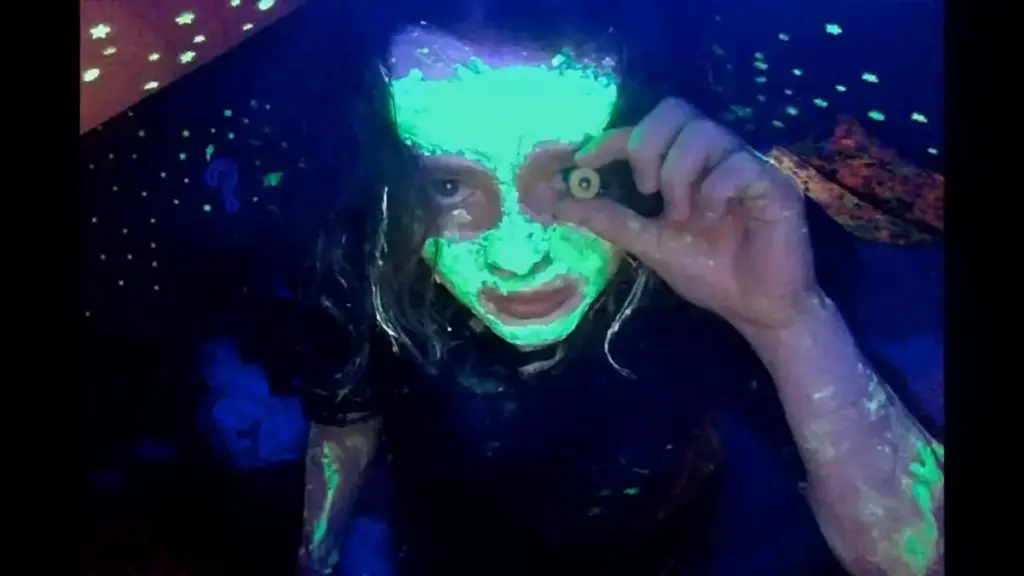
The mechanics of the challenge are deceptively simple yet immediately disturbing. Participants must repeat a specific, hypnotic mantra three times into a camera, prick their finger to draw blood, and watch a mysterious, flashing video file. For an experienced horror aficionado, these elements might initially register as a rapid-fire speedrun of conventional genre tropes. However, Schoenbrun subverts expectations by anchoring these grotesque acts in the mundane, hyper-realistic setting of a teenage girl’s bedroom late at night.
When Casey stares unblinkingly into her webcam, lit only by the cold blue glare of her monitor, the artificiality of traditional horror dissolves. The sequence where she repeatedly jabs herself with a pin to draw blood is remarkably visceral; it is a moment that routinely forces physical recoils from audiences, marking the intersection where digital performance art bleeds into genuine physical self-harm.
Phase 2: The Documentation of Symptoms
Once the ritual is complete, participants are instructed to document their transformation. The challenge is framed as a pseudo-scientific game where "players" must upload regular video logs tracking their symptoms. These symptoms are bizarre, nebulous, and deeply psychological: subjects report feeling their skin turn to hard plastic, or imagining that their internal organs are slowly rearranging themselves into physical Tetris pieces.
For Casey, these videos serve a dual purpose. On one hand, they are her contributions to the broader digital collective; on the other, they are desperate, screaming pleas for human contact. Throughout the film’s runtime, Casey is never once shown interacting with peers of her own age. Her home life is defined by an oppressive auditory void—her father is an unseen presence, lingering just off-camera, whose dialogue is strictly limited to harsh, authoritarian shouting echoing through the hallways. Isolated and unheard in the physical world, Casey turns to the infinite, indifferent expanse of the internet to validate her existence.
Phase 3: The Intrusion of JLB
As Casey’s video logs accumulate views, the film introduces its sole secondary character of significant weight: JLB, a lonely, middle-aged man operating under an enigmatic online handle. JLB stumbles across Casey’s increasingly erratic uploads and reaches out, claiming that she is in grave, immediate danger—that the "changes" she is experiencing are real, accelerating, and potentially fatal.
The dynamic between Casey and JLB introduces a palpable layer of psychological unease. The film adopts a distinctly voyeuristic framing, forcing the audience into the uncomfortable position of observing an intimate, potentially predatory relationship unfold across glowing computer screens. Though never explicitly articulated through exposition, the subtext heavily implies that JLB is attempting to groom a vulnerable, emotionally starved teenager under the guise of mentorship and protection. This ambiguity leaves viewers suspended in a state of perpetual dread, unsure whether JLB is a dangerous cyber-predator, a well-meaning but misguided internet stranger, or merely another lonely ghost lost in the same digital ether as Casey.
Supporting Context & Metrics: The Indie Horror Landscape
We’re All Going to the World’s Fair arrived during a pivotal cultural moment when the COVID-19 pandemic had forced global society into unprecedented digital isolation. While big-budget horror franchises relied on supernatural jump scares, a new wave of independent filmmakers—spearheaded by artists like Schoenbrun—began to harness the specific texture of contemporary anxiety: screen fatigue, the blurring of physical and digital realities, and the chilling anonymity of internet forums.
Critical Reception and Streaming Accessibility
Upon its debut at the 2021 Sundance Film Festival, World’s Fair garnered widespread critical acclaim, particularly for its daring formal choices and atmospheric restraint. Critics praised Schoenbrun’s ability to capture the authentic cadence of YouTube culture, role-play communities, and late-night rabbit holes.
Unlike conventional horror films that prioritize exposition and clear narrative closure, World’s Fair thrives on ambiguity. This thematic choice elevated the film within critical circles, cementing its status as a cult classic even before Schoenbrun achieved mainstream commercial breakthroughs with A24. For audiences eager to explore or revisit this modern touchstone, the film is readily accessible across several premier independent streaming platforms:
- The Criterion Channel: Cementing the film’s artistic pedigree and status as modern cinema.
- Kanopy: Facilitating academic and public library access for film enthusiasts.
- Hoopla Digital: Providing broad digital availability for local library cardholders.
Official Statements and Artistic Intent
Jane Schoenbrun has been remarkably candid about the deeply personal genesis of We’re All Going to the World’s Fair. In various interviews surrounding the film’s release and subsequent legacy, the director has articulated a vision centered on the paradox of the modern internet: a space that promises infinite connection while frequently delivering profound, crushing isolation.
"I wanted to make a movie about the internet that didn’t feel like a sci-fi dystopia or a cautionary tale written by people who don’t understand how young people live," Schoenbrun noted in retrospective discussions regarding the film’s aesthetic. "The internet is where so many of us—particularly queer youth and isolated kids—go to find ourselves, to try on identities, and to scream into the void hoping someone, anyone, is listening. The horror isn’t the technology itself; it’s the desperate human need for validation that the technology exploits."
Furthermore, industry analysts and film critics have frequently contextualized World’s Fair as a vital stepping stone in Schoenbrun’s overarching artistic trajectory. While later works like I Saw the TV Glow lean into vibrant, surreal camp and grander stylistic ambitions, World’s Fair remains the purest distillation of micro-budget indie resourcefulness. It demonstrates how limitation can breed intense formal focus, transforming a handful of webcam setups and austere interiors into a sprawling canvas of existential dread.
Future Outlook: The Enduring Legacy of Schoenbrun’s Universe
As Jane Schoenbrun continues to ascend as one of the most distinctive and visionary voices in contemporary auteur cinema, the cultural footprint of We’re All Going to the World’s Fair continues to expand. Far from being overshadowed by the explosive success of subsequent projects, Schoenbrun’s debut is increasingly viewed as the foundational blueprint for a new subgenre of digital-age horror.
The Evolution of Digital Horror
The cinematic landscape has increasingly embraced narratives that engage directly with screen culture, desktop interfaces, and alternate reality games (a trend often categorized under "screenlife" or "analog horror"). However, few films achieve the psychological depth and empathetic resonance found in World’s Fair. By treating its young protagonist with profound dignity—refusing to exploit her vulnerability while unflinchingly examining the systemic loneliness that birthed it—Schoenbrun set a high benchmark for ethical and artistic engagement with internet culture.
Looking Ahead
Looking forward, the critical re-evaluation of We’re All Going to the World’s Fair underscores a broader shift in how audiences consume and value independent cinema. As viewers grow increasingly fatigued by predictable franchise reboots and sanitized studio horror, original, idiosyncratic visions like Schoenbrun’s debut offer a vital antidote.
Whether analyzed as a harrowing coming-of-age tragedy, an astute sociological study of modern alienation, or a masterclass in minimalist body horror, We’re All Going to the World’s Fair secures its place in film history. It stands as a chilling, beautiful monument to the screens that bind us, the ghosts we summon in the dark, and the enduring, desperate human search for a place to belong.