Designing for Immersion: What Survios’ Electronauts Teaches Us About the Future of VR Interface Architecture
Executive Overview
Eight years after its initial market debut, Survios’ acclaimed virtual reality music-creation title Electronauts remains a masterclass in spatial computing design. While initially categorized as a rhythm and DJ simulation game, the underlying architectural philosophy of its user interface transcends the boundaries of entertainment software. In an industry where establishing standardized, ergonomic, and intuitive interaction models remains a moving target, Electronauts offers enduring lessons on how to bridge the gap between human biomechanics and digital environments.
As spatial computing matures—expanding beyond niche gaming ecosystems into enterprise workflows, productivity suites, and collaborative toolsets—developers face a persistent challenge: the absence of physical feedback. Traditional user interfaces rely on tactile cues like the click of a mouse or the physical resistance of a keyboard. In virtual reality, these affordances vanish.
Electronauts solved this fundamental limitation years ahead of its time by anchoring its core interaction loops in three foundational design pillars: ease-of-use, hierarchy, and flexibility. By treating interface elements as physical tools rather than flat, floating menus, Survios created a frictionless environment where users can manage complex variables smoothly, even under the temporal pressure of a relentless musical beat.
This retrospective examines the engineering decisions, ergonomic insights, and cognitive frameworks that make Electronauts a landmark case study in XR interface design. Through an analysis of tool-mediated interactions, spatial hierarchies, and modular workspaces, this report explores how the lessons of Electronauts continue to inform the next generation of spatial computing interfaces.
Detailed Chronology: The Evolution and Legacy of Electronauts
The 2016–2018 Era: Pioneering VR Interaction
When Survios conceptualized Electronauts in the mid-2010s, the consumer virtual reality landscape was in its infancy. Hardware was tethered, controllers lacked standardized capacitive touch tracking, and developers were largely figuring out best practices through trial and error. Early VR titles frequently suffered from "skeuomorphic translation"—the flawed practice of taking traditional 2D desktop paradigms (such as floating flat windows and cursor clicks) and simply placing them into a 3D space.
Survios took a different path. Recognizing that traditional input models break down when stripped of physical resistance, the development team focused heavily on how human physiology interacts with physical objects. Released globally across major VR platforms in August 2018, Electronauts was praised not just for its accessible music-making mechanics, but for how seamlessly players could navigate its menus without breaking immersion.
Critical Reception and Immediate Impact
Upon release, the game garnered critical acclaim for democratizing electronic music creation. Reviewers noted that even users with zero musical background could craft coherent, dynamic soundscapes within minutes. However, behind the flashy particle effects and catchy tracks lay a deeply calculated design system. The game successfully addressed the "empty space" problem of VR—the awkwardness of interacting with invisible UI elements—by turning menus into tangible, physical entities.
The 2026 Milestone: Eight Years of Enduring Relevance
Today, as spatial computing headsets leverage advanced hand tracking, passthrough mixed reality, and complex eye-tracking arrays, the core interface lessons of Electronauts have only grown more pertinent. Celebrating its eighth anniversary, the game’s enduring architectural insights remind developers that effective spatial UI is rooted in human ergonomics, not just graphical fidelity. By re-examining Electronauts through the lens of modern XR design, the industry can better understand how timeless UX principles outlive hardware iterations.
Supporting Context & Metrics: The Anatomy of a Spatial UI Masterpiece
To understand why the Electronauts interface succeeds where many contemporary productivity apps fail, one must analyze the cognitive load and mechanical precision required in virtual environments. The interface’s brilliance is built upon three distinct pillars:
[ Electonauts UI Architecture ]
 ├── 1. Ease-of-Use (Tool-Mediated Interaction & Precision Triggers)
 ├── 2. Hierarchy (Cube-Based Modular Mini-Apps & Shallow Menus)
 └── 3. Flexibility (Ambidextrous Workspaces & Custom Arrangements)
Pillar 1: Ease-of-Use via Tool-Mediated Interaction
Humans are evolutionarily hardwired to use tools. Anthropological and neurological studies confirm that with sufficient repetition, the human brain subconsciously incorporates handheld implements into its internal body schema—a psychological phenomenon known as proprioceptive extension. When a user holds a tool, they no longer calculate the physical boundaries of the tool itself; instead, they calculate the boundaries of the tool’s point of impact.
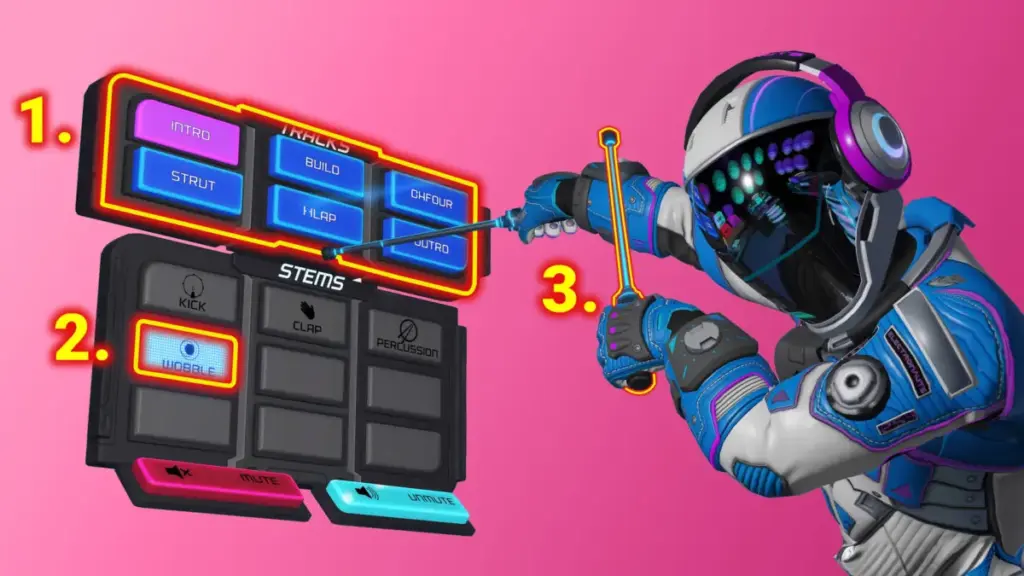
Survios capitalized on this evolutionary trait by outfitting players with drumsticks as their primary instruments and interface manipulation tools.
- Extended Reach and Comfort: By providing virtual drumsticks, the developers effectively extended the player’s reach. This allowed the interface elements to be scaled up comfortably in physical space. Larger targets inherently reduce precision errors, minimizing accidental activations and cognitive frustration.
- Overcoming the Absence of Tactile Feedback: In a real-world setting, physical buttons provide resistance and a satisfying click, confirming that an action has been registered. In VR, simulated buttons offer no physical pushback, leading to "ghost touches" and missed inputs.
- The Intersect-and-Pull Mechanism: Electronauts solved this by decoupling touch from activation. Rather than requiring users to simply tap a flat, simulated button, the interface demands that the user physically insert their drumstick into the button geometry and then pull a hardware trigger to confirm the selection. This two-stage action (spatial intersection followed by a deliberate trigger pull) drastically increases input accuracy and builds user confidence.
Pillar 2: Streamlined Hierarchy and Modular Architecture
In any complex software ecosystem, information hierarchy dictates how quickly a user can locate, comprehend, and execute a function. Poor hierarchy leads to excessive cognitive load, while deep, multi-layered folder structures cause "menu fatigue."
Electronauts addresses this challenge through a clean, containerized approach to tool management:
- Cube-Based Functionality: All system functions, audio tracks, and modulation tools are housed within physical cubes.
- The "Mini-App" Paradigm: Much like modern smartphone operating systems represent complex software suites as clean, isolated application icons on a home screen, Electronauts restricts active functions to tangible cubes. To access a tool’s capabilities, the player simply places a cube into an active pedestal.
- Shallow Menu Depth: By capping the number of active cubes at any given moment (typically three), the game avoids visual clutter. Users never find themselves digging through nested folders or obscure sub-menus. Every function is immediately visible, contextual, and reachable within a single physical gesture.
Pillar 3: Spatial Flexibility and Ambidextrous Design
Traditional desktop applications often lock users into rigid layouts, forcing left-handed individuals to adapt to right-handed defaults or rely on awkward remapping settings. Electronauts, by virtue of its physicalized interface design, is inherently ambidextrous and deeply flexible.
- Modular Rearrangement: Because tools exist as physical cubes that can be picked up, carried, and placed anywhere within the user’s workspace, the interface adapts entirely to the individual. If a left-handed user prefers their backing-track controller on the left side of their mixing deck, they simply pick up the corresponding cube and place it there.
- The Digital Desktop Analogy: This dynamic mirrors the freedom of dragging windows across a computer screen or rearranging physical tools on a workbench. By empowering the user to customize their ergonomic workspace on the fly, Electronauts eliminates friction, allowing players to focus entirely on creative flow rather than fighting the interface.
Official Statements and Industry Insights
Designers and developers across the spatial computing ecosystem have long pointed to rhythm and music titles as the unsung heroes of XR user experience design. Because music games operate under strict temporal constraints—forcing users to make rapid-fire decisions aligned with an unrelenting auditory beat—they expose the absolute limits of poor UI design.
In retrospective analyses of the game’s development, Survios engineering leads noted that the primary goal was to make complex music-mixing mechanics feel as natural as playing an acoustic instrument.
"When you build for virtual reality, you aren’t just designing graphics on a screen; you are carving out a physical environment where human muscles, eyes, and psychology must harmonize," notes a foundational design brief from the Survios development archives. "If an interface requires the user to think about how to use it, the immersion is broken. By anchoring our interface to familiar physical actions—holding sticks, placing objects into slots, pulling triggers—we bypassed the cognitive friction of traditional computing."
UX researchers in the broader XR community frequently cite the game’s "intersect-and-pull" mechanic as a blueprint for high-precision enterprise applications. Whether a user is manipulating 3D architectural models in CAD software or performing virtual robotic surgeries, the requirement for unambiguous, verified input confirmation remains identical to the principles demonstrated in Electronauts.
Future Outlook: The Enduring Blueprint for Spatial Computing
As the technology sector pivots rapidly toward mixed reality headsets, spatial operating systems, and AI-driven spatial interfaces, the lessons embedded within Electronauts are more relevant than ever.
1. The Death of the Flat UI in Spatial Computing
The temptation to port 2D paradigms (such as mobile app grids and desktop toolbars) into spatial headsets remains strong among developers rushing to deploy enterprise and consumer apps. However, consumer fatigue with floating flat screens is growing. The future belongs to tangible, skeuomorphic, and tool-mediated interfaces that respect human biomechanics. Future productivity suites will likely adopt variations of the "cube-and-pedestal" modularity seen in Electronauts, transforming abstract data points into physical, manipulable objects.
2. Hand-Tracking and Extended Tool Metaphors
With the widespread adoption of optical hand tracking (seen in modern devices like the Apple Vision Pro and Meta Quest series), the need for physical controllers is shifting. Yet, the psychological insight remains valid: humans understand tools better than abstract touch surfaces. As gesture-based interfaces evolve, developers are exploring "air-tools"—virtual extensions of the hands that mimic the reach, leverage, and precision of physical implements like the drumsticks in Electronauts.
3. Cross-Industry Applications
The three pillars of ease-of-use, hierarchy, and flexibility provide a foolproof checklist for any spatial computing developer:
- Ease-of-Use: Does your interface rely on natural human tool-use and precise, multi-stage confirmation to combat the lack of tactile feedback?
- Hierarchy: Are your functions modular and shallow, avoiding the cognitive trap of nested menus and visual clutter?
- Flexibility: Can your workspace be effortlessly rearranged to suit ambidextrous preferences, physical reach limitations, and contextual workflows?
Conclusion
Eight years after its release, Electronauts stands as a shining example of thoughtful XR architecture. It proves that the best user interfaces are those that disappear entirely, leaving only the user, their intent, and the seamless execution of their craft. As spatial computing continues its inexorable march into the mainstream, designers would do well to look back at Survios’ musical triumph—reminding themselves that the future of digital interaction was mapped out years ago on a virtual DJ deck.