Pushing the Portable Pioneer Beyond its Limits: The Revolutionary PSP Overclocking Breakthrough
By: Editorial Staff
Published: April 17, 2026
Source/Attribution: Originally reported by Acid_Snake (Wololo.net)
Executive Overview
For over two decades, the PlayStation Portable (PSP) has held a revered, almost mythic status in the annals of handheld gaming history. Launched by Sony in 2004, the device was a technical marvel for its era, boasting multimedia capabilities and a widescreen display that brought console-quality experiences into the palms of players’ hands. Yet, as the years progressed, hardware limitations became the defining bottleneck for the platform. For a long time, the ceiling for the PlayStation Portable’s CPU clock speed was universally capped at 333 MHz—a restriction imposed by Sony to balance thermal output, system stability, and battery consumption.
Even as the homebrew and Custom Firmware (CFW) community achieved staggering milestones over the years—ranging from native port implementations to complete system kernel exploits—breaking through the 333 MHz barrier remained the holy grail of PSP hardware modification.
That narrative has officially changed.
Talented scene developer m-cid has engineered an open-source solution that shatters the decades-old performance ceiling, introducing native, dynamic CPU overclocking to the PSP ecosystem. Better yet, this breakthrough has been seamlessly integrated into ARK-5, the latest evolution of the popular Custom Firmware.
Initial testing confirms that this development fundamentally alters how demanding titles run on vintage hardware. Heavy hitters like Grand Theft Auto: Liberty City Stories, Grand Theft Auto: Vice City Stories, and Metal Gear Solid: Peace Walker—titles notoriously bogged down by fluctuating frame rates, heavy stuttering, and agonizing input lag—can now achieve smooth, stable 30 frames per second (FPS) when paired with community-made patches.
However, pushing hardware past its intended design specifications is rarely a plug-and-play affair. Silicon lottery variations across different PSP revisions mean that results will vary wildly from device to device. While owners of later models, such as the PSP-3000 and the sleek PSP Go, are enjoying remarkably high frequency thresholds, early hardware variants like the PSP-1000 face unique stability hurdles, and budget-oriented models like the PSP Street are currently left out in the cold.
This comprehensive report explores the technical mechanics of the m-cid overclocking breakthrough, analyzes real-world performance metrics across various hardware revisions, outlines hardware compatibility hurdles, and evaluates what this means for the enduring legacy of Sony’s legendary handheld.
Detailed Chronology: Breaking the 333 MHz Barrier
To fully appreciate the gravity of m-cid’s achievement, one must understand the historical context of PSP performance optimization. Since the early days of HEN (Homebrew Enabler) and Custom Firmwares like Prometheus and PRO-C, the standard maximum frequency recognized by the system’s internal modules and game headers was 333 MHz. While developers could underclock the CPU to save battery life during lighter emulation tasks or homebrew execution, pushing beyond 333 MHz was widely considered a physical impossibility due to hardware register limits and undocumented bus constraints.
The Genesis of the Open-Source Overclock
The breakthrough did not happen overnight. It was the culmination of meticulous reverse-engineering, deep-kernel debugging, and a resilient community of hardware hackers who refused to accept that the PSP’s computational limits had been fully tapped. Developer m-cid approached the problem by examining how the console’s internal clock generator interfaces with the CPU core.
By writing an open-source module capable of dynamically reprogramming the system’s PLL (Phase-Locked Loop) multipliers beyond standard software parameters, m-cid bypassed the hardcoded safety checks that locked the processor at 333 MHz.
Integration into ARK-5
An overclocking exploit of this magnitude is only as good as its accessibility. A tool restricted to complex command-line arguments or risky manual injections would remain isolated to hardcore developers. Recognizing this, the development team behind ARK-5—one of the most advanced and actively maintained Custom Firmwares for the PSP—moved swiftly to integrate m-cid’s solution directly into the firmware’s core architecture.
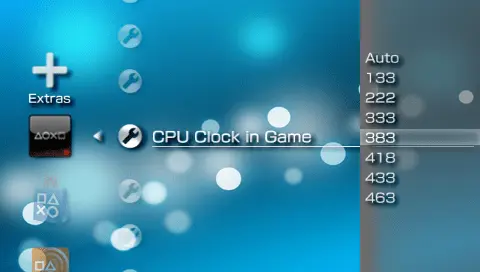
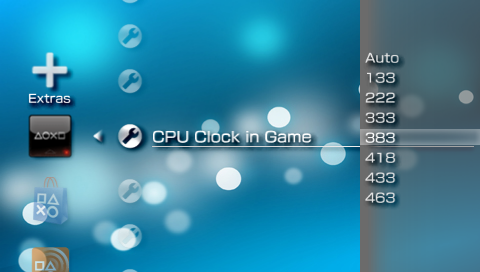
With ARK-5, users gain access to advanced frequency adjustments directly within the firmware’s recovery menu or vsh menu. This integration transforms what was once an experimental proof-of-concept into a user-friendly, deployable feature set that is readily available to anyone willing to update their system software.
Supporting Context & Metrics: Real-World Performance Analysis
The ultimate metric of any performance modification is how it translates to the player’s fingertips. For years, playing open-world titles or complex third-person action games on native PSP hardware meant tolerating compromised frame rates.
Taming the Open-World Stutter: Grand Theft Auto on PSP
Rockstar Games’ Grand Theft Auto: Liberty City Stories and Vice City Stories pushed the PSP hardware to its absolute breaking point. Rendering sprawling 3D environments, handling physics, and streaming assets from the UMD disc (or Memory Stick) simultaneously meant these titles frequently hovered around 20 to 25 FPS, dipping into the teens during intense action sequences or rapid driving through dense city blocks.
With the new ARK-5 overclocking integration—and utilizing Freakler’s acclaimed CheatDeviceRemastered frame-rate patches—these games undergo a radical metamorphosis. When the CPU is pushed to stable frequencies above 433 MHz, the engine can process asset streaming and AI calculations fast enough to maintain a locked, fluid 30 FPS. The difference is not merely marginal; it transforms notoriously sluggish experiences into genuinely playable, modern-feeling handheld adventures.
Elevating Cinematic Action: Metal Gear Solid
Similarly, Metal Gear Solid: Peace Walker, widely celebrated as one of the technical masterpieces of the platform, suffered from frame drops during heavy combat encounters and particle-heavy explosions. While standard 333 MHz configurations struggled to keep the action smooth, higher CPU frequencies smooth out these computational bottlenecks, ensuring that stealth-action gameplay remains responsive when split-second timing matters most.
The Ecosystem of Patches
It is important to note that unlocking the CPU clock alone is only half the battle. Many commercial PSP titles shipped with internal frame-rate caps hardcoded into their game engines. Therefore, to reap the full benefits of m-cid’s overclock, players must utilize community-developed patches. Alongside Freakler’s work on the GTA series, traditional plugins such as CWCheat and custom PRX patches continue to serve as vital tools for unlocking frame-rate caps across a wide library of classic titles.
Hardware Compatibility & The Silicon Lottery
Not all PSPs were created equal. Over its six-year hardware lifecycle, Sony released multiple distinct iterations of the PlayStation Portable, each featuring subtle hardware revisions, different screen panels, and varying degrees of thermal efficiency and electrical tolerance. Consequently, m-cid’s overclocking solution introduces a fascinating case study in the modern "silicon lottery."
The Sweet Spot: PSP-3000 and PSP Go
According to extensive testing compiled by the Wololo development and community testing circles, owners of later-generation hardware are reaping the biggest rewards from this breakthrough:
- PSP-3000: The final standard iteration of the hardware handles high frequencies remarkably well. Tests indicate that 433 MHz is universally stable across most units, with several consoles scaling gracefully even higher.
- PSP Go: Sony’s innovative, slider-based digital-only handheld has proven to be an unexpected powerhouse in this arena. Testing reports confirm that the PSP Go easily handles frequencies of 433 MHz and 463 MHz while remaining completely stable. Interestingly, hardware idiosyncrasies showed that some units successfully processed extreme frequencies while occasionally rejecting intermediary steps (such as 418 MHz), highlighting the unpredictable nature of overclocking vintage chips.
The Middle Ground: PSP-1000 and PSP-2000
Launch-era units (PSP-1000) and the slim redesign (PSP-2000) require a more conservative approach. Because of older manufacturing nodes and differing power delivery circuits, these devices show varied tolerances:
- Universal Stability: Thorough testing reveals that 433 MHz remains the most reliably stable baseline for the majority of properly functioning consoles.
- Conservative Scaling: Certain units among the 1K and 2K families prefer lower frequencies to prevent system instability or sudden hard crashes, with sweet spots often found at 418 MHz or, in extreme cases, 383 MHz. Users are strongly advised to stress-test their specific hardware rather than blindly applying the highest available setting.
The Outliers: PSP Street and PlayStation Vita (ePSP)
Unfortunately, not every device in the PlayStation portable lineage shares in this triumph:
- PSP-E1000 (PSP Street): Designed as a cost-reduced, budget-friendly variant released late in the PSP’s lifecycle, the Street model lacks the robust power management and hardware tolerances of its predecessors. Applying the overclocking utility to a PSP Street currently yields the exact opposite of the intended effect: the system slows down drastically, dropping below the minimum thresholds allowed in the ARK user interface (133 MHz). At present, it remains entirely unknown whether this hardware limitation can be patched or if the Street’s internal architecture fundamentally prohibits overclocking.
- PlayStation Vita (ePSP / Adrenaline): Users operating within the adrenaline bubble on hacked PlayStation Vita or PlayStation TV systems are also out of luck. Because the Vita runs the PSP environment as an emulated sandbox (ePSP) governed by the Vita’s hypervisor and system constraints, the effective clock speed is rigidly capped at the original hardware maximum of 333 MHz. The overclocking module has no operational effect within this environment.
Future Outlook: The Endless Life of Retro Hardware
The release of m-cid’s open-source overclocking solution and its integration into ARK-5 marks a watershed moment for the retro gaming and homebrew communities. For nearly twenty years, the 333 MHz barrier was accepted as an immutable law of physics within the PSP ecosystem—a boundary set by Sony engineers that could never be crossed.
By dismantling this restriction, the community has breathed an entirely new lease of life into a console that many thought had reached the absolute zenith of its optimization. It proves that even legacy platforms that have been picked apart by hackers for decades still harbor hidden depths waiting to be unlocked by dedicated developers.
What Lies Ahead?
As word of the breakthrough spreads, the homebrew community is mobilizing to expand its utility. Developers are already looking into:
- Refining Compatibility Patches: Creating automated tools and user-friendly profiles within ARK-5 to automatically suggest the optimal overclocking frequency based on detected hardware models.
- Investigating Edge Cases: Further research into the PSP Street architecture to see if a software workaround can mitigate the severe underperformance currently plaguing budget units.
- Expanding Game Libraries: Encouraging community members to write new frame-rate and performance patches for secondary tier titles that previously suffered from minor stutters.
Ultimately, m-cid’s work serves as a powerful reminder of the ingenuity inherent in open-source software development. Long after official corporate support has vanished, dedicated fans and programmers continue to push hardware past the boundaries originally envisioned by its creators, ensuring that legendary platforms like the PlayStation Portable will continue to thrive, evolve, and surprise us for decades to come.