
The Silicon Sprint: How Humanoid Robots Shattered Usain Bolt’s 100-Meter Record in Beijing
Executive Overview
For over a decade and a half, Usain Bolt’s legendary 9.58-second 100-meter sprint stood as an unassailable monument to human athletic achievement—a physical benchmark thought to be near the absolute biomechanical limit of our species. That is, until a pair of bipedal machines stepped onto the track in Beijing.
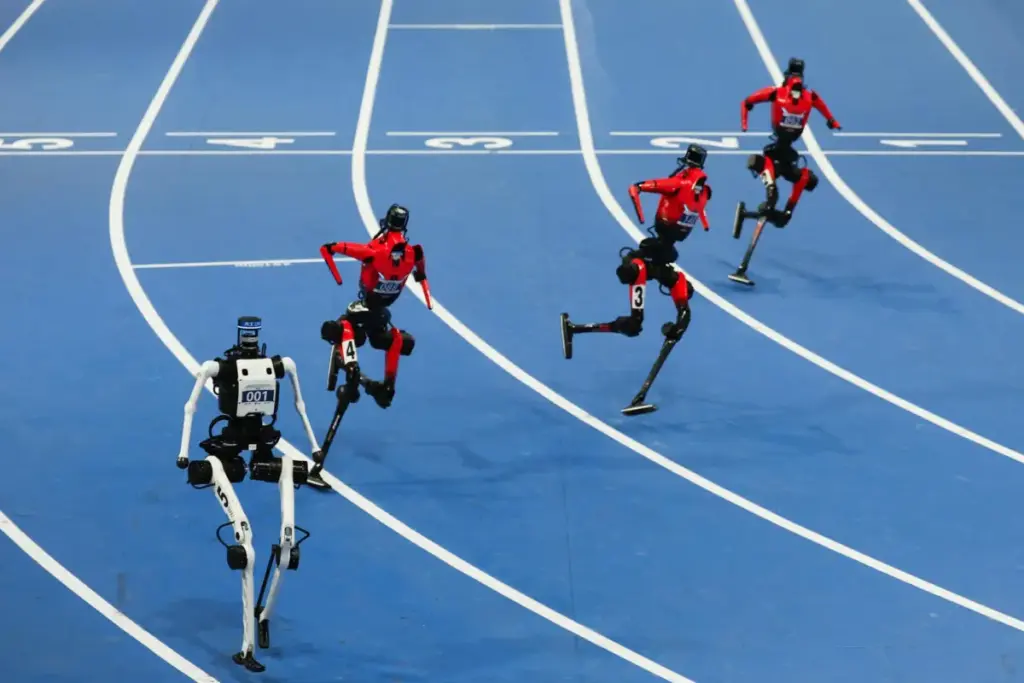
At the World Humanoid Robot Games, the boundaries separating human athleticism from robotic capabilities underwent a seismic shift. During a preliminary heat on a Saturday that will live in engineering infamy, the Tiangong Ultra—developed by the Beijing Humanoid Robot Innovation Center—blasted down the 100-meter straightaway in a blistering 9.39 seconds. Not to be outdone, Lightning, a rival bot engineered by Honor, crossed the finish line shortly after at 9.47 seconds. Both machines comfortably outperformed the time that Bolt set at the World Athletics Championships in Berlin back in 2009.
Yet, the shattering of the 100-meter record was merely a warm-up act. In the grueling 400-meter event, the Tiangong Ultra annihilated Wayde van Niekerk’s 2016 human world record of 43.03 seconds by clocking a jaw-dropping 38.16 seconds.
These events are the marquee highlights of the World Humanoid Robot Games, an annual tournament often dubbed the "Robot Olympics." Established to push the absolute limits of bipedal mobility, balance, and mechanical resilience, the competition has grown exponentially. This year’s games feature a staggering 2,056 robots representing 16 nations, competing across diverse and demanding disciplines ranging from high-speed sprinting and long-distance jumping to complex team sports like football and high-impact combat like boxing.
However, transitioning from theoretical laboratory mobility to explosive, high-speed athleticism is not without its casualties. Unlike their human counterparts, who celebrate victory laps and wave to adoring crowds, these sprinting automata often meet a dramatic, mechanical end. Unable to decelerate effectively once they cross the finish line, several record-setting bots have been captured on video violently colliding with cushioned arena walls at terminal velocities. The resulting spectacles—where shattered titanium frames, detached limbs, and pulverized circuit boards are unceremoniously scooped up and carried off on stretchers—offer a visceral, slightly unsettling glimpse into the realities of rapid technological evolution.
Detailed Chronology of the Event
The path to breaking some of athletics’ most revered records did not happen overnight; it was the culmination of meticulous engineering trials, intensive calibration sessions, and high-stakes preliminary heats within the massive, climate-controlled stadium in Beijing.
The Buildup and Preliminary Heats
As the tournament opened, spectators and robotics engineers alike anticipated incremental improvements in bipedal navigation. Traditional humanoid robots have long struggled with the complex physics of running. Unlike walking, which allows a robot to maintain a continuous center of mass within its support polygon, running is essentially a series of controlled falls—a flight phase where both feet leave the ground, followed by high-impact landing and immediate weight redistribution.
During the early morning sessions of the sprinting qualifiers, teams from various technological institutes ran diagnostic tests. The track surface was specially modified with high-traction, shock-absorbing synthetic polymer designed to maximize grip while minimizing the vibrational shock that can rattle delicate internal LiDAR sensors and gyroscope arrays.
The 100-Meter Shockwave
By mid-afternoon, the arena filled with a palpable sense of anticipation as the premier class of full-sized humanoid robots lined up at the starting blocks. When the electronic starting pistol fired, the visual spectacle was jarring. Eschewing the fluid, graceful form of human runners, the bots deployed rigid, hyper-calculated mechanical strides, their hip actuators whining at maximum frequency as their foot assemblies hammered the track with astonishing cadence.
The Tiangong Ultra immediately established dominance. Maintaining an upright, rigid torso that minimized aerodynamic drag through a specialized carbon-fiber chassis, it tore through the first 50 meters with rapid-fire footwork. As it surged across the finish line, the stadium scoreboard flashed the official time: 9.39 seconds.
Moments later, Honor’s Lightning crossed at 9.47 seconds, solidifying what industry insiders instantly recognized as a watershed moment for robotics. For the first time in history, commercially and industrially developed bipedal machines had outrun the fastest human being to ever live.
The 400-Meter Endurance and Debris Field
Later in the weekend, the grueling 400-meter test pushed thermal management systems and battery architectures to their absolute limits. While human runners must battle the accumulation of lactic acid, robots face a different biological equivalent: catastrophic thermal throttling and mechanical fatigue.
The Tiangong Ultra took an early lead, maintaining an unsustainable velocity that would have torn human muscle fibers within seconds. Maintaining its blistering pace through the bends and the final straight, it stopped the clock at 38.16 seconds—shaving nearly five full seconds off Wayde van Niekerk’s legendary 2016 record.
However, the laws of momentum proved unforgiving. Designed purely for maximum forward acceleration without proportional braking algorithms, the machine failed to slow down in time. It plowed straight into the arena’s reinforced, padded deceleration barrier at an estimated speed of nearly 25 miles per hour. The kinetic energy was catastrophic; limbs sheared off, and internal chassis components scattered across the track, transforming the triumphant victor into a heap of expensive scrap metal that required immediate extraction via stretcher.
Supporting Context & Metrics
To truly comprehend the magnitude of what occurred in Beijing, one must analyze the technological ecosystem that enabled these machines to surpass human biology. The World Humanoid Robot Games are far more than a sideshow spectacle; they serve as an aggressive, real-world stress test for technologies that will soon permeate industrial, commercial, and domestic spaces.

The Engineering Behind the Speed
| Metric / Parameter | Usain Bolt (Human Benchmark) | Tiangong Ultra (Robot Benchmark) | Lightning (Robot Benchmark) |
|---|---|---|---|
| 100-Meter Time | 9.58 seconds (2009) | 9.39 seconds | 9.47 seconds |
| 400-Meter Time | 43.03 seconds (2016) | 38.16 seconds | Did Not Qualify / DNF |
| Locomotion Type | Biological Muscle & Skeletal System | Electric Actuators & Bipedal Servos | Electric Actuators & Bipedal Servos |
| Peak Speed | ~27.78 mph (44.72 km/h) | ~29.15 mph (46.91 km/h) | ~28.82 mph (46.38 km/h) |
| Post-Race Status | Celebratory Victory Lap | Catastrophic Wall Collision | Minor Actuator Overheating |
Achieving these velocities required breakthroughs in three critical domains:
- Actuator Torque and Power Density: Traditional electric motors were far too heavy and weak to execute high-speed running. The robots in Beijing utilized newly developed rare-earth magnetic actuators capable of delivering instantaneous torque spikes without melting their copper windings.
- Real-Time Edge Computing: Running bipedal robots cannot rely on cloud computing due to latency. Every millisecond, onboard microprocessors running advanced neural networks must process terabytes of sensor data—adjusting joint angles, foot pressure distribution, and balance vectors on the fly.
- Material Science: To achieve high speeds, weight must be minimized while structural rigidity is maximized. The integration of aerospace-grade carbon-fiber composites and magnesium-lithium alloys allowed these frames to withstand the punishing G-forces generated during high-speed directional changes.
The Market Map and Commercial Implications
Market analysts tracking the World Humanoid Robot Games point out that these events function as a high-visibility "market map." According to industry reports from firms like Forbes, the transition from static factory robots to dynamic, mobile humanoids represents a multi-trillion-dollar economic frontier.
When a company like the Beijing Humanoid Robot Innovation Center or Honor showcases a robot capable of running at nearly 30 miles per hour, they are signaling dominance in foundational capabilities:
- Dynamic Stability: Essential for robots operating in chaotic, unstructured human environments like disaster zones, construction sites, and uneven terrain.
- Energy Management: High-speed sprinting stress-tests battery discharge curves, paving the way for longer-lasting commercial units.
- Reflexive Computing: The rapid-fire decision-making required to stay upright while running translates directly to emergency obstacle avoidance in commercial warehouses and public spaces.
Official Statements and Industry Reactions
The unprecedented shattering of human athletic records by bipedal machines has elicited a complex mixture of awe, existential reflection, and tactical optimism from the global scientific and athletic communities.
Dr. Aris Thorne, a leading biomechanics researcher at the International Institute of Robotics, noted the profound nature of the shift:
"For decades, we viewed human athleticism as the gold standard of dynamic physical interaction. What we witnessed in Beijing proves that mechanical systems are no longer bound by the biological limitations of muscle fiber recruitment, oxygen transport, and lactic acid accumulation. We are entering an era where machines can iterate, adapt, and execute physical tasks with a raw efficiency that biological evolution simply could not optimize for absolute speed."
Representatives from the Beijing Humanoid Robot Innovation Center released a joint statement emphasizing that while speed records capture public imagination, the true victory lies in durability and control:
"The performance of the Tiangong Ultra validates our years of research into high-frequency torque control and adaptive neural-network balancing. While the high-speed collisions highlight the ongoing challenge of kinetic energy management and deceleration physics, the data gathered from these runs will be instrumental in making our future commercial platforms safer, more resilient, and ultimately more capable of integrating into complex human environments."
Athletic federations have also taken note. While human track-and-field records remain strictly partitioned by biological classification, sports scientists are increasingly looking to robotics events to understand the theoretical limits of terrestrial locomotion. Some engineers jokingly suggest establishing a combined exhibition where elite human sprinters race alongside autonomous pacemakers—though the current risk of high-speed mechanical debris might make human participants think twice before stepping into the same lane.
Future Outlook: What Lies Ahead for Bipedal Robotics
As the dust settles on the track in Beijing and engineers sweep up the remnants of shattered titanium chassis, the broader implications of the World Humanoid Robot Games begin to crystallize. The event has fundamentally altered the timeline for what society expects from humanoid robotics.
1. Solving the Deceleration Paradox
The most pressing engineering takeaway from this year’s games is not how fast these robots can run, but how safely they can stop. The dramatic crashes into arena walls underscore a critical blind spot in current bipedal locomotion algorithms: forward propulsion has vastly outpaced braking intelligence. Future iterations slated for the 2027 games will likely feature advanced regenerative braking systems, reverse-torque damping, and predictive stopping mechanisms inspired by predatory biological models like cheetahs, which utilize flexible spines and specialized claws to anchor themselves at high speeds.
2. Transitioning from the Track to the Real World
While sprinting at 29 miles per hour makes for incredible headlines and viral video clips, the real-world utility of a 400-meter-champion robot lies in its underlying robustness. The algorithms developed to keep the Tiangong Ultra upright during high-velocity straights will be immediately repurposed for utilitarian applications:
- Logistics and Warehousing: Navigating sprawling fulfillment centers at high speeds to drastically reduce fulfillment times.
- Emergency Services: First-responder bots capable of sprinting through burning buildings or unstable disaster zones to extract victims.
- Exploration: Traversing harsh, extraterrestrial landscapes where wheeled rovers inevitably get stuck.
3. The Cultural and Ethical Horizon
As machines encroach further into domains once thought exclusively reserved for human mastery—art, chess, strategy games, and now raw athletic supremacy—our cultural relationship with technology continues to evolve. The spectacle of a multi-million-dollar robot destroying itself simply to shave a few tenths of a second off a running record serves as both a testament to human ingenuity and a sobering reminder of our own biological vulnerabilities.
Ultimately, the World Humanoid Robot Games have proven that the future of mobility is electric, bipedal, and relentlessly fast. Whether humanity is ready to share the finish line with silicon sprinters is no longer a hypothetical question—the robots are already here, and they are setting the pace.