The Evolution of Dual-Screen Emulation: Inside Yoniq’s High-Stakes Entry Into the Retro Handheld Market
Executive Overview
The retro handheld emulation market—traditionally known for scrappy, grassroots startup projects born on enthusiast forums—is experiencing a seismic shift. For years, the industry has grown organically, starting as labor-of-love passion projects built by one or two dedicated tinkerers who slowly built communities, iterated on designs, and eventually achieved mainstream success. However, the landscape is shifting dramatically with the arrival of a heavily backed, ambitious newcomer: Yoniq.
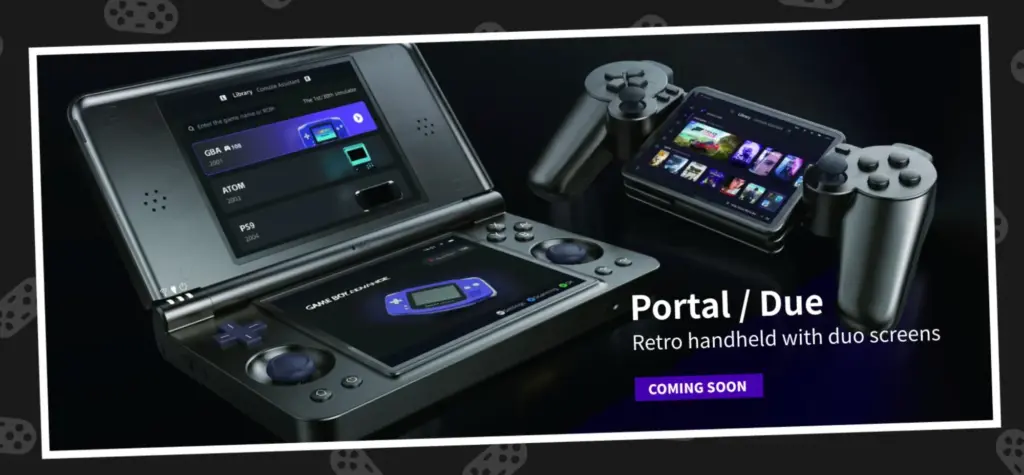
Yoniq has formally announced its debut in the portable emulation scene with a striking new piece of hardware, the Yoniq Duo Dual-Screen Handheld. Eschewing the typical crowdfunding roots of most startups, Yoniq enters the arena with substantial financial backing, an established manufacturing lineage valued at over $50 million USD, and an aggressive rollout strategy that includes a physical presence at Gamescom 2024 in Cologne, Germany.
Promising a high-definition dual-screen design equipped with 4x pixel-perfect scaling and a built-in physical stylus, the Yoniq Duo aims to solve one of emulation’s trickiest challenges: authentically replicating the distinct, interactive ergonomics of classic dual-screen handhelds like the Nintendo DS and Nintendo 3DS. Beneath the hardware lies Pantas, a proprietary open-platform ecosystem designed to unify save states, game libraries, and cross-device synchronization.
While skepticism is natural in an industry frequently flooded with unverified vaporware and low-quality clones, Yoniq’s heavy corporate backing, supply chain maturity, and upcoming Gamescom debut suggest that this is a project built to disrupt the status quo. This comprehensive report breaks down everything we know so far about the Yoniq Duo, its proprietary software ecosystem, its industrial pedigree, and what this means for the future of retro gaming.
Detailed Chronology: From Cold Email to Gamescom Debut
The Initial Contact
The story of the Yoniq Duo began quietly—and somewhat suspiciously—in the inbox of industry insiders. Like many tech journalists and retro gaming reviewers, editors at leading emulation outlets receive a constant stream of speculative pitches regarding "revolutionary new handhelds." When an unfamiliar company named Yoniq first made contact via email, initial impressions leaned heavily toward dismissal as spam.
However, a deeper investigation into the sender’s credentials quickly shifted the narrative. Unlike typical fly-by-night operations that rely on generic digital mockups and disappear after a failed crowdfunding campaign, Yoniq revealed concrete plans to exhibit their hardware at Gamescom, Europe’s largest and most influential interactive gaming trade fair held annually in Cologne, Germany. Securing a physical booth at an event of this magnitude requires significant financial investment, logistical planning, and corporate accountability—elements rarely seen from rookie emulation startups.
Unveiling the Yoniq Duo
Following the initial outreach, Yoniq shared the first official promotional assets and a brief product statement outlining the philosophy behind their maiden device.
The statement read:
"The Yoniq Duo Dual-Screen Handheld is a high-definition dual-screen design with 4× pixel-perfect scaling and a built-in physical stylus, recreating the interaction of classic dual-screen handhelds. It combines retro charm with modern technology, allowing players to rediscover the authentic dual-screen experience in a contemporary form."
While full technical specifications remain tightly under wraps, the accompanying press render offered a wealth of visual clues regarding the device’s design language.
Visual Analysis of the Prototype
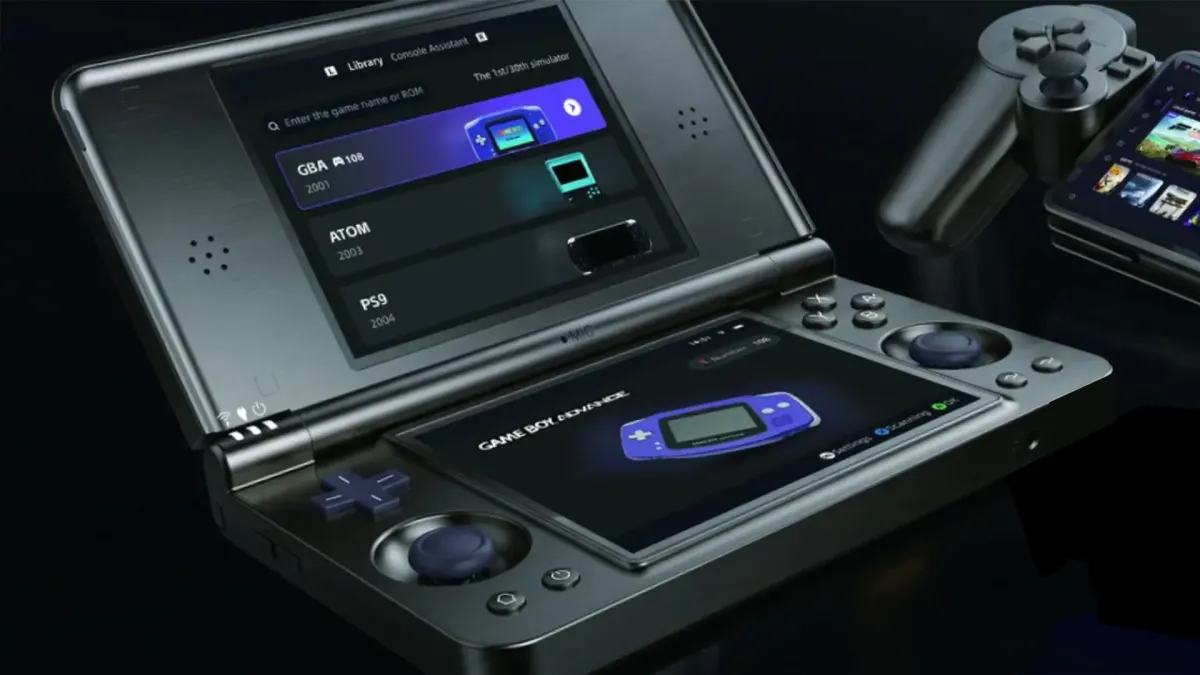
A close examination of the single available press image reveals a sleek, contemporary aesthetic that borrows structural cues from modern vertical and clamshell handhelds while carving out its own identity.
- Chassis & Form Factor: The device features a clean, matte finish with ergonomic contours, slender bezels surrounding both displays, and crisp color-accented action buttons and analog sticks.
- Control Layout: Dual joysticks flank the lower control deck, accompanied by standard directional pads and face buttons, ensuring modern compatibility alongside retro titles.
- Connectivity & Audio: A modern USB-C port is visible along the chassis, complemented by front-facing stereo speakers designed to deliver clean audio without obstruction during handheld play.
- The Built-In Stylus: Hidden neatly within the casing is a physical stylus—a crucial inclusion for emulating touch-screen-heavy platforms.
- The "PS9" Easter Egg: Eagle-eyed observers scrutinizing the screen render spotted the placeholder text "PS9" displayed on the interface, confirming that the initial imagery is derived from an early-stage development mockup rather than a final production unit.
Despite the early nature of the mockup, Yoniq has officially invited press and community members to inspect working or advanced prototype units in person at Gamescom (Hall 10.1, Booth C-052G).
Supporting Context & Metrics: Decoding the Hardware and Software
Understanding 4× Pixel-Perfect Scaling
One of the most revealing technical hints dropped in Yoniq’s initial brief is the inclusion of "4× pixel-perfect scaling." In the context of retro handheld development, this metric provides valuable insight into the target screen resolution and emulation fidelity.
Classic retro handhelds like the Game Boy Advance natively run at a resolution of 240×160. Applying an integer 4× scale yields a clean 960×640 display. Similarly, dual-screen systems like the Nintendo DS utilize a native resolution of 256×192 per screen; a 4× integer scale translates precisely to a 1024×768 resolution.
By prioritizing pixel-perfect integer scaling rather than arbitrary stretching, Yoniq is signaling to purists that games will be rendered with razor-sharp pixels, avoiding the shimmering artifacts and scaling distortion common on cheap, mismatched panels. Whether the Duo opts for a custom dual-panel layout or a unique single tall screen masked by software, the emphasis on scaling underscores a design philosophy tailored specifically to retro enthusiasts.
The Stylus Factor: Bridging the Emulation Gap
Emulating touch-based systems like the Nintendo DS on traditional single-screen or non-touch handhelds has historically required awkward workarounds—mapping a joystick to an on-screen cursor or forcing players to awkwardly tap capacitive phone screens.
By integrating a dedicated, physical stylus directly into the hardware architecture, Yoniq is addressing a long-standing pain point in the emulation community. Titles that heavily rely on touch mechanics—such as The Legend of Zelda: Phantom Hourglass, The World Ends With You, and Brain Age—finally have a purpose-built hardware home outside of original Nintendo hardware.
Pantas: The Open Gaming Ecosystem
Hardware is only half the battle in modern emulation; software architecture dictates the long-term viability of any portable gaming device. At the core of Yoniq’s broader hardware strategy is Pantas—a proprietary, open-platform ecosystem that extends far beyond a simple user interface.
Pantas functions as a tripartite system comprising:
- A Custom Operating System: Tailored for low-latency performance and rapid boot times across Yoniq-certified hardware.
- A Unified Game Launcher: A centralized hub designed to aggregate, organize, and launch retro libraries seamlessly.
- Pantas Bridge: The underlying networking infrastructure designed to facilitate cross-platform synchronization.
According to company disclosures, Pantas Bridge acts as a connective tissue linking smartphones, personal computers, living room set-top boxes, and dedicated handheld consoles into a single cohesive ecosystem. Users can theoretically manage their ROM libraries across multiple devices, synchronize save states in real-time, and transition from playing a game on their desktop PC to continuing their session on the Yoniq Duo without missing a beat.
While terms like "ecosystem" are frequently thrown around by tech startups, the true test of Pantas will lie in its openness, resource efficiency, and community adoption rate. If Yoniq provides developer hooks and supports open-source emulation cores, Pantas could evolve into a formidable competitor to established frontends like EmulationStation and Daijishō.
Official Statements & Corporate Background: Who is Yoniq?
Manufacturing Muscle and Financial Backing
The primary reason the retro emulation community is taking Yoniq seriously—despite its status as a newcomer—lies in its corporate lineage. The modern retro handheld landscape is littered with crowdfunded projects that suffered catastrophic delays, supply chain failures, or outright insolvency due to a lack of manufacturing experience.
Yoniq bypasses these startup pitfalls through established industrial roots. Representatives for the company have confirmed that Yoniq is backed by a massive enterprise based in China valued at over $50 million USD. This parent organization has a proven track record of collaborating with over 500 gaming brands and maintains deep, direct ties to one of China’s leading gaming-accessory manufacturers.
This existing supply chain infrastructure completely alters the risk profile of the Yoniq Duo. Rather than scrambling to source cheap components or negotiate factory minimums from scratch, Yoniq commands the purchasing power and production capacity required to manufacture complex dual-screen hardware at an accessible consumer price point.
Furthermore, this industrial maturity helps insulate the brand from the "cheap TEMU handheld" stigma that plagues digital marketplaces with poorly assembled, unoptimized clones. By leveraging professional manufacturing standards, Yoniq aims to deliver a premium fit and finish that rivals established enthusiast brands like Anbernic, Retroid, and Ayaneo.
Future Outlook: What the Yoniq Duo Means for Retro Gaming
The introduction of the Yoniq Duo marks a fascinating turning point for the retro handheld community. As emulation hardware matures from a niche hobby into a multi-million-dollar industry, the entry of well-capitalized, professionally manufactured hardware manufacturers is inevitable.
However, corporate backing alone does not guarantee success in a market driven by passionate, vocal communities. Enthusiasts demand transparency, open-source compliance, robust driver support, and competitive pricing. If Yoniq can deliver on the hardware promises made in their preliminary briefings—accurate 4x scaling, reliable dual-screen ergonomics, a responsive physical stylus, and a functional Pantas ecosystem—they could carve out an entirely new hardware category for dual-screen emulation.
The immediate crucible for Yoniq will be its debut at Gamescom 2024. By placing working hardware directly into the hands of journalists, reviewers, and veteran gamers at Hall 10.1, Booth C-052G, the company is inviting immediate, unvarnished scrutiny.
As the retro gaming world watches closely, the Yoniq Duo represents more than just a new handheld; it is a litmus test for whether corporate scale and manufacturing muscle can successfully merge with the nostalgic heart of classic emulation.