
The Evolution of Fan-Driven MMOs: Inside the Phenomenon of PokeMMO and the Rise of Retro-Handheld Ergonomics
Executive Overview
The intersection of classic handheld nostalgia and modern emulation hardware has birthed an underground software ecosystem that continues to push the boundaries of community-driven game development. In an era dominated by live-service giants and microtransaction-laden mobile titles, a persistent, fan-engineered marvel called PokeMMO has captured the attention of handheld enthusiasts and retro purists alike. Operating quietly in the legal and technical shadows for over a decade, PokeMMO seamlessly binds five distinct generations of Nintendo’s flagship franchise—spanning Red, Green, Blue roots to the Nintendo DS era—into a single, cohesive, and continuously populated massively multiplayer online universe.
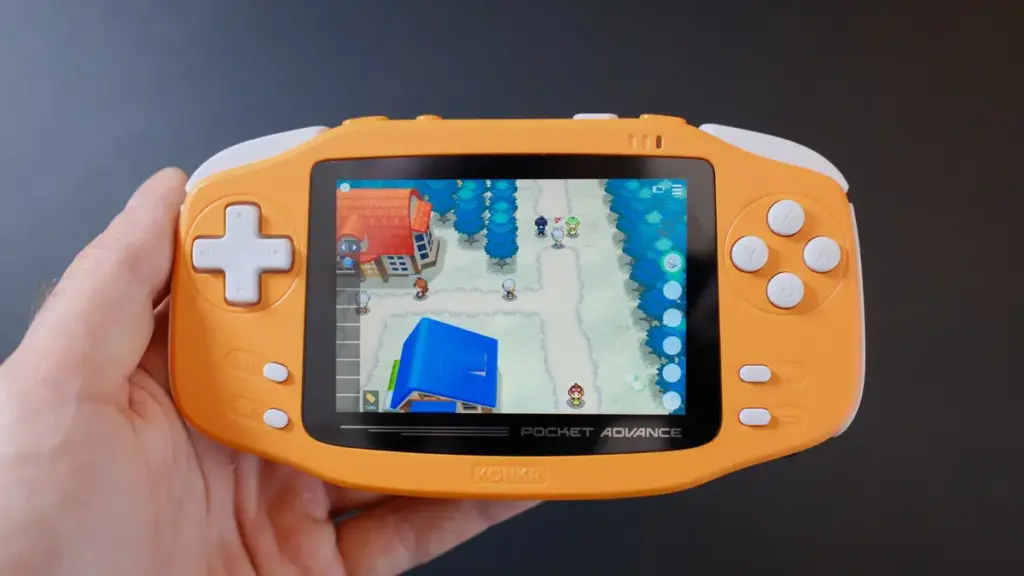
The rediscovery of this title often occurs serendipitously. Recently, during routine hardware evaluations of the striking, vibrant-orange KONKR Pocket Advance—a specialized emulation device whose form factor directly echoes Nintendo’s iconic 2001 handheld—reviewers stumbled upon the platform. The synergy between a device built explicitly to replicate the tactile joy of classic cartridge-based gaming and a software suite that transforms antiquated single-player ROMs into a shared MMO space highlights a profound shift in how players consume retro media.
This in-depth investigative report examines the mechanics, architectural wizardry, community-driven economy, and legal tightrope walk defining PokeMMO. Furthermore, it evaluates the broader hardware renaissance—exemplified by devices like the KONKR Pocket Advance—that makes experiencing such ambitious passion projects more immersive than ever before.
Detailed Chronology: From Underground ROM Hacks to a Unified Ecosystem
To understand the sheer technical audacity of PokeMMO, one must trace the evolutionary timeline of Pokémon rom-hacking and multiplayer emulation, a subculture that has spent decades breaking down the barriers of proprietary code.
The Early Days of Emulation and Link Cables (2000–2010)
In the nascent days of internet-based gaming, playing Pokémon with friends across the globe was a fever dream. The Game Boy and Game Boy Advance relied strictly on physical hardware accessories—the Game Link Cable—limiting multiplayer interactions to local proximity. As PC-based emulators like Visual Boy Advance matured in the early 2000s, developers introduced rudimentary local networking features. Enthusiasts could theoretically trade and battle across local area networks (LANs) or via early IP-tunneling software, but the experience was fraught with desyncs, complex configuration hurdles, and an absolute ceiling of two-player limitations.
Concurrently, the ROM-hacking community began disassembling game cartridges. Pioneers injected custom maps, altered type charts, and boosted difficulty curves. Yet, these projects remained strictly single-player experiences constrained by the original engine’s limitations.
The Birth of PokeMMO (2012)
Recognizing the untapped potential of a shared-world Pokémon experience, a collective of anonymous programmers and reverse-engineers launched PokeMMO in early 2012. Eschewing the traditional route of distributing a modified ROM file, the creators engineered a proprietary client wrapper.
The core innovation of PokeMMO was its reliance on legitimate, user-sourced ROMs combined with a heavy-duty server-side framework. Instead of downloading a pre-packaged, pirated game file, users pointed the PokeMMO launcher to specific, legally gray or self-extracted ROMs of foundational titles: Pokémon FireRed/LeafGreen, Pokémon Emerald, Pokémon Platinum, and eventually, Pokémon Black/White.
By running these titles concurrently through a unified client, the developers achieved the impossible: hundreds of players walking through the tall grass of Kanto, Hoenn, Sinnoh, and Unova simultaneously, seeing real avatars, chatting in real-time, and engaging in fluid player-versus-player (PvP) matches.
Expansion and Modernization (2015–Present)
Over the past decade, PokeMMO has evolved from a fragile novelty into a robust, highly polished platform. The developers systematically integrated additional generations, refined the economy, introduced seasonal events, and instituted cross-platform play encompassing Windows, macOS, Linux, Android, and various mobile-adjacent handheld operating systems.
Today, the project operates with the logistical sophistication of an indie studio, featuring automated anti-cheat protocols, regular balance patches that meticulously adjust abilities and move pools to match modern competitive standards, and a sprawling, player-driven economy that rivals traditional MMORPGs like Runescape or World of Warcraft.
Supporting Context & Metrics: The Architecture of a Fan-Made Giant
Operating an MMORPG based on intellectual property (IP) owned by one of the most litigious corporations in entertainment requires a unique architectural approach. PokeMMO does not technically distribute copyrighted Nintendo software; rather, it provides the bridge and the server architecture that allows user-owned assets to function collectively.
Technical Breakdown: How It Works
When a user launches PokeMMO, the client verifies the cryptographic checksums (MD5 hashes) of specific legitimate ROM files provided by the player. If the files match approved versions of FireRed, Emerald, Platinum, or Black/White, the client unlocks the respective region’s content.
Behind the scenes, the server-side infrastructure handles:
- Persistent World States: Managing thousands of concurrent avatars across multiple regional servers.
- Matchmaking & Ranking: Powering automated matchmaking queues for single battles, double battles, and specialized tournament formats with Elo-based ranking systems.
- The Global Link Market (GTM): A centralized auction house where players buy, sell, and trade Pokémon (with varying IVs, natures, and egg moves), held items, vanity items, and evolutionary stones.
Quantitative Metrics of the Ecosystem
While the project maintains a decentralized and privacy-focused profile, community metrics reveal a staggering scale of engagement:

- Generations Integrated: 5 full regional iterations (Kanto, Hoenn, Sinnoh, Unova, alongside Johto elements mapped through HeartGold/SoulSilver frameworks).
- Active Concurrent Users: Peak daily active users regularly cross tens of thousands across global servers, with distinct community hubs forming around specific regions.
- Economic Velocity: Millions of in-game PokeDollars change hands daily via the Global Trade Market, driven by hardcore "brewing" communities that spend dozens of hours breeding optimal competitive specimens.
The Handheld Hardware Renaissance
The resurgence of platforms like PokeMMO coincides with a golden age of retro emulation hardware. Devices designed to mimic legacy aesthetics while packing modern System-on-Chip (SoC) architectures have transformed how enthusiasts interact with portable gaming.
Take, for instance, the KONKR Pocket Advance in its striking, high-visibility orange colorway. Its industrial design deliberately evokes the horizontal ergonomics of Nintendo’s 2001 handheld, yet beneath the nostalgic shell lies a modernized Linux or Android-based environment capable of running complex emulation layers, streaming modern titles, and supporting native clients like PokeMMO.
+--------------------------------------------------------------------------+
|                     HARDWARE-SOFTWARE ECOSYSTEM SYNERGY                  |
+--------------------------------------------------------------------------+
|  [ KONKR Pocket Advance / Retro Handheld ]                               |
|        │                                                                 |
|        ├─► Ergonomic D-Pad & Tactile Face Buttons (Nostalgia Form Factor)|
|        ├─► Modern ARM Processor & Wi-Fi Connectivity                     |
|        │                                                                 |
|        ▼                                                                 |
|  [ PokeMMO Client Layer ]                                                |
|        │                                                                 |
|        ├─► Verifies User-Supplied ROMs (FireRed, Emerald, Platinum, etc.)|
|        └─► Connects to Secure MMORPG Server Clusters                     |
|                                                                          |
|        ▼                                                                 |
|  [ Persistent Multiplayer Experience ]                                   |
|        └─► Shared Overworlds, Global Markets, Real-Time PvP/Trading     |
+--------------------------------------------------------------------------+
When players experience PokeMMO on hardware specifically engineered for classic sprite-based navigation, the line between official Nintendo software and community innovation blurs entirely. The tactile snap of high-quality rubber membrane buttons paired with a vibrant, modern IPS screen elevates a PC-centric MMO into a true handheld evolution.
Official Statements and Industry Implications
The existence of PokeMMO occupies a fascinating space within the broader gaming industry, forcing observers to examine the boundaries between copyright enforcement, community preservation, and consumer demand.
The Legal Tightrope
Neither Nintendo nor The Pokémon Company has ever officially endorsed PokeMMO. Historically, major Japanese gaming conglomerates maintain zero-tolerance policies regarding unauthorized uses of their intellectual property, frequently deploying cease-and-desist orders against fan-made Pokémon MMOs, demakes, and multiplayer patches (notable examples including Pokémon Uranium or various indie conversion projects).
Legal analysts often point to PokeMMO’s clever distribution model as the primary reason it has managed to evade swift legal termination for over a decade. By refusing to host or distribute copyrighted ROM files directly—requiring the end-user to supply their own files—the developers construct a legal buffer similar to the defense utilized by early emulation pioneers. However, legal experts emphasize that this defense is precarious; the inclusion of monetized cosmetic items (vanity hats, mounts, and supporter perks) within the PokeMMO cash shop introduces commercial elements that could attract severe scrutiny under copyright law.
Industry Perspectives
Independent game developers frequently cite PokeMMO as an unexpected masterclass in live-service retention. By taking mechanically sound, beloved single-player role-playing games and injecting modern social architecture—guilds, global economies, cooperative PvE raids, and ranked competitive ladders—the creators solved a fundamental design problem: how to make turn-based monster-catching perpetually engaging.
An anonymous developer formerly associated with prominent mobile titles noted:
"What Nintendo and Game Freak failed to capitalize on for decades, a group of dedicated coders built in their spare time. Fans didn’t just want a new Pokémon game every three years with minor graphical updates; they wanted a living, breathing world where their investments in training and collecting retained permanent communal value. PokeMMO proved that the old engine frameworks can support modern MMO infrastructure if treated with respect."
Future Outlook: Where Do Retro MMOs Go From Here?
As we look toward the horizon of portable gaming and community-led software development, projects like PokeMMO and the hardware ecosystems supporting them are poised for significant maturation.
Technical and Content Expansion
The most persistent question within the PokeMMO community revolves around the integration of subsequent generations. While regions up to Unova (Generation 5) are fully realized with advanced sprite-to-3D environment mappings, fans frequently speculate on the feasibility of incorporating Kalos (Generation 6) and beyond. The technical hurdle shifts dramatically when transitioning from sprite-based grid movement to fully realized polygonal 3D engines (such as those introduced on the Nintendo 3DS). Yet, given the ingenuity demonstrated by the development team over the past twelve years, dismissing future generational leaps would be shortsighted.
Hardware Integration and Dedicated Ecosystems
The symbiotic relationship between bespoke handheld hardware—such as the KONKR Pocket Advance—and community software projects highlights an emerging market trend. Consumers are increasingly fatigued by locked-down, ecosystem-restricted mobile storefronts. They desire open, customizable platforms where they can run native emulators, community-run MMORPG clients, and independent software without arbitrary gatekeeping.
Manufacturers are taking note. Future handhelds are expected to feature enhanced Wi-Fi 6/7 stability, superior battery optimization for continuous online multiplayer sessions, and layouts meticulously tuned for both retro d-pad navigation and modern thumbstick control schemes.
Conclusion
PokeMMO remains an anomaly in modern gaming—a brilliant, precarious, and deeply addictive monument to fan dedication. By fusing the timeless charm of classic monster-taming adventures with the social infrastructure of an MMORPG, it achieves what official developers have often hesitated to attempt. Paired with modern retro-inspired hardware like the KONKR Pocket Advance, playing these games is no longer merely an exercise in nostalgia; it is a vibrant, living testament to the power of community-driven software preservation and innovation.
Whether it survives another decade under the radar or eventually faces the inevitable legal reckoning of intellectual property titans, PokeMMO has permanently altered our understanding of what classic games can become when placed in the hands of passionate creators.