Breakthrough on the Horizon? Noted Hacker TheFloW Discloses Critical PS5 Kernel Vulnerability Impacting Firmware up to 10.40
Executive Overview
The PlayStation 5 hacking community has spent years locked in a frustrating holding pattern, largely isolated to older, increasingly scarce firmware versions. However, a major development has injected a fresh wave of cautious optimism—and fierce debate—into the scene. Renowned security researcher and PlayStation hacker TheFloW has publicly disclosed a critical kernel vulnerability through the HackerOne bug bounty platform.
Initially submitted in December 2024, the vulnerability centers on a complex race condition within the sys_fsc2h_ctrl system call, potentially resulting in a kernel stack free. According to prominent scene analysts, this flaw impacts PlayStation 5 consoles running Firmware 10.40 and earlier, with Sony having patched the issue in subsequent software updates like Firmware 10.60.
While the disclosure lacks a ready-to-use Proof of Concept (PoC) exploit code, it represents the most significant movement for modern PS5 firmware security in recent memory. If compatible user-mode exploits can be discovered to pair with this kernel-level bug, it could eventually pave the way for a revolutionary jailbreak targeting devices far beyond the long-standing 7.61 firmware barrier.
Yet, the news has also reignited a contentious debate within the homebrew community. Prominent developers are urging users to temper their enthusiasm, questioning whether the bug can be successfully weaponized into a practical jailbreak. Furthermore, the reliance on corporate bug bounty platforms like HackerOne continues to divide the community, raising questions about ethics, control, and the future of independent console hacking.
Detailed Chronology: From HackerOne Submission to Public Disclosure
Understanding the weight of this disclosure requires examining the timeline of events leading up to the public release of the vulnerability report.

- December 14, 2024: TheFloW formally submits a vulnerability report to Sony via the HackerOne bug bounty platform, detailing a critical kernel stack free vulnerability within the
sys_fsc2h_ctrlsyscall. - January 23, 2025: Sony releases Firmware 10.60, quietly deploying a patch to remediate the vulnerability reported by TheFloW, effectively closing the security gap on newer console updates.
- April 18, 2025: Following standard disclosure protocols—and with the patch safely deployed on current system software—the vulnerability details are made public on HackerOne. Scene veteran Jose Coixao (known widely as Zecoxao) takes to social media to analyze the technical limits of the disclosure, confirming that Firmware 10.40 marks the upper threshold of vulnerable systems.
- Late April 2025: The homebrew community reacts. While everyday users celebrate the prospect of breaking past the 7.61 firmware wall, veteran developers express skepticism regarding the actual exploitability of the reported race condition, highlighting the steep hurdles required to transform a bug report into a functional jailbreak.
Technical Deep Dive: Inside the sys_fsc2h_ctrl Vulnerability
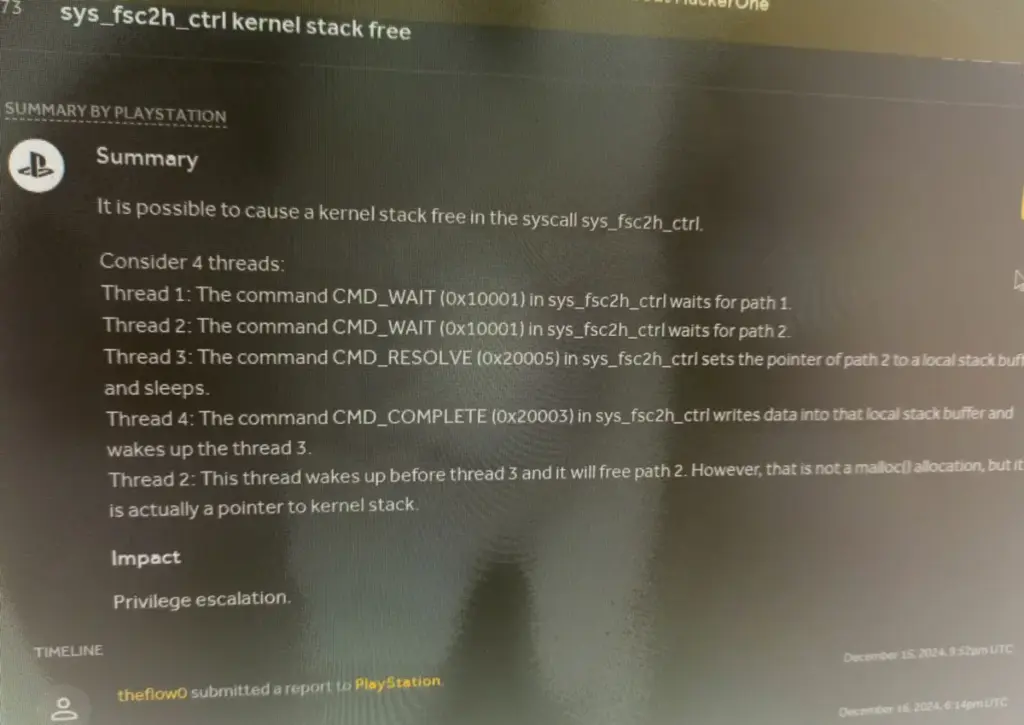
To appreciate why this vulnerability has caught the attention of security researchers, one must look at the mechanics of the bug itself as detailed in the HackerOne submission. The flaw is rooted in a multi-threaded race condition inside the sys_fsc2h_ctrl system call, specifically leading to a kernel stack free.
The vulnerability relies on the interaction of four distinct execution threads:
- Thread 1: Executes the command
CMD_WAIT(0x10001) withinsys_fsc2h_ctrl, actively waiting for path 1. - Thread 2: Executes the command
CMD_WAIT(0x10001) withinsys_fsc2h_ctrl, actively waiting for path 2. - Thread 3: Executes the command
CMD_RESOLVE(0x20005) withinsys_fsc2h_ctrl, which explicitly sets the pointer of path 2 to a local stack buffer and subsequently enters a sleep state. - Thread 4: Executes the command
CMD_COMPLETE(0x20003) withinsys_fsc2h_ctrl, writing data directly into that local stack buffer and waking up Thread 3.
The critical breakdown occurs when Thread 2 wakes up prematurely—before Thread 3 can properly handle its state. Upon waking, Thread 2 proceeds to free path 2. However, rather than freeing a safe heap allocation generated via standard memory management functions like malloc(), the system mistakenly treats a raw pointer to the kernel stack as the target for deallocation.
The Impact: Privilege Escalation
In cybersecurity terms, freeing a kernel stack pointer directly introduces catastrophic memory corruption risks, most notably Use-After-Free (UAF) conditions. If manipulated correctly by an attacker, this kind of primitive can allow arbitrary read and write capabilities within kernel memory, ultimately leading to privilege escalation—the holy grail for achieving full administrative control (jailbreaking) over the hardware.
Supporting Context & Metrics: The State of PlayStation Hacking
The Firmware Divide
For quite some time, the PlayStation 4 and PlayStation 5 security scenes have faced a rigid reality: successful jailbreaks and custom firmware solutions are heavily restricted to aging, un-updated software versions.

While recent months saw massive breakthroughs for firmware versions up to 7.61—thanks to the deployment of the umtx exploit and subsequent ports of etaHEN and ItemzFlow—users who updated past 7.61 found themselves entirely locked out of the homebrew ecosystem. The prospect of a kernel exploit stretching up to Firmware 10.40 represents a quantum leap, potentially bringing millions of newer consoles back into the fold.
The Bug Bounty Economics Dilemma
The disclosure via HackerOne has once again sparked fierce debates over the intersection of corporate security programs and independent homebrew preservation. Critics argue that utilizing platforms like HackerOne places the fate of public jailbreaks entirely at the mercy of corporate discretion. If Sony chooses not to disclose a bug, or if researchers are bound by corporate agreements, the public scene receives nothing.
However, pragmatists argue that platforms like HackerOne provide a vital financial and professional incentive that the homebrew community can never hope to match organically. Organizing crowd-funded campaigns to consistently raise $10,000 bounties for private security researchers is practically impossible. Historically, gathering even $1,000 for a promising exploit lead is an extraordinary challenge plagued by friction and legal gray areas. For professional researchers balancing careers and ethical boundaries, corporate bug bounties offer legitimate remuneration and professional "street cred" that community donations simply cannot replicate.
Expert Perspectives: Hope Versus Realism
Despite the excitement surrounding the HackerOne disclosure, prominent figures within the PlayStation development scene are counseling caution.
Tempering Expectations
Leading homebrew developer SpecterDev took to community channels to urge users to keep their expectations grounded. The existence of a bug report—even one that commands a $10,000 payout from Sony—does not automatically equate to a functioning jailbreak.

Sony’s security payout may simply reflect an acknowledgment of the bug’s theoretical severity rather than proof of an easy exploitation path. Kernel stack manipulation is notoriously difficult, requiring precision timing, advanced memory layout control, and reliable stabilization to prevent kernel panics (crashes).
The Road Ahead: Entry Points and Exploitation Chains
Even if a talented researcher manages to weaponize the sys_fsc2h_ctrl vulnerability into a robust kernel exploit, it is only half the battle. A kernel exploit alone cannot grant user access; it requires a matching user-mode entry point (such as a WebKit exploit or a browser-based vulnerability) on the targeted firmware versions (up to 10.40) to execute initial arbitrary code before the kernel exploit can elevate privileges.
Furthermore, speculation regarding TheFloW’s upcoming appearance at TyphoonCon 2025 has been met with realism. While conference talks by elite hackers are always closely watched, agenda previews suggest his presentation will focus more broadly on career retrospectives rather than dropping active, day-zero zero-day exploit chains for current-generation consoles.
Future Outlook: What’s Next for PS5 Homebrew?
As the dust settles on the initial HackerOne disclosure, the PlayStation 5 homebrew scene finds itself at a familiar crossroads.
- Analysis and Verification: Independent security researchers will undoubtedly spend the coming weeks analyzing the mechanics of the
sys_fsc2h_ctrlstack free. Determining whether the race condition can be reliably triggered outside of a theoretical environment is the primary objective. - The Search for User-Mode Entry Points: Developers will need to hunt for companion user-mode vulnerabilities on firmwares ranging from 7.62 up to 10.40 to establish the necessary execution chain.
- Community Patience: For everyday enthusiasts, the golden rule of the PlayStation scene remains unchanged: buy early, keep your console offline, and never update.
Whether TheFloW’s HackerOne disclosure blossoms into the next great milestone for console modding or remains an interesting theoretical exercise in memory corruption depends entirely on the ingenuity of the security community in the months ahead. For now, patience is the ultimate prerequisite.