The Evolution of Autonomous Maintenance: A Definitive Review of the Beatbot AquaSense X
Executive Overview
The landscape of residential property management is undergoing a quiet, highly calculated revolution. For decades, pool ownership has carried an undeniable asterisk: the arduous, recurrent labor of sanitation and debris management. Traditional robotic cleaners have long promised autonomy, yet they routinely stalled at the finish line, requiring human operators to haul heavy units from the water, manually strip down filters, and rinse out matted leaves and silt after every cycle.
Enter the Beatbot AquaSense X. Positioning itself at the bleeding edge of the smart-home ecosystem, this top-of-the-line system seeks to eliminate the final friction point of pool maintenance. More than merely an iteration of previous automated cleaners, the AquaSense X introduces a paradigm-shifting hardware component: a self-cleaning, automated charging and docking base. Supported by a robust suite of 29 onboard sensors, artificial intelligence-driven path mapping, and multi-zone targeting, the system is designed to operate with near-total independence.
Retailing at a standard MSRP of $4,250—though currently seeing targeted promotional discounts—the AquaSense X is unapologetically positioned in the luxury tier of smart-home technology. This comprehensive review examines the hardware, unboxing logistics, multi-layered setup procedure, real-world aquatic performance, and the transformative mechanics of its proprietary auto-emptying base to determine whether it justifies its premium price tag.
![Tested: Beatbot AquaSense X, the AI powered, self-cleaning pool robot [Video]](https://i0.wp.com/9to5toys.com/wp-content/uploads/sites/5/2026/08/Aquasense-x-hero.jpg?resize=1200%2C628&quality=82&strip=all&ssl=1)
Detailed Chronology: Unboxing, Assembly, and Setup
Deploying a flagship piece of consumer technology of this magnitude requires a deliberate, methodical approach. Unlike standard, plug-and-play pool cleaners, the AquaSense X arrives across two heavily insulated, systematically organized boxes, reflecting the dual nature of its hardware architecture: the submersible cleaning robot and the heavy-duty peripheral base station.
Box One: The Aquatic Vanguard
The primary package houses the core cleaning unit, finished in a matte, understated black that matches its dock. Upon opening, users are greeted with comprehensive literature, including a streamlined quick-start guide, an exhaustive manual, and a specialized retrieval hook. Also nestled within the protective foam are the modular brush strips—designed for easy snap-on installation—and a single-use water clarifier cartridge to condition the pool during initial deployment.
Beneath these accessories sits the familiar chassis of the robot itself, sharing a foundational design language with previous iterations in Beatbot’s catalog. The structural integrity of the packaging ensures zero transit degradation, a testament to the manufacturer’s supply-chain logistics.
![Tested: Beatbot AquaSense X, the AI powered, self-cleaning pool robot [Video]](https://9to5toys.com/wp-content/uploads/sites/5/2026/08/Aquasense-x-hero.jpg?quality=82&strip=all&w=1400)
Box Two: The Self-Cleaning Command Center
The secondary box introduces the technological differentiator: the self-cleaning base station. Secured alongside the base is an accessory compartment housing essential peripheral hardware, including heavy-duty plumbing hoses, a specialized faucet adapter, utility tools, and replacement debris collection bags.
The physical assembly of the base station, while straightforward, demands attention to detail. Users must mount the overhead self-cleaning spray nozzle arm onto the chassis. Removing a side panel reveals the internal plumbing architecture, where technicians must securely snap in the water inlet hose and clamp on the dedicated wastewater drainage line.
- Plumbing Considerations: While Beatbot includes a water “T” adapter designed to share an outdoor hose bib, initial testing revealed potential leakage points under high household water pressure. For immediate, leak-free deployment, connecting the unit directly to a dedicated outdoor spigot is recommended, leaving the splitting adapter for secondary optimization.
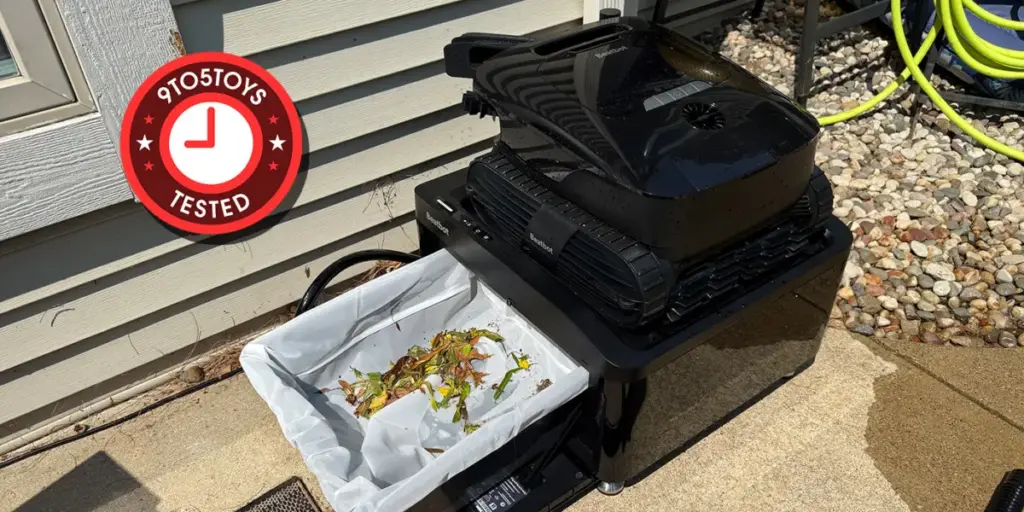
- Leveling and Integration: Because the base manages dynamic high-pressure water evacuation, it features an integrated bubble level to ensure structural stability on uneven patio surfaces. The internal debris basket slides out via a soft-touch side panel and can hold up to an astonishing two months of accumulated pool waste before requiring manual intervention—a massive qualitative leap for daily operations.
Software Integration and Network Pairing
With the physical hardware assembled and the robot placed on its charging terminal, the digital pairing sequence commences via the Beatbot companion application. The app instantly discovers the AquaSense X over local wireless protocols, synchronizing it to the user’s smart-home network.
![Tested: Beatbot AquaSense X, the AI powered, self-cleaning pool robot [Video]](https://9to5toys.com/wp-content/uploads/sites/5/2026/08/Aquasense-x-bar.jpg?quality=82&strip=all)
Initial setup requires a mandatory firmware installation, lasting approximately 20 minutes. Once updated, the app transforms into a comprehensive mission control dashboard. Users can initiate cleaning cycles, monitor active progress metrics, manually pilot the robot via remote-control inputs, and audit the consumption levels of water clarifiers and maintenance intervals.
Supporting Context & Metrics: Engineering and Performance
The technical specifications of the AquaSense X explain its commanding presence in the luxury market. Beneath its rugged exterior lies a sophisticated network of navigational intelligence and hydraulic engineering designed to tackle diverse pool environments.
Sensor Suite and Mapping Intelligence
The AquaSense X relies on a formidable array of 29 distinct environmental sensors, combining infrared proximity arrays, ultrasonic depth finders, and a high-definition AI optical camera. When submerged, the robot does not merely bounce blindly off pool walls; it actively constructs a real-time spatial map of the basin.
![Tested: Beatbot AquaSense X, the AI powered, self-cleaning pool robot [Video]](https://9to5toys.com/wp-content/uploads/sites/5/2026/08/Aquasense-x-haul.jpg?quality=82&strip=all)
This spatial awareness allows the unit to optimize its cleaning vectors dynamically, recognizing variations in pool construction—whether concrete, vinyl liner, fiberglass, or complex tile mosaics. Obstacles such as main drains, underwater stools, and irregular architectural features are identified and navigated in real time, preventing the system from becoming high-centered or trapped.
Comprehensive Cleaning Modes
Expanding upon previous models, the AquaSense X introduces specialized operational profiles tailored to complex backyard layouts:
- Standard Floor/Wall/Waterline Modes: Dedicated routines targeting specific surface zones to scrub algae and skim surface oils.
- Areas Mode: A user-customized targeting system allowing operators to isolate problem zones within the pool via the mobile application.
- AI Quick Mode: A rapid-deployment setting engineered for fast sediment and leaf removal from the pool floor prior to unexpected gatherings.
- Multi-Zone Mode: Designed specifically for pools featuring intricate architecture, such as shallow sun shelves, tanning ledges, and tiered entry steps.
Coverage and Endurance Metrics
- Surface Coverage: Capable of clearing nearly 3,900 square feet on a single charge.
- Battery Runtime: Operates continuously for 5 to 10 hours, with runtime varying based on the selected intensity mode and surface texture resistance.
- Retrieval Mechanics: If a cycle must be cut short, issuing a "Park" command via the mobile app causes the unit to autonomously moor itself at the waterline, presenting an ergonomic handle for straightforward lifting and rapid water drainage.
Official Statements and Industry Impact
Industry analysts tracking the smart-appliance sector have noted a distinct consumer shift toward total ecosystem automation. In official product releases, Beatbot engineers emphasized that the AquaSense X was conceptualized to address the "last mile" problem of robotic pool care.
![Tested: Beatbot AquaSense X, the AI powered, self-cleaning pool robot [Video]](https://9to5toys.com/wp-content/uploads/sites/5/2026/08/Aquasense-x-basket-front.jpg?quality=82&strip=all)
"While autonomous cleaners successfully removed the physical labor of scrubbing pool walls, they inadvertently created a new chore: cleaning out the slime, leaves, and particulate matter trapped inside the onboard filters after every single cycle," noted a lead product development representative for Beatbot. "By integrating a high-pressure, automated self-cleaning docking station that interfaces directly with household water and drainage lines, the AquaSense X bridges the gap between robotic navigation and true, hands-off property maintenance."
Market observers point out that while the $4,250 price tag restricts the AquaSense X to high-end residential segments, it establishes a new benchmark for what consumers should expect from premium automated maintenance devices. The transition from manual filter rinsing to a two-month maintenance cycle represents the kind of generational leap previously seen in the evolution of robotic indoor vacuum cleaners transitioning from manual bins to self-emptying disposal towers.
Future Outlook: The Trajectory of Automated Pool Maintenance
The introduction of self-cleaning docks to the robotic pool cleaner market signals a broader trajectory for outdoor automation. As artificial intelligence and sensor miniaturization become more cost-effective, features once exclusive to ultra-premium flagships like the AquaSense X will inevitably filter down into mid-tier consumer models.
![Tested: Beatbot AquaSense X, the AI powered, self-cleaning pool robot [Video]](https://9to5toys.com/wp-content/uploads/sites/5/2026/08/Aquasense-x-long.jpg?quality=82&strip=all)
However, the immediate future of high-end pool maintenance will likely focus on ecosystem integration. We can anticipate future iterations featuring deeper integration with smart-home automation protocols (such as Apple HomeKit, Google Home, and Amazon Alexa), automated chemical dispensing adjustments based on real-time water quality telemetry, and predictive maintenance algorithms that anticipate algae blooms before they manifest visually.
For property owners currently navigating the ecosystem, the Beatbot AquaSense X proves that complete, hands-off pool autonomy is no longer a theoretical concept—it is a commercially available reality. While the upfront investment is substantial, the elimination of daily filter maintenance and the precision of multi-zone AI mapping redefine the standard of modern outdoor living.