The Great Memory Crunch: How the AI Boom Undid Two Decades of RAM Price Declines in Months
Executive Overview
For decades, the trajectory of computer hardware seemed as immutable as the laws of physics. Thanks to relentless advancements in semiconductor manufacturing, miniaturization, and mass production, computer memory followed a predictable path: it grew exponentially faster while dropping precipitously in price. This continuous deflation turned RAM from an exclusive, high-cost enterprise luxury into a ubiquitous, inexpensive commodity found in everything from pocket calculators to high-end gaming rigs.
However, that historic era of affordability has come to a screeching halt. Driven by an insatiable, unprecedented global demand for High Bandwidth Memory (HBM) to fuel the generative artificial intelligence boom, the consumer electronics and PC hardware markets have been plunged into a full-scale crisis.
According to groundbreaking analysis by software performance expert, scientist, and GitHub developer Daniel Lemire, the astronomical rise in memory costs has effectively erased nearly 20 years of technological and economic progress in a matter of months. Modern RAM prices have reverted to levels not seen since the mid-to-late 2000s—a historical anomaly that industry veterans describe as entirely unprecedented.
As the shockwaves of this "memory apocalypse" spread far beyond custom PCs, disrupting supply chains for GPUs, budget smartphones, gaming consoles, and even the automotive industry, analysts and tech executives alike are sounding the alarm. With demand outstripping supply by staggering margins, the fundamental economics of the modern tech ecosystem are facing an unsustainable reckoning.
Detailed Chronology: Tracing the Collapse of Affordable Memory
To understand the severity of the current crisis, one must first look at the historical baseline that preceded it. Ever since the dawn of the digital computing era—highlighted by milestones like the launch of the ENIAC general-purpose digital computer 80 years ago—hardware economics have relied on a deflationary model.
In 1946, ENIAC cost the U.S. government roughly $400,000 (equivalent to nearly $6.85 million today adjusted for inflation) while delivering a modest computing capability of around 5,000 additions per second. To contextualize the scale of progress over the decades, a budget smartphone purchased today for under $100 packs a processor capable of executing 3.3 trillion operations per second (3.3 TOPS) thanks to integrated AI acceleration. This extraordinary curve of progress traditionally applied to all computer components, especially Dynamic Random-Access Memory (DRAM). Year after year, fabrication plants became more efficient, yields improved, and the cost per gigabyte of RAM dwindled to pennies.
Then came the artificial intelligence revolution.
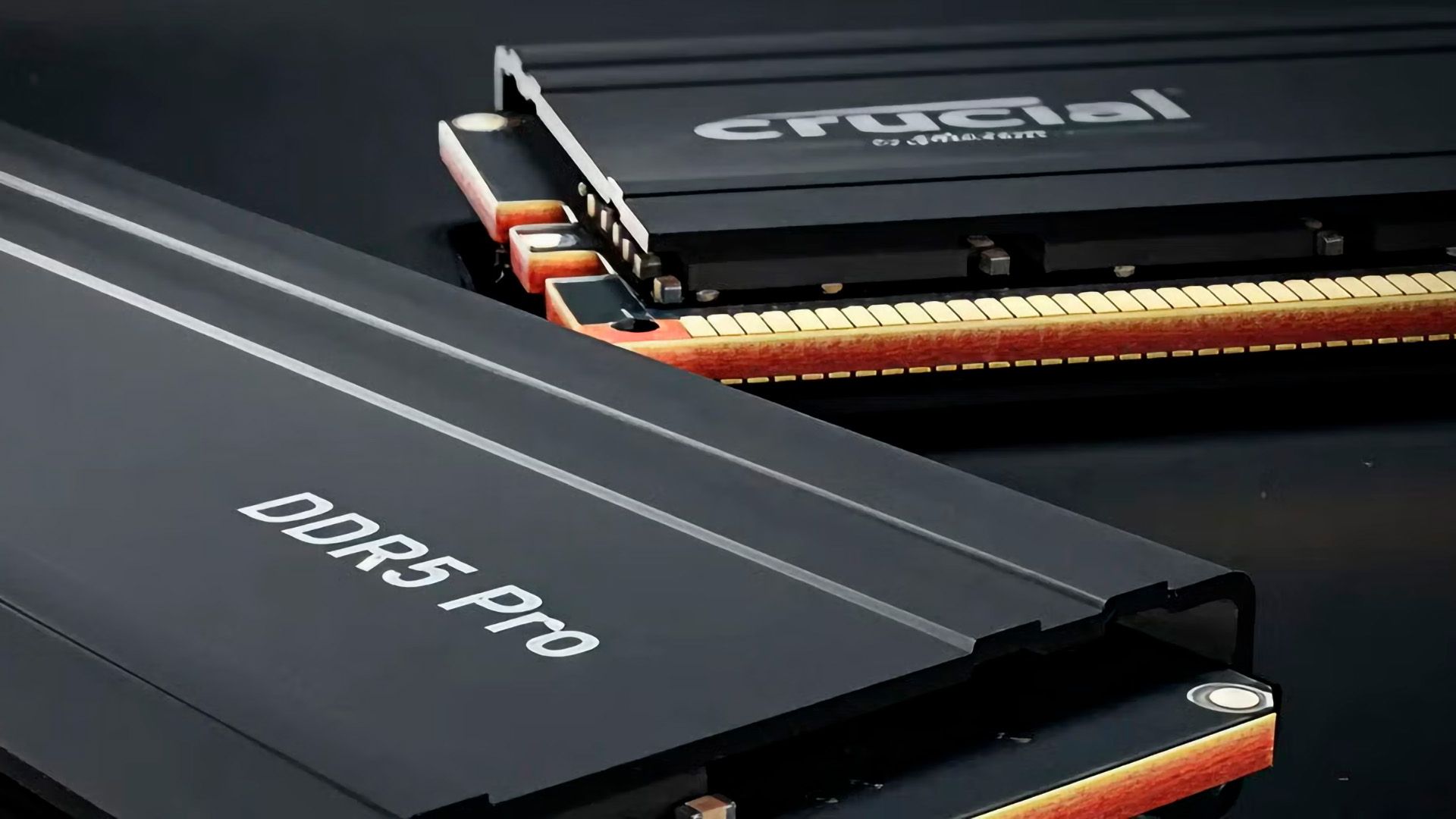
As hyperscalers, tech giants, and enterprise entities rushed to build, train, and deploy massive Large Language Models (LLMs), the hardware requirements shifted overnight. Training and running modern AI models demands immense computational throughput, which in turn relies heavily on specialized processors paired with ultra-fast, high-capacity memory solutions, primarily High Bandwidth Memory (HBM).
Unlike standard consumer DDR5 RAM, HBM requires intricate multi-die stacking and advanced packaging techniques that consume disproportionately large amounts of wafer capacity and fab resources. Because major semiconductor manufacturers—namely the industry’s "Big Three": Micron, Samsung, and SK hynix—pivoted their production lines aggressively toward profitable HBM and enterprise-grade server memory, consumer-facing DRAM lines were squeezed.
The result was a textbook supply-and-demand disaster. What began as early warning signs of tightness quickly snowballed into a severe market crunch. In a matter of months, structural manufacturing shifts wiped out decades of consistent consumer-side cost reductions, leaving the market grappling with a structural deficit that standard supply adjustments cannot easily fix.
Supporting Context & Metrics: Quantifying the "RAM Apocalypse"
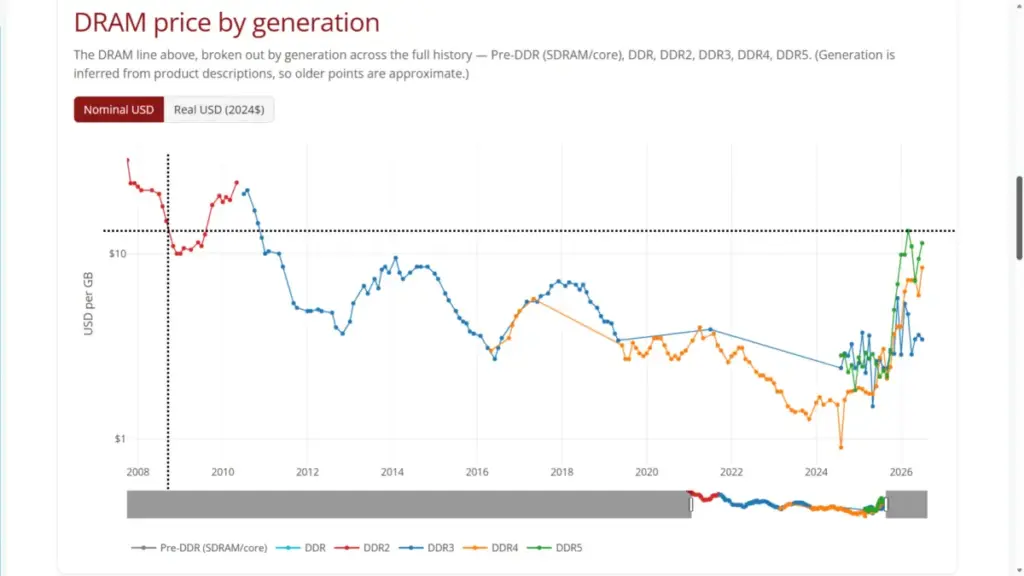
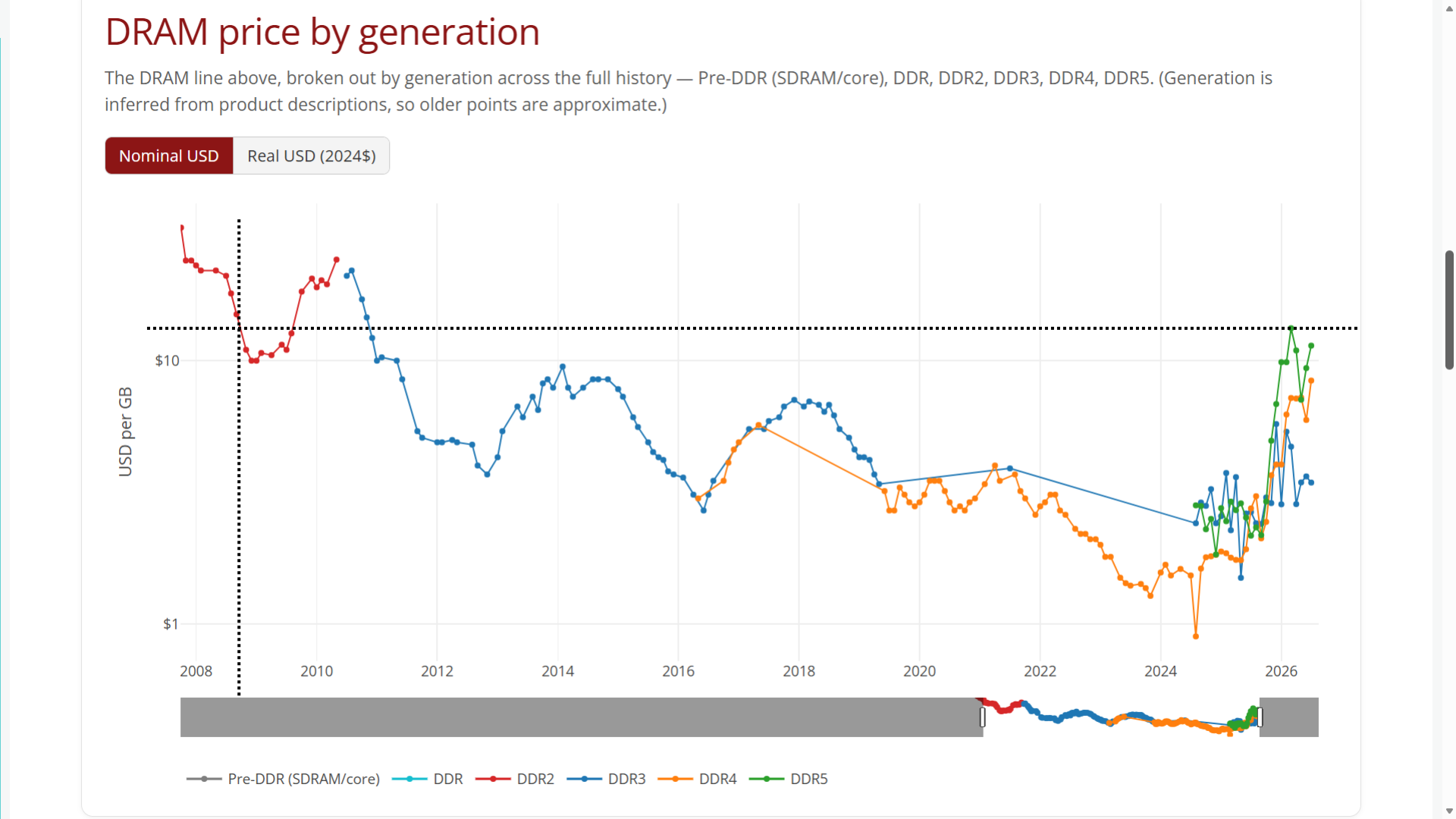
The empirical data backing up this market reversal is both staggering and sobering. In an analysis shared on social media platform X, Daniel Lemire pointed out a stark reality that has stunned economists and engineers alike: "On a historical basis, computer memory has been falling at an exponential rate for decades. But we just undid about 20 years of progress. RAM on a per unit basis is about as expensive as it was in 2007."
Independent verification through third-party pricing data compiled by David Shim for the Stanford DAM Project paints a similarly grim picture. Current market tracking shows the spot and retail price of modern DDR5 memory sitting between $11.41 and $13.28 per gigabyte. When examining nominal USD values, consumers have to look back to 2008—when aging DDR2 memory commanded $11.00 to $15.00 per GB—to find equivalent per-unit pricing.
Even when adjusting for inflation using 2024 baselines, current DDR5 pricing (ranging from $10.94 to $12.74 per GB) mirrors the economic reality of 2011, a period when DDR3 hovered around $11.85 per GB. For an industry accustomed to seeing memory get cheaper, faster, and larger with every passing product generation, paying 2008-era prices for 2026-era hardware represents a profound market distortion.
Hopes that alternative regional manufacturers might serve as a budget savior have largely been dashed. While industry watchers initially looked toward Chinese manufacturer CXMT (ChangXin Memory Technologies) to inject lower-cost DRAM modules into the global market, pricing on CXMT-powered hardware has aggressively tracked the upward trajectory set by the Big Three, proving that the shortage is systemic rather than regional or brand-specific.
Official Statements: Industry Leaders Sound the Alarm
The underlying mismatch between manufacturing growth and AI expansion has drawn blunt admissions from some of the most influential executives in the technology sector.
During a recent SpaceX earnings call, Elon Musk highlighted the stark mathematical imbalance driving the crisis:
"The memory output is increasing by around 20% per year. Now, normally, that would be fantastically fast and amazing for any large, mature industry, but ask yourself, ‘Is the demand increasing by 20% a year?’ No, the demand is increasing by 200% a year, maybe higher."
This sentiment is echoed across the manufacturing sector. The chairman of SK Group, the parent company of leading memory chip maker SK hynix, publicly admitted that current RAM pricing is "abnormally high" and acknowledged that the industry is scrambling to expand production footprints, including exploring the construction of new domestic semiconductor plants in the United States to alleviate chipflation and bolster supply.
Meanwhile, computing giants like Intel have openly addressed the untenable nature of the market. Company executives have stressed that "something has to give," noting that while chipmakers are trying to maintain support for legacy memory technologies and ensure budget-conscious products remain viable, the sheer economic pressure exerted by the AI infrastructure buildout is testing the limits of the consumer electronics ecosystem.
Ripple Effects Across Global Tech Ecosystems
The fallout from the memory crisis is no longer confined to custom PC builders or enterprise data centers; it is actively destabilizing adjacent consumer electronics and industrial supply chains.
1. Graphics Cards and PC Hardware
Faced with prohibitive memory costs, GPU vendors have resorted to drastic measures, including re-releasing older, entry-level 2020-era graphics cards—such as the GeForce RTX 3060 and RTX 3050—back into key regional markets like Asia. Manufacturers are finding it increasingly difficult to price next-generation entry-to-mid-range cards competitively without taking heavy losses or inflating retail prices past what consumers are willing to pay.
2. The Collapse of the Budget Smartphone Market
Lower-tier mobile devices have been hit hardest by the crunch. Projections indicate that budget smartphone sales could experience a massive drop of up to 22%, as memory components alone now account for a staggering 64% of the total manufacturing bill of materials for lower-tier handsets. Building a sub-$150 smartphone has become economically unviable when the cost of system memory consumes the vast majority of the device’s production budget.
3. Automotive and Smart Vehicles
Modern automobiles are essentially computers on wheels, requiring robust computational and memory arrays for infotainment suites, sensor processing, and Advanced Driver Assistance Systems (ADAS). Automotive heavyweights like General Motors have issued warnings regarding sweeping cost increases, while major EV manufacturers like BYD have already been forced to hike prices on driver-assistance features by up to 20% to absorb rising semiconductor costs.
Future Outlook: Navigating Uncharted Waters
As the industry pushes deeper into what many are calling the "RAM apocalypse," the path forward remains shrouded in uncertainty.
Daniel Lemire offered a pragmatic, albeit challenging, view on potential resolutions: "I do not think anyone can predict what will happen, but I am guessing that we either find a way to build AI systems without so much memory, or we find really clever ways to make much more memory much faster."
Solving this crisis will require breakthroughs on multiple fronts. On the manufacturing side, fab expansions by Micron, Samsung, and SK hynix will take years to come online, meaning immediate relief is unlikely. On the software and architecture side, AI researchers are under immense pressure to develop leaner, more memory-efficient model topologies that reduce the reliance on ever-larger HBM stacks.
Until these supply-and-demand forces find equilibrium, the tech world sits at a precarious crossroads. The era of cheap, abundant memory may have suffered a devastating multi-decade setback, but necessity remains the mother of invention. Whether through radical architectural redesigns in artificial intelligence or unprecedented capital investment in semiconductor fabrication, the industry knows one fundamental truth: the current situation is unsustainable, and sooner or later, something has to give.