The Witcher 3: Wild Hunt Remastered and "Song of the Past" DLC Announced for Nintendo Switch 2: A Comprehensive Breakdown
Executive Overview
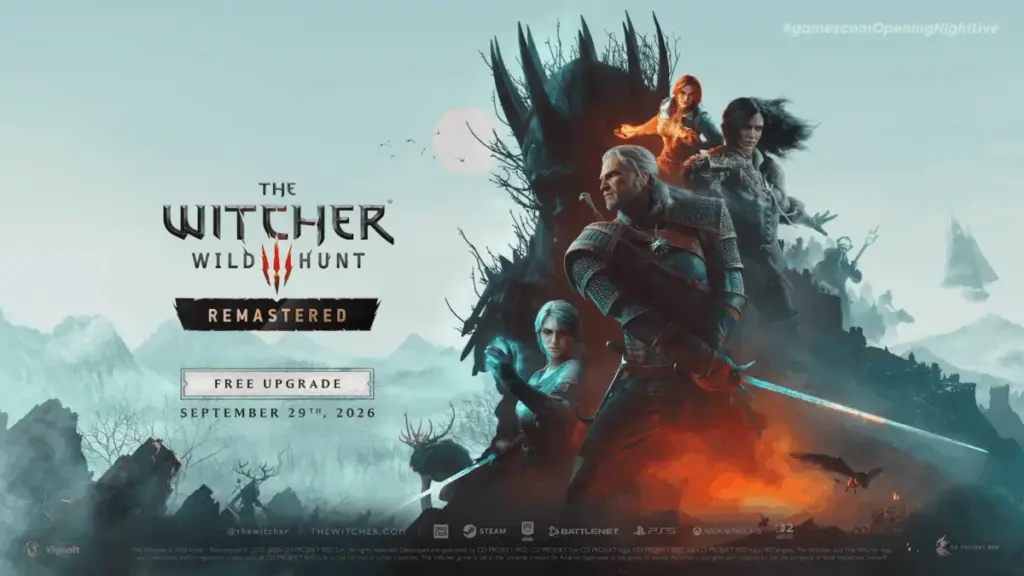
In a landmark announcement that bridges the gap between beloved last-generation hardware and Nintendo’s next-generation ecosystem, CD Projekt Red has officially revealed The Witcher 3: Wild Hunt Remastered for the upcoming Nintendo Switch successor, widely referred to as the Switch 2. Set for release on September 29, 2026, this definitive edition is not merely a straightforward port; it represents a comprehensive, ground-up technological and mechanical overhaul designed to harness the advanced capabilities of Nintendo’s powerful new hardware.
Crucially, CD Projekt Red has confirmed that the remaster will be distributed as a completely free upgrade for all existing owners of The Witcher 3: Wild Hunt. This generous consumer-first initiative extends to players who purchased the original Nintendo Switch version, allowing them to carry their library forward into the next generation without incurring additional costs.
Beyond sweeping graphical enhancements, the remastered package boasts a staggering array of mechanical improvements. Players can expect refined combat systems, brand-new visual effects for Witcher Signs, revamped mount handling, smarter monster behaviors, a completely overhauled skill tree, transmogrification capabilities, an expanded photo mode, and the inclusion of both major narrative expansions—Hearts of Stone and Blood and Wine.
Compounding this monumental reveal is the announcement of an entirely new post-launch narrative add-on: the "Song of the Past" Expansion Pack, which will debut alongside the Switch 2 remaster. This report provides an in-depth, investigative analysis of the announcement, examining the technical implications, historical context, player-first upgrade models, and the broader future outlook for both CD Projekt Red and Nintendo’s hardware trajectory.
Detailed Chronology: From Handheld Miracle to Next-Gen Masterpiece
To fully appreciate the gravity of the Witcher 3: Wild Hunt Remastered announcement for the Nintendo Switch 2, one must look back at the arduous journey of bringing Geralt of Rivia’s sprawling open-world epic to handheld platforms.
Phase 1: The Original Switch Port (2019)
When The Witcher 3 was first released on the original Nintendo Switch in October 2019, industry experts and gamers alike viewed it as a technological impossibility. Squeezing a massive, graphically demanding open-world RPG into a cartridge while running on mobile-grade architecture required heroic optimization by developer Saber Interactive in collaboration with CD Projekt Red. While the 2019 port necessitated significant compromises in resolution, draw distances, and texture fidelity—often running at a dynamic 540p in handheld mode—it was widely praised as a triumph of porting wizardry. It allowed millions of players to experience one of the greatest role-playing games of all time on the go.
Phase 2: The Hardware Generation Gap (2020–2025)
As gaming hardware advanced with the launch of the PlayStation 5, Xbox Series X/S, and high-end PC architectures, CD Projekt Red released the comprehensive "Next-Gen Update" in late 2022. This update introduced ray tracing, 60fps performance modes, integrated community-made mods, and quality-of-life upgrades to modern platforms. However, due to severe hardware limitations, the original Nintendo Switch was left behind, unable to process these next-generation enhancements. For years, Nintendo fans wondered if they would ever see Geralt’s world updated to modern standards.
Phase 3: The Switch 2 Horizon and the 2026 Reveal
As rumors and official disclosures regarding Nintendo’s next-generation console (the Switch 2) began to materialize, industry insiders speculated on how third-party developers would scale their back catalogs. On August 25, 2026, all speculation came to an end. CD Projekt Red officially announced The Witcher 3: Wild Hunt Remastered exclusively for the Nintendo Switch 2.
Scheduled for release on September 29, 2026, the title immediately seized the attention of the gaming community. Unlike the 2019 port, which fought against hardware bottlenecks, the Switch 2 edition is built to leverage modern rendering pipelines, offering a native experience that rivals—and in some cases utilizes unique features of—contemporary hardware ecosystems. Furthermore, by promising the upgrade for free to existing owners, CD Projekt Red set a new benchmark for consumer loyalty in the transition between console generations.
Supporting Context & Metrics: What’s New in the Remaster?
The scope of The Witcher 3: Wild Hunt Remastered goes far beyond a simple resolution bump and frame-rate unlock. CD Projekt Red has meticulously reviewed player feedback gathered over a decade, integrating long-requested community features and mechanical overhauls directly into the core game.
1. Visual and Technical Enhancements
- Advanced Graphical Fidelity: Leveraging the advanced computational and graphical architecture of the Switch 2, the remaster delivers vastly superior texture resolution, improved lighting models, denser vegetation, and enhanced shadow rendering.
- New Witcher Signs FX: Elemental magic receives a visual overhaul, with fluid particle systems, dynamic casting animations, and enhanced environmental interactions for Igni, Aard, Quen, Yrden, and Axii.
- Expanded Photo Mode: Building upon the robust photo mode introduced in the 2022 next-gen update, the Switch 2 version adds new filters, framing tools, posing options, and camera controls, empowering players to capture the breathtaking vistas of Velen, Novigrad, and Toussaint.
2. Gameplay and Mechanical Overhauls
- Enhanced Combat System: Hitboxes have been tightened, responsiveness has been improved, and alternate casting options for Signs are now seamlessly integrated without interrupting the flow of combat.
- Revamped Mount Handling: Roach, Geralt’s faithful steed, receives modernized pathfinding and movement physics, drastically reducing instances of getting stuck on environmental geometry and making equestrian travel smoother than ever.
- Enhanced Monster Behaviors: Artificial intelligence routines for adversaries have been upgraded. Monsters exhibit more tactical combat patterns, reacting dynamically to Geralt’s offensive strategies and environmental hazards.
- Skill Tree Revamp: The progression system has been rebalanced to eliminate underutilized abilities, introduce synergistic passive perks, and offer deeper build variety for players tailoring Geralt to specific playstyles (alchemy, combat, or signs).
- Transmogrification System: Addressing a long-standing player request, the visual customization system allows gamers to alter the appearance of their armor and weapons while retaining optimal statistical attributes.
3. Comprehensive Content Package
In addition to the base game, the remaster includes the critically acclaimed expansions:
- **Hearts of Stone: The 10-hour expansion taking Geralt into the wilds of No Man’s Land and the polished halls of Oxenfurt to deal with the enigmatic Man of Glass.
- **Blood and Wine: A massive 30-hour expansion introducing the vibrant, sun-drenched region of Toussaint, complete with a new estate management system, grand tournaments, and a gripping vampire mystery.
4. The "Song of the Past" Expansion Pack
Perhaps the most exciting announcement accompanying the remaster is the upcoming "Song of the Past" DLC. While specific narrative details remain tightly under wraps, CD Projekt Red has teased that this expansion will delve deep into untold chapters of the Witcher lore, offering fresh regions, challenging foes, and pivotal character interactions that further flesh out Geralt’s twilight years as a monster slayer.
Official Statements and Industry Impact
The announcement has sent ripples through the gaming industry, eliciting praise from critics, analysts, and fans alike.
In a joint press release accompanying the reveal, CD Projekt Red’s executive producers highlighted the studio’s commitment to the Nintendo platform:
"Bringing The Witcher 3 to the original Nintendo Switch was a monumental engineering challenge, but the overwhelming love from our community proved that players wanted Geralt’s adventures anywhere they went. With the Nintendo Switch 2, we finally have the technological canvas required to deliver not just a port, but a truly definitive, remastered experience. Offering this as a free upgrade to our loyal fans is our way of thanking those who walked the Path with us across generations."
Industry analysts have noted that CD Projekt Red’s decision to offer a free upgrade for existing Switch owners serves as a masterclass in consumer relations. In an era where cross-generation upgrades are frequently monetized through tiered pricing models or mandatory "Director’s Cut" purchases, CD Projekt Red’s strategy reinforces brand loyalty and revitalizes the game’s active player base ahead of the "Song of the Past" launch.
Furthermore, technical analysts reviewing the initial trailer footage (embedded below via official channels) have pointed out the remarkable scalability of the Switch 2 hardware. The ability to maintain stable performance targets while handling denser crowd simulations, improved draw distances, and complex lighting effects signals a bright future for third-party support on Nintendo’s upcoming platform.
Future Outlook: The Path Ahead for CD Projekt Red and Nintendo
The launch of The Witcher 3: Wild Hunt Remastered on September 29, 2026, marks a significant milestone not only for CD Projekt Red but also for the broader handheld gaming landscape.
1. Setting a Precedent for Third-Party Support on Switch 2
For years, the original Nintendo Switch faced skepticism regarding its ability to run AAA titles from major western publishers. By positioning The Witcher 3 Remastered as a marquee launch window title for the Switch 2, CD Projekt Red and Nintendo are sending a clear signal: the new console is fully equipped to handle massive, graphically intensive open-world experiences without sacrificing performance or fidelity. This opens the door for other major publishers to bring their heavy-hitting franchises to Nintendo’s ecosystem.
2. The Legacy of The Witcher 3
Released originally in 2015, The Witcher 3: Wild Hunt continues to defy the typical lifespan of a video game. Over a decade after its initial debut, the franchise remains a cornerstone of modern pop culture, buoyed by successful transmedia adaptations, ongoing community engagement, and continuous technical refinement by its creators. The "Song of the Past" expansion proves that CD Projekt Red is not yet finished mining the rich lore of the Witcher universe, even as the studio concurrently ramps up production on future projects like Project Polaris (the next mainline Witcher saga).
3. Conclusion: A Definitive Journey Awaits
As September 29, 2026, approaches, anticipation among Nintendo and RPG fans is reaching a fever pitch. Whether players are stepping onto the Path for the very first time or returning to the Continent to experience the upgraded mechanics, enhanced visuals, and the brand-new "Song of the Past" DLC, The Witcher 3: Wild Hunt Remastered on Nintendo Switch 2 stands as a testament to the enduring power of exceptional storytelling and technical craftsmanship. Geralt of Rivia’s journey on Nintendo hardware is far from over—and the future has never looked brighter.