From Virtual Reality Sandbox to Desktop Chaos: The Journey of ‘Job Simulator: Human Relations’
Executive Overview
The video game industry has long operated on a predictable trajectory: successful intellectual properties start on traditional "flatscreen" monitors and televisions before eventually being adapted for emerging mediums like virtual reality. However, the maturation of the immersive gaming ecosystem has begun to invert this traditional pipeline. Increasingly, successful virtual reality franchises are proving that their mechanics, humor, and brand equity can transition out of the headset and onto standard desktop and console displays.
The latest and perhaps most striking example of this paradigm shift comes from Austin-based development studio FarBridge. Known for their work on the Quest strategy title Homeworld: Vast Reaches (2024), FarBridge has officially launched a high-stakes crowdfunding campaign on Kickstarter to support the development of Job Simulator: Human Relations. Developed in official collaboration with Owlchemy Labs—the Google-owned studio that holds the intellectual property and created the groundbreaking original—this new project marks the first fully realized flatscreen adaptation in the iconic comedy franchise.
Rather than offering a simple 1:1 port of the 2016 VR pioneer, Job Simulator: Human Relations reimagines the universe as a cooperative physics sandbox explicitly designed for standard monitors. Featuring robust four-player co-op gameplay, the title hinges on orchestrating and surviving catastrophic workplace disasters. According to FarBridge, these scenarios are engineered to "challenge, delight, or challenge and delight you and your co-workers."
This bold commercial gamble arrives at a fascinating cultural and economic crossroads. Job Simulator is not just any VR game; it is an industry titan. Released a decade ago, it remains a perennial favorite and a foundational "must-have" title for anyone purchasing a virtual reality headset. On the Meta Quest platform alone, it stands as the second best-selling game of all time, sitting comfortably just below Beat Games’ ubiquitous rhythm sensation, Beat Saber.
Yet, as FarBridge takes Job Simulator back to the traditional screen, it reflects a broader industry trend. High-profile VR developers are increasingly looking to traditional gaming formats to extend the lifecycles of their intellectual properties. From Polyarc adapting its acclaimed VR platformer Moss for PC monitors and traditional consoles to Vertigo Games expanding the reach of its post-apocalyptic Arizona Sunshine franchise, the boundary between virtual reality and flat-panel gaming is becoming increasingly porous.
As FarBridge races against a September 10, 2026 funding deadline to secure its $150,000 base goal, the gaming community is left to ponder a compelling question: Can a game built entirely on the foundational principles of virtual reality physical interaction translate its magic to a standard keyboard, mouse, or controller, or is its signature charm inextricably tied to the headset?
Detailed Chronology: From the Vive Launch to the Flatscreen Era
To understand the gravity of Job Simulator: Human Relations, one must examine the astonishing trajectory of the franchise over the past decade. The story of Job Simulator is, in many ways, the story of modern consumer virtual reality itself.
2016: The Genesis of Immersive Interaction
When Job Simulator launched alongside the original HTC Vive in 2016, the consumer VR landscape was an absolute Wild West. Crucially, Valve and HTC’s headset launched with full motion-controller support out of the box—a luxury that competing systems like the Oculus Rift did not enjoy during their initial rollout. Owlchemy Labs capitalized on this technological advantage by designing a game that felt tailor-made for the medium.
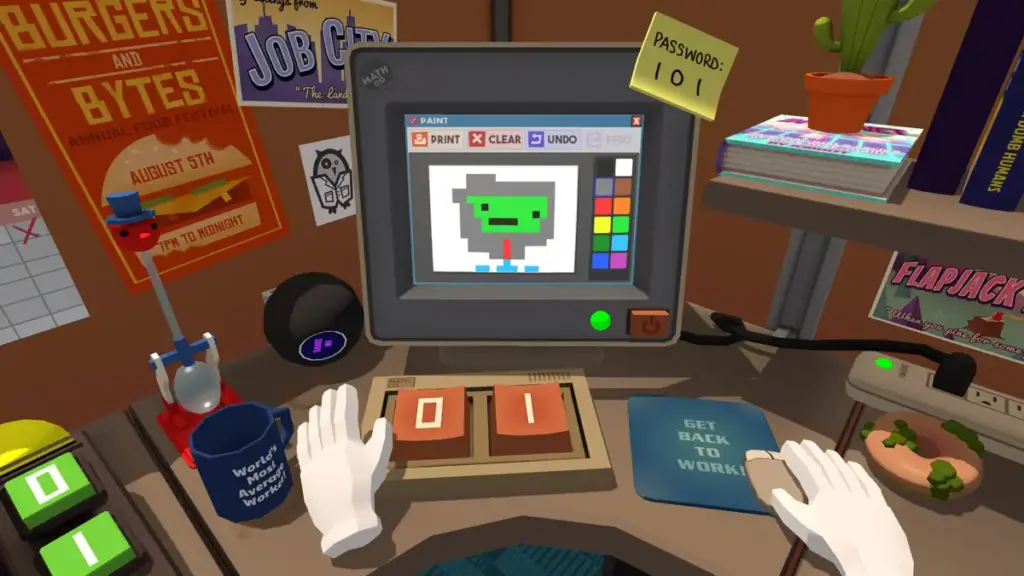
Set in a satirical future where robots have replaced human workers and automated historical "job simulators" for entertainment, the game placed players in cramped, highly interactive cubicles and kitchens. Every single stapler, coffee mug, and donut was a physical object that could be picked up, thrown, inspected, or abused. It was an instant masterclass in how to build intuitive, immersive interactions without relying on traditional button layouts.
2017: The Google Acquisition
The impact of Job Simulator was so profound that tech giant Google took notice. Barely a year after the game’s initial release, Google acquired Owlchemy Labs. Backed by the immense resources of one of the world’s largest technology companies, Owlchemy scaled its operations significantly. As new standalone headsets—most notably the Oculus Quest line—flooded the market equipped with accessible motion controllers, Owlchemy ported Job Simulator to virtually every major VR platform. It quickly cemented its status as the definitive entry-level title for anyone buying their first headset.
2019–2024: Expansion and the Multiplayer Experiment
Buoyed by unprecedented commercial success, Owlchemy Labs released a sequel, Vacation Simulator, in 2019, expanding the formula to beaches, forests, and ski resorts.
By 2024, the collaborative ecosystem surrounding these developers had evolved further. FarBridge partnered on Dimensional Double Shift, a social VR experience dripping with the chaotic, occupational humor that fans had come to expect. This creative synergy laid the groundwork for FarBridge to pitch an even more radical departure: bringing the franchise to the millions of gamers who do not own virtual reality hardware.
2026: The Kickstarter Campaign for Human Relations
Now, in 2026, the timeline reaches a critical inflection point. With the launch of the Kickstarter campaign for Job Simulator: Human Relations, FarBridge and Owlchemy Labs are attempting to bridge the gap between VR exclusivity and mainstream accessibility. However, the path forward is steep. With a base funding goal of $150,000 required by September 10th, 2026, and early contributions sitting at roughly $12,000 shortly after launch, the studio faces an uphill battle to prove that demand for a flatscreen Job Simulator spin-off is high enough to justify full-scale development.
Supporting Context & Metrics: The Weight of an Industry Titan
To appreciate why a flatscreen spin-off is a noteworthy gamble, one must look at the hard data surrounding the Job Simulator intellectual property.
- The Quest Ecosystem Behemoth: According to retrospective platform data tracking the all-time best-selling titles on the Meta Quest store, Job Simulator holds a staggering position. It ranks as the second best-selling Quest game of all time, trailing only Beat Saber. Considering the sheer volume of games released on the platform over the years, this achievement places Job Simulator in an elite tier of commercial success.
- The "First-Time Buyer" Pipeline: Industry analysts have long cited Job Simulator as the quintessential onboarding tool for new VR users. Its whimsical presentation, lack of complex narrative barriers, and inherently funny physics engine mean that children, grandparents, and hardcore gamers can all pick up the controllers and immediately understand what to do.
- The Cross-Platform Exodus: FarBridge’s move is part of a broader industry trend where developers look beyond headset boundaries to maximize ROI and audience retention. Notable historical precedents include:
- Polyarc’s Moss: The acclaimed VR adventure platformer was eventually adapted for traditional PC monitors and home consoles to capture a wider narrative-driven audience after hitting platform saturation in VR.
- Vertigo Games’ Arizona Sunshine: While retaining its VR roots, the studio expanded its publishing footprint and explored adjacent media formats to keep its zombie-survival IP relevant in a crowded market.
Despite these precedents, Job Simulator faces a unique hurdle: its entire identity was forged in the fires of spatial computing. Translating spatial manipulation into a mouse-and-keyboard or standard controller scheme requires a fundamental redesign of the player’s relationship with the game world.
Official Statements and Vision
In promotional materials and press releases accompanying the Kickstarter launch, the stakeholders have emphasized that Job Simulator: Human Relations is not meant to replace virtual reality, but rather to invite a brand-new demographic into a shared brand of digital absurdity.
FarBridge describes the core gameplay loop of Human Relations as an intentional exercise in collaborative chaos. The integration of four-player cooperative play is designed to weaponize the game’s signature physics engine. In the original VR game, players caused chaos in solitary confinement; in Human Relations, that chaos is distributed, amplified, and thrown directly onto a shared screen where players must manage absurd occupational duties together.
Owlchemy Labs has expressed enthusiastic support for the project, granting FarBridge the formal IP licensing and creative blessing required to reimagine the universe outside of virtual reality. By maintaining a close creative collaboration, the IP holders aim to ensure that the distinct humor, sarcastic robot overlords, and brightly colored aesthetic remain entirely intact, even as the camera perspective shifts from first-person stereoscopic immersion to a traditional multi-user display.
Future Outlook: Can the Magic Survive the Transition?
The million-dollar question facing FarBridge, Owlchemy Labs, and the backers of Job Simulator: Human Relations is simple: Can a game defined by its VR-native interactions successfully capture the lightning-in-a-bottle magic of the original on a flatscreen?
The Ingredients of Staying Power
If you were to construct a recipe for a video game with generational staying power, it requires a precise combination of elements:
- Broad Accessibility: A whimsical, approachable tone that appeals across age demographics.
- Favorable Timing: Releasing hardware-defining software precisely when a new medium is taking off.
- Constant Support: Long-term platform updates and porting efforts to meet players wherever their hardware happens to be.
- Competent Development: A studio capable of executing tight, responsive game loops.
Job Simulator possessed all of these traits in 2016. Its early momentum was so fierce and well-timed that virtually none of its spiritual successors or copycats have managed to replicate its cultural footprint.
The Flatscreen Challenge
However, translating that legacy to flatscreen monitors carries inherent risks. While games like Among Us or Phasmophobia have proven that chaotic, multiplayer, task-oriented cooperative titles can achieve stratospheric success on desktop and console displays, they were built from the ground up for those platforms.
Relying purely on the brand recognition of a decade-old virtual reality game will not be enough to turn Human Relations into the next viral phenomenon. The developers must prove that the core mechanic—mucking about with workplace physics—is just as engaging when viewed through a flat monitor as it is when reaching out with virtual hands.
As the September 10, 2026 Kickstarter deadline approaches, the indie development community will be watching closely. Whether Job Simulator: Human Relations smashes its $150,000 goal or becomes a cautionary tale of platform transition, the experiment itself marks an important milestone in how gaming franchises migrate across the dividing lines of hardware technology.