Nvidia DLSS 4.5 Ray Reconstruction: A Paradigm Shift in Real-Time Path Tracing Fidelity
Executive Overview
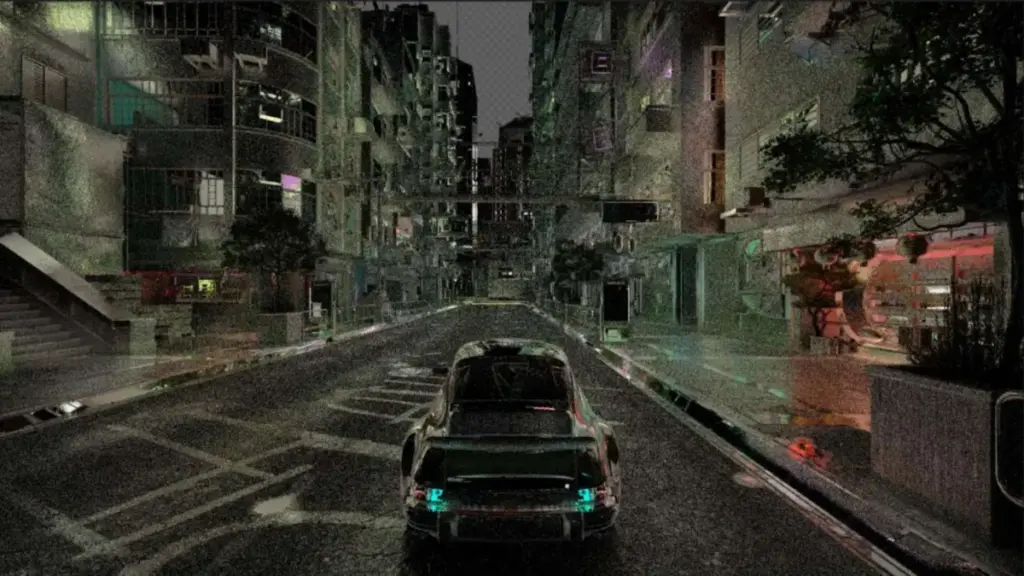
For years, the holy grail of real-time computer graphics has been path tracing—the pinnacle of simulated lighting that models physical light transport with staggering photorealistic accuracy. Yet, achieving this visual fidelity has always come at an exorbitant cost. Beyond the massive performance taxes levied on even the most capable graphics processing units, path-traced and ray-traced games have historically suffered from a persistent, deeply frustrating visual flaw: persistent artifacting, ghosting, and temporal instability in motion.
When a scene is static, light rays bounce across geometry to coalesce into breathtaking clarity. But the moment the camera pans or characters move, the underlying computational shortcuts required to make the frame rate viable begin to fracture. The result? Visual trails, shimmering textures, and spatial noise that can ruin an otherwise immersive experience.
Enter Nvidia’s latest graphics milestone: DLSS 4.5 Ray Reconstruction (RR). By introducing a sharper, second-generation Transformer-based AI model—initially deployed in DLSS 4.5 Super Resolution earlier this year—Nvidia is fundamentally rewriting how denoising and pixel interpolation are handled in real-time rendering. Released today, this upgraded feature aims to eradicate the notorious "boiling" textures and ghosting trails that have plagued games like Cyberpunk 2077 and Alan Wake 2. Best of all, it achieves this while remaining RTX-agnostic, supporting generations of hardware from Turing to the bleeding-edge Blackwell architecture.
This comprehensive deep-dive explores how DLSS 4.5 Ray Reconstruction works, analyzes its real-world performance improvements across marquee titles, details how to enable it, and evaluates its broader implications for the future of interactive real-time entertainment.
Detailed Chronology: The Evolution of Real-Time Denoisers
To understand why DLSS 4.5 Ray Reconstruction represents such a monumental leap forward, one must first examine the historical bottleneck of ray tracing: compute limitations.
The Mathematics of Light and the Denoiser Problem
To render a completely accurate path-traced scene, an infinite (or at least astronomically high) number of light photons and pixels must be tracked as they bounce off surfaces, refract through transparent mediums, and cast shadows. Even with modern hardware acceleration dedicated to ray/triangle intersections, tracking every single photon in real time is computationally impossible.
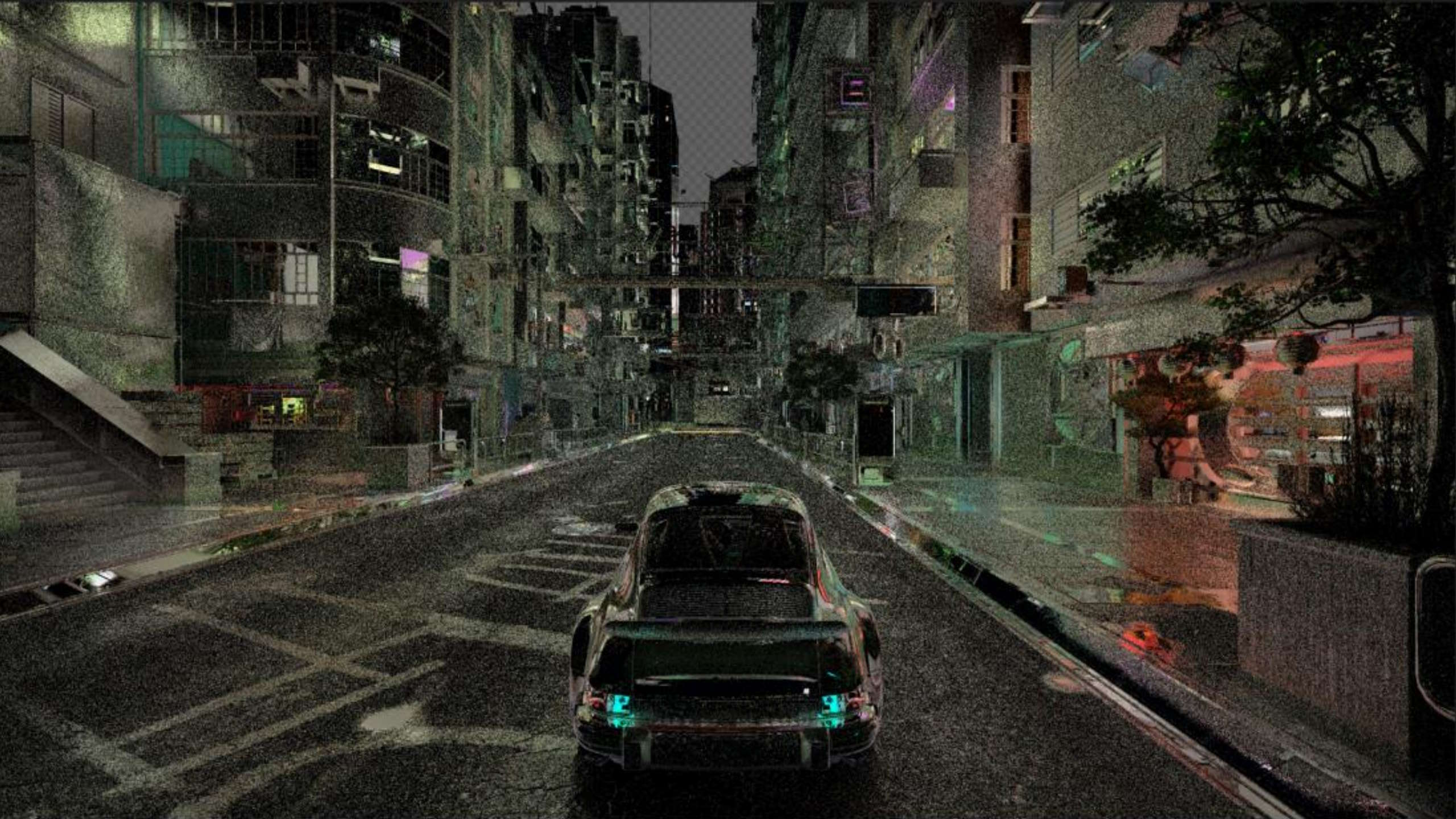
Instead, modern renderers rely on a tiny, representative statistical sample of rays bouncing through a game world. This produces a sparse, low-fidelity output filled with severe noise. To transform this sparse data into a coherent, production-ready frame, engineers have historically relied on denoisers.
- Hand-Tuned Denoisers (Era 1): Traditional denoisers use hand-coded mathematical algorithms to track and group pixels across multiple sequential frames. They borrow historical pixel data to interpolate and blend scenes together. While effective for still images, these heuristics break down catastrophically in motion. Pixels rapidly lose their representativeness, leading to smearing, loss of fine texture detail, and distracting visual "trails."
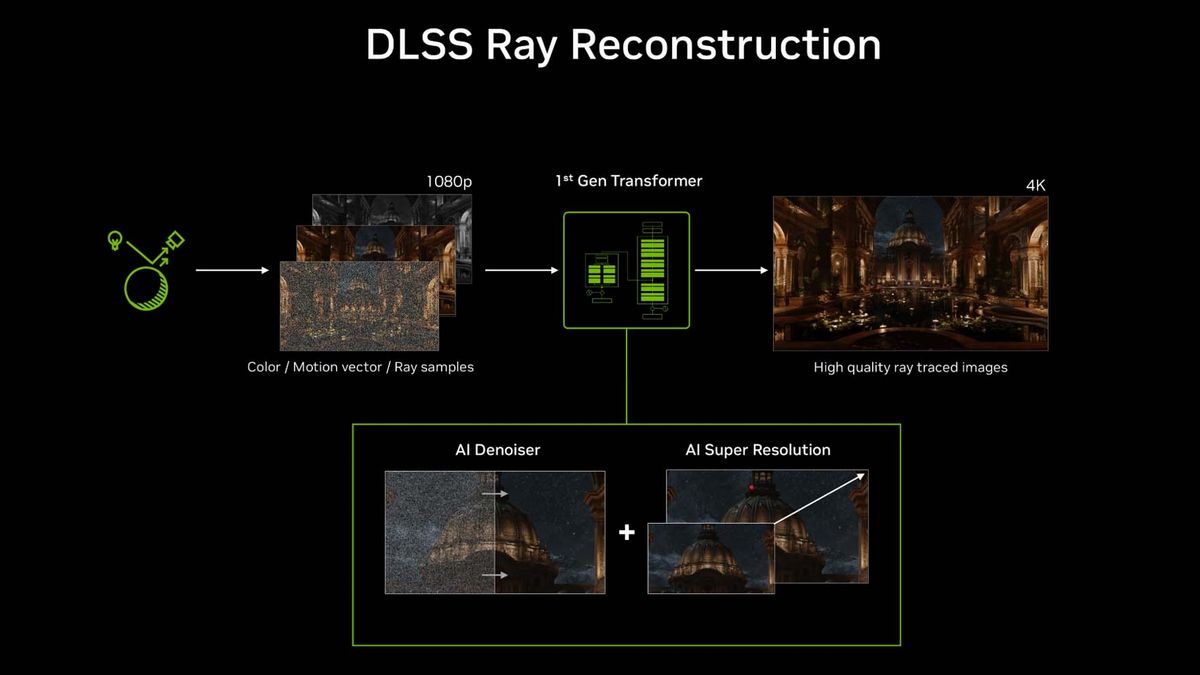
- The AI Revolution: Original Ray Reconstruction (Era 2): Recognizing that hand-tuned math was hitting a ceiling, Nvidia introduced AI-based Ray Reconstruction with DLSS 3.5. By swapping out traditional denoisers for a specialized neural network trained on offline-rendered reference images, the AI learned to recognize what a fully resolved lighting pass should look like. It generated superior, context-aware pixels between sampled rays.
- The Transformer Era: DLSS 4.5 (Current State): Today marks the next evolutionary step. Nvidia has upgraded its core architecture by integrating a cutting-edge, second-generation Transformer model into Ray Reconstruction. Operating in tandem with updated upscaling models, this new iteration yields unprecedented temporal stability, faster texture convergence, and drastically reduced artifacting.
Supporting Context & Metrics: How DLSS 4.5 RR Reshapes Key Titles
While the architectural theory is impressive, the proof lies in motion. Nvidia’s rollout of DLSS 4.5 Ray Reconstruction impacts a wide array of existing and upcoming titles (accessible via an expanding ecosystem detailed in official hardware lists).
1. Cyberpunk 2077: Eradicating Temporal Smearing
Cyberpunk 2077 remains the ultimate testing ground for cutting-edge rendering technologies. Under previous iterations of Ray Reconstruction, rapid camera movements inside neon-drenched interiors or dimly lit underpasses could trigger noticeable temporal artifacts—such as after-images or screen-edge silhouettes momentarily imprinting themselves onto flooring and ceilings before fading away.
With DLSS 4.5 RR, these ghosting anomalies are largely smoothed out. When looking up at complex, decaying concrete ceilings in underpasses, older versions of RR struggled to determine surface characteristics, leading to a "wobbling" visual state. The second-gen Transformer model resolves these textures with significantly higher certainty, resulting in razor-sharp stability and zero lingering artifact footprints.
2. Alan Wake 2: Taming the Dreamlike Trails
Remedy Entertainment’s Alan Wake 2 makes heavy use of path tracing to construct its suffocating, psychological horror atmosphere. In prior builds, the surreal, dreamlike visual trails surrounding characters moving through environments almost received a free pass from critics because they matched the game’s uncanny tone. However, they were still computational flaws rather than intentional artistic choices.
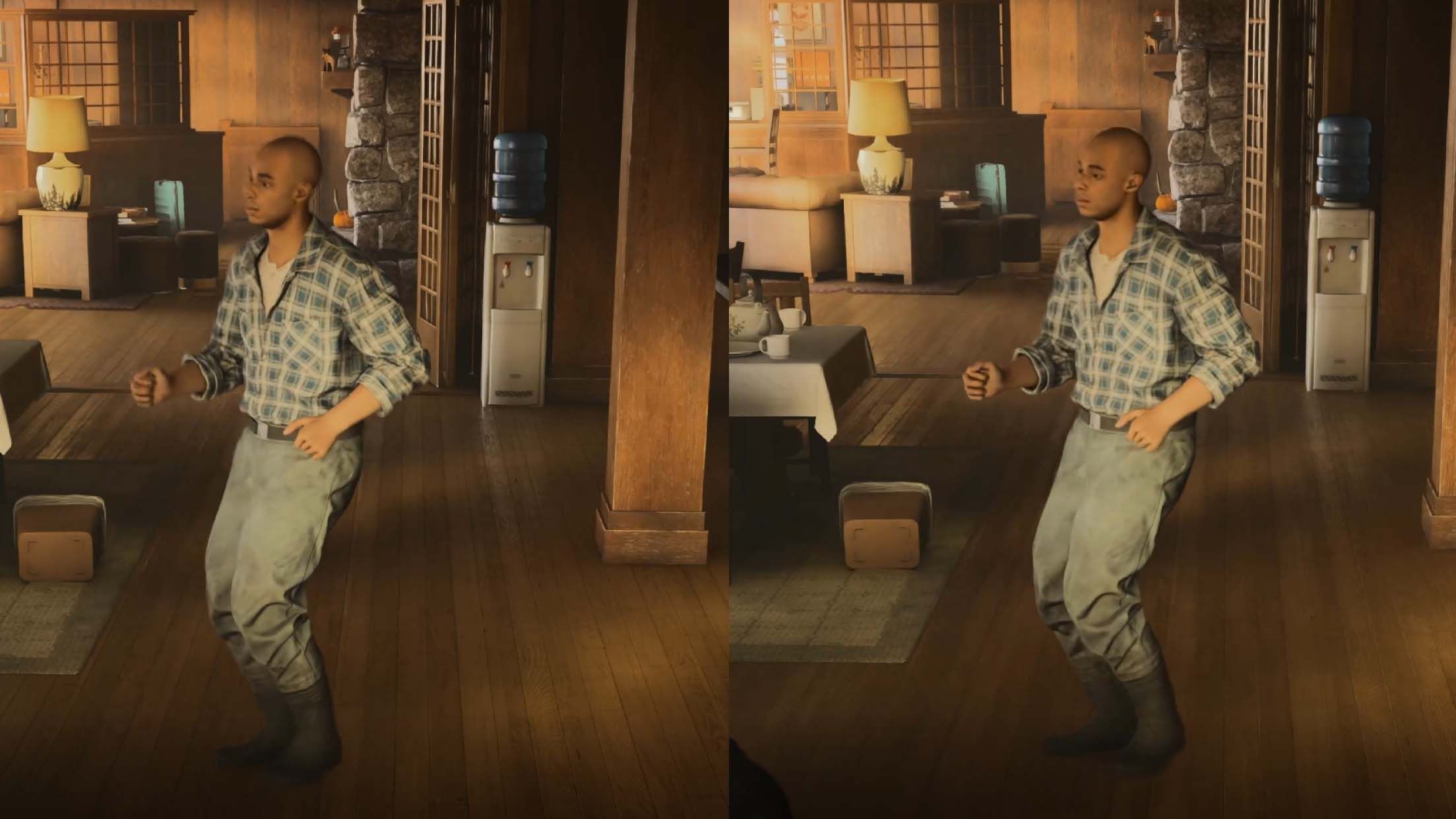
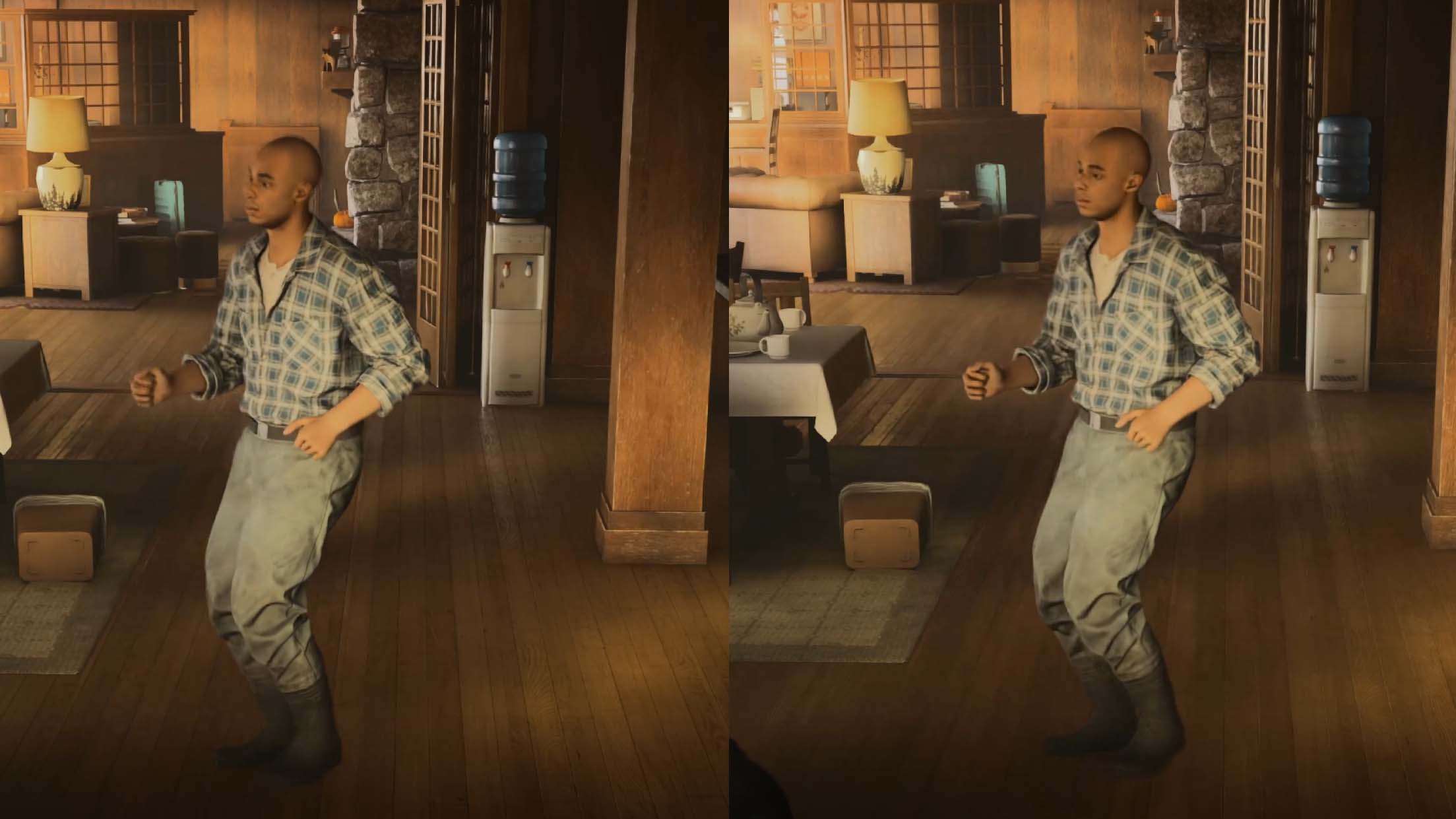
Testing the iconic dancing scene in the Elderwood Palace Lodge bar reveals that DLSS 4.5 RR successfully cleans up the sprawling motion trails around character models. While minor pixel noise and spatial shimmering can still occasionally be observed immediately around fast-moving feet on wooden slats, the surrounding environment—such as the complex wood grain planks on walls and background surfaces—gains a tremendous injection of retained structural detail.
3. Resident Evil Requiem: Surface Clarity in the Rain
In opening sequences featuring torrential rain effects atop slick car finishes and asphalt, older denoising models often allowed wet-surface textures to shimmer and dissolve behind precipitation particle systems. DLSS 4.5 RR locks down these surfaces with remarkable tenacity, ensuring that minute debris, cracks, and grit on the ground plane remain crisp and legible even under heavy environmental particle stress.
Technical Implementation: How to Enable DLSS 4.5 RR Today
Unlike traditional graphics settings that are toggled directly inside an individual game’s in-game video options menu, Nvidia has streamlined the deployment of its latest Transformer-based models via system-level software control.
Gamers looking to test DLSS 4.5 Ray Reconstruction can activate it through the Nvidia App by following these steps:
- Ensure your graphics drivers and the Nvidia App are updated to the latest available versions supporting DLSS 4.5 frameworks.
- Open the Nvidia App and navigate to your installed game library.
- Select the specific supported title (e.g., Cyberpunk 2077, Alan Wake 2, or Avatar: Frontiers of Pandora).
- Locate the ‘DLSS Override – Model Presets’ entry within the graphics customization panel.
- Drop down the ‘Ray Reconstruction’ menu and select ‘Preset F’ (which forces the loading of the second-gen Transformer model).
- Apply the changes and launch the title.
Supported Ecosystem at Launch
The rollout covers a massive array of current blockbusters and highly anticipated upcoming titles, including:
- Alan Wake 2
- Avatar: Frontiers of Pandora
- Cyberpunk 2077
- DOOM: The Dark Ages
- Indiana Jones and the Great Circle
- Portal with RTX
- Star Wars Outlaws
- Call of Duty: Black Ops 7 (Scheduled for August 20th integration), alongside dozens of others spanning tactical shooters, racing titles, and open-world epics.
Future Outlook: Hardware Demands and the Road Ahead
Despite the immense strides made by DLSS 4.5 Ray Reconstruction, visual perfection in real-time path tracing is not yet a 100% solved equation. The industry remains locked in a delicate dance between software wizardry and raw hardware muscle.
The Hardware Performance Equation
A crucial question for PC builders is how DLSS 4.5 RR impacts hardware performance. Fortunately, Ray Reconstruction remains largely RTX-agnostic, meaning it functions across all generations of GeForce RTX graphics cards—from the foundational RTX 20-series (Turing) up through Ampere, Ada Lovelace, and the latest RTX 50-series (Blackwell) architectures.
However, users of older hardware must manage expectations. Transformer-based models demand significant Tensor Core utilization. While Super Resolution is engineered primarily to reclaim framerates on struggling cards, Ray Reconstruction is designed specifically to elevate the visual integrity of ultra-high-end path-traced rendering.
Owners of legacy Turing and Ampere GPUs will find that running heavy path-tracing alongside advanced AI denoising imposes a noticeable tax on their systems. Consequently, uncompromising, maximum-fidelity path-traced gaming remains heavily optimized for high-end Ada Lovelace and Blackwell hardware ecosystems.
Looking Forward
As data center computing demands continue to compete fiercely with consumer hardware manufacturing pipelines, relying purely on raw silicon brute-force to calculate millions of additional light bounces is an impractical strategy. Instead, the future of real-time graphics will be defined by intelligent neural rendering.
Nvidia’s DLSS 4.5 Ray Reconstruction proves that AI can successfully bridge the gap between impossible computational requirements and stunning visual reality. While minor artifacts can still be coaxed out of the engine if one looks hard enough, the reduction of "boiling" textures, smearing, and ghosting makes this update an essential milestone. It transforms path tracing from a stuttering, experimental tech demo into a stable, deeply immersive standard for modern PC gaming.