Dive into the Madness: Blood Dungeon Combines Bullet Heaven Chaos with Agonizingly Fast Platforming
Executive Overview
The indie gaming landscape has long been defined by sudden, explosive intersections of popular genres. Yet, few recent announcements have managed to synthesize the kinetic, relentless dopamine loop of "bullet heaven" survival games with the tight, high-stakes verticality of hardcore platformers quite like Blood Dungeon. Developed by the creative minds behind the critically acclaimed fencing party game Nidhogg, this upcoming action roguelike drops players into a feverish, hand-drawn underworld where static positioning is a death sentence.
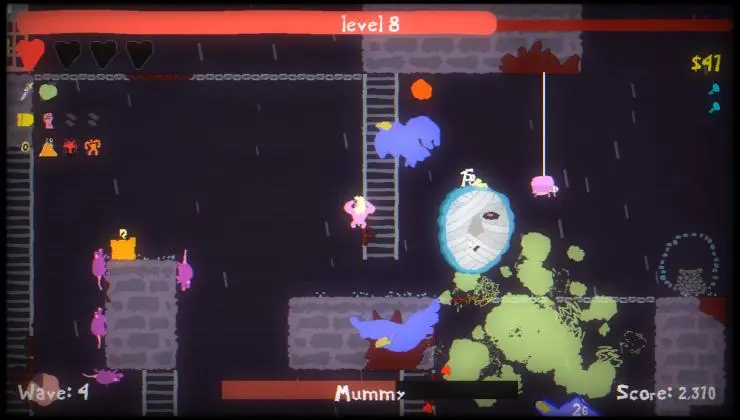
Featuring a wonderfully chaotic, squiggly art style that belies its punishing mechanics, Blood Dungeon challenges players to run, jump, climb, and weave their way through swarms of subterranean horrors. Far from the typical ground-level arena survival template popularized by titles like Vampire Survivors, this title forces you to master every square inch of its multi-tiered environments. Walls, ceilings, rickety ladders, suspended chains, and watery depths become both your sanctuary and your battlefield.
With an expansive roster exceeding 100 distinct enemy types—each boasting idiosyncratic movement patterns, attack vectors, and behavioral traits—Blood Dungeon promises an evolving tactical puzzle wrapped in a high-octane action package. Following a warmly received public demo that has already turned heads across the PC gaming community, anticipation for the full release is reaching a fever pitch. Moreover, with confirmed compatibility for Linux and Steam Deck via Proton and Wine, the title is poised to reach a wide, performance-conscious audience looking for their next handheld obsession. This comprehensive report explores the genesis, mechanics, platform ecosystem, and future horizon of one of the most exciting upcoming releases in the indie sector.
Detailed Chronology: From Cult Classics to Subterranean Chaos
To truly understand the pedigree driving Blood Dungeon, one must look backward to the origins of its creators. The developers, known for their work on the iconic, minimalist dueling masterpiece Nidhogg, have long specialized in games defined by unyielding momentum, instantaneous feedback loops, and pure, unadulterated kinetic energy. Where Nidhogg focused on hyper-competitive, one-on-one fencing battles across a continuous horizontal strip, Blood Dungeon pivots this design philosophy inward and upward, translating that obsession with relentless movement into a chaotic, single-player survival environment.
The conceptualization of Blood Dungeon began quietly behind closed doors, born from a desire to merge the screen-clearing, hypnotic satisfaction of the bullet heaven genre with the physical agency of traditional platforming. For years, the bullet heaven (or reverse-bullet-hell) genre has dominated PC gaming charts, largely characterized by characters who move automatically or simply walk across flat, static planes while firing cascades of automated projectiles. While wildly successful, the genre faced a plateau of mechanical innovation: once a player mastered positioning and DPS scaling, runs could occasionally devolve into passive exercises in resource management.
The developers sought to shatter this plateau. By introducing complex architectural layouts—requiring players to actively climb chains, scramble up ladders, leap across crumbling grates, and cling to slippery walls—Blood Dungeon re-injected physical dexterity into the survival equation. You cannot simply outrun a horde by circling a map; you must scale the architecture, drop through grates, and exploit the verticality of the dungeon to survive.
The project gained significant public traction when the development team released a playable demo to the public. The demo served as a vital stress test for the game’s core mechanics, introducing players to the frenetic movement suite and the dizzying array of early-game foes. Within days of its launch, word-of-mouth recommendations spread rapidly across digital storefronts and community forums like GamingOnLinux, praising the game’s deceptively simple yet wildly expressive aesthetic. The demo remains live, acting as an ongoing invitation for daring adventurers to test their reflexes ahead of the official full release window.
Supporting Context & Metrics: Anatomy of a Bullet Heaven Platformer
To appreciate what makes Blood Dungeon tick, it is essential to examine the structural mechanics, enemy design philosophies, and technical foundations underpinning the experience.
The Mechanics of Momentum
In Blood Dungeon, movement is not merely a tool for transit; it is your primary defensive shield and offensive catalyst. Traditional bullet heavens rely heavily on passive damage output, where success is measured by numerical builds (Armor, Regeneration, Area of Effect). While Blood Dungeon incorporates roguelike progression and build-crafting, it fundamentally alters the survival loop through spatial mastery.
Players must navigate environments that utilize every dimension of the screen:
- Vertical Scrambling: Ladders and chains allow for rapid elevation changes, letting players escape ground-level kill boxes.
- Environmental Fluctuations: Grates, destructible walls, and watery depths alter movement speed, jump height, and tactical options on the fly.
- Ceiling Crawling and Wall Jumps: Vertical surfaces are fully interactive, turning corners and dead ends into dynamic parkour opportunities.
A Menagerie of Madness: Over 100 Enemy Types
One of the most ambitious claims made by the development team is the inclusion of over 100 unique enemy types in the full release. In many roguelikes, enemy variety is artificially inflated through simple color-swaps or numerical scaling (e.g., faster, stronger versions of early-game monsters). Blood Dungeon, however, emphasizes behavioural diversity.
Each of the 100+ enemies possesses distinct movement patterns that interact directly with the game’s verticality. Some foes might scuttle along ceilings, dropping down directly onto unsuspecting players who linger too long on flat ground. Others might tunnel through walls, swim through watery subterranean pools with blistering speed, or fire arcing projectiles that force the player to time their mid-air jumps meticulously. Learning these profiles transforms every run from a mindless button-masher into an intricate dance of evasion and resource exploitation.
The Hand-Drawn Aesthetic
Visually, Blood Dungeon rejects the polished, hyper-realistic, or pixel-art tropes currently flooding the indie market. Instead, it embraces a striking, squiggly, hand-drawn art style that feels simultaneously charming and deeply unsettling. The frantic line-work mirrors the psychological panic of being hunted by an endless horde, while the stark, high-contrast color palettes ensure that players can track incoming projectiles and fast-moving hazards amidst the visual cacophony.
Technical Foundation and Compatibility
From a technical standpoint, Blood Dungeon has been built with modern cross-platform accessibility in mind. Notably, the game runs smoothly via Proton and Wine, ensuring robust, native-feeling performance for Linux desktop users and handheld gaming PC enthusiasts alike (such as the Steam Deck). In an era where operating system fragmentation can occasionally alienate segments of the PC gaming populace, the developers’ proactive commitment to Linux compatibility is a massive win for open-source gaming advocates.
Official Statements & Developer Insights
While formal press releases from the secretive indie studio have been measured, interviews and developer diaries accompanying the rollout of the Blood Dungeon demo have shed light on their creative vision.
Reflecting on the transition from Nidhogg to their current project, lead developers noted that the core DNA of both games remains identical: action defined by flow state.
"With Nidhogg, we wanted to capture the breathless, reactionary intensity of a high-stakes duel where a single misstep costs you everything," a studio spokesperson shared during a community Q&A. "With Blood Dungeon, we wanted to scale that feeling up to an operatic, monstrous degree. You aren’t just fighting one opponent anymore—you are fighting an entire ecosystem that wants to swallow you whole. But the underlying philosophy hasn’t changed: if you stop moving, you die."
Regarding the distinctive art direction, the team emphasized that the squiggly, hand-drawn look was born out of rapid prototyping constraints that ultimately evolved into the game’s defining visual identity.
"We didn’t want something sterile or clinically clean," the developers explained. "The dungeon should feel alive, digestive, and erratic. The art style breathes with the game. When the screen is packed with fifty leaping ghouls and you’re clinging to a crumbling chain by your fingertips, the visual noise needs to feel chaotic yet readable. That balance took years to nail down, but the response to the demo proved we hit a nerve."
Community reception has likewise validated the studio’s risk-taking approach. Early players on platforms like GamingOnLinux have lauded the game’s immediate pick-up-and-play accessibility paired with a remarkably high skill ceiling. Comments from demo testers frequently highlight the "addictive flow" of chaining wall-jumps while clearing out screen-filling waves of monsters, cementing the title as one of the most anticipated dark-horse indies on the horizon.
Future Outlook: What Lies Ahead for Blood Dungeon
As the public demo continues to gather invaluable telemetry and player feedback, the gaming community’s eyes are firmly fixed on the horizon for the full release of Blood Dungeon. Several key milestones and questions remain as the studio prepares to unleash the complete underworld experience:
- Content Expansion: While the demo offered a tantalizing taste of the action, the full release promises to flesh out the promised roster of 100+ enemies, alongside expanded biomes, boss encounters, and upgrade paths. How the roguelike meta-progression balances against raw player skill will dictate the game’s long-term replayability.
- Platform Optimization: Given the smooth early performance on Proton and Wine, Linux and Steam Deck players can look forward to a verified, optimized experience at launch. As handheld PC gaming continues its explosive growth, having a twitch-based platformer that runs flawlessly on-the-go is an invaluable commercial asset.
- Community-Driven Balancing: The developers have shown a keen willingness to listen to early feedback. The ongoing tuning of enemy telegraphs, movement floatiness, and weapon synergies will likely be shaped by the community members currently dissecting the public demo.
Blood Dungeon represents everything that makes the independent gaming scene so vital: bold genre mashups, distinctive artistic risks, and a relentless focus on mechanical satisfaction. By taking the hypnotic, numbers-driven chaos of the bullet heaven genre and standing it upright on a vertical platforming stage, the creators of Nidhogg have crafted something genuinely fresh.
If the full release delivers on the frantic, movement-focused promise of its demo, Blood Dungeon won’t just be a cult hit—it may very well redefine how we look at survival roguelikes for years to come. In the meantime, the demo remains live, the chains are waiting, and the horde is growing hungry. Will you survive the descent?