PS5/PS4 “Lapse” Kernel exploit released, compatible up to PS4 12.02 and PS5 10.01 (but…)
May 10, 2025
By Wololo (Adapted and Expanded for Investigative Coverage)
Executive Overview
The PlayStation homebrew and security research community has experienced a seismic shift. In a release that has sent immediate shockwaves through developer circles and gaming forums alike, a prominent community developer known as "abc" has officially published the "Lapse" kernel exploit. This newly uncovered vulnerability targets both the PlayStation 4 (PS4) and the PlayStation 5 (PS5), boasting an impressive compatibility window stretching all the way up to Firmware 12.02 on the PS4 and Firmware 10.01 on the PS5.
According to technical breakdowns provided alongside the release, Sony patched the vector in subsequent updates, specifically neutralizing it in PS4 Firmware 12.50 and PS5 Firmware 10.20. Because of this wide berth of vulnerable system software versions, the Lapse exploit represents one of the most substantial hardware security disclosures for Sony’s last two console generations in recent history.
Simultaneously, compounding the excitement across the console modification scene, well-known security researcher Zecoxao has dropped heavy hints regarding an impending Hypervisor exploit targeted at early-generation PS5 firmware versions (3.xx and 4.xx). Should this hypervisor exploit materialize into a fully functional public tool, it would grant low-level, unmitigated control over the console’s architecture—surpassing traditional kernel-level exploits in terms of stability, performance, and overall feature accessibility.
However, despite the celebratory mood surrounding the initial drop, industry analysts and developers urge caution. The currently available public package is strictly a Proof of Concept (PoC) tailored exclusively for PS4 Firmwares 8.0x. Translating this breakthrough into a practical, user-friendly jailbreak for modern PS4 and PS5 systems will require significant technical hurdles to be cleared, notably the discovery and implementation of reliable user-mode entry points on contemporary firmware iterations.
Detailed Chronology of the Vulnerability
To fully understand the weight of the Lapse exploit, one must examine the underlying mechanics of the vulnerability and the timeline of events leading up to its public release in May 2025.
The Root Cause: A Double Free in aio_multi_delete
At the technical heart of the Lapse exploit lies a critical vulnerability residing within the system’s asynchronous I/O handling: specifically, a double-free bug in the aio_multi_delete() function.
In systems programming, a "double-free" error occurs when a program attempts to free the same memory allocation twice. This can lead to memory corruption, allowing malicious or carefully crafted code to manipulate system pointers, escalate privileges, and ultimately achieve arbitrary kernel code execution. The flaw has been meticulously documented within developer communities, including early write-ups mirrored on pastebin repositories and reference entries on the community-driven PS4 Dev Wiki.
Historically, kernel vulnerabilities of this magnitude require immense reverse-engineering efforts to isolate. The discovery that this specific asynchronous I/O bug spanned across multiple generations of the FreeBSD-derived Orbis OS (which powers the PS4) and its evolution on the PS5 highlights the lingering legacy codebases shared between Sony’s hardware iterations.
From Discovery to Release
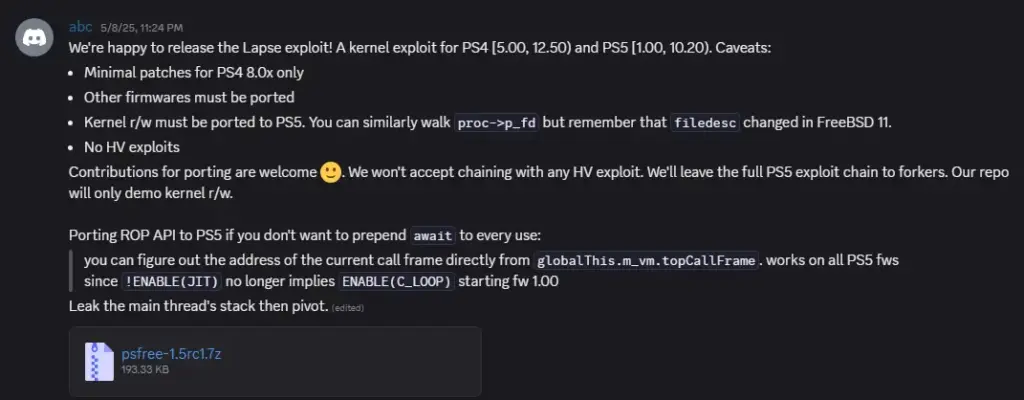
While the underlying bug in aio_multi_delete() had been tracked and analyzed in pockets of the underground security scene for some time, developer "abc" delivered the decisive blow by turning theoretical vulnerability into a functional exploitation path. Dropping the files onto the scene on May 9–10, 2025, abc provided the community with the vital stepping stones needed to study modern kernel manipulation.

Crucially, however, software exploitation is rarely a one-size-fits-all mechanism. The initial code made publicly available via community mirrors (such as the package highlighted by prominent scene figure Modded Warfare, packaged around psfree-1.5rc1) is strictly bound to PS4 Firmware 8.0x.
This means that while the vulnerability exists up to PS4 12.02 and PS5 10.01, the actual working implementation code released so far cannot simply be executed out-of-the-box on a modern, up-to-date console. Bridging that gap will require intense porting efforts by skilled system architects.
Supporting Context & Technical Metrics
The release of Lapse and the concurrent news regarding the PS5 hypervisor bring several key technical challenges, metrics, and architectural hurdles to the forefront.
Firmware Compatibility Matrix
To evaluate the true scope of the Lapse exploit, researchers have mapped out the affected software versions against Sony’s patch history:
- PlayStation 4 Compatibility:
- Vulnerable: All firmware versions up to and including v12.02.
- Patched: Introduced security mitigations starting in v12.50.
- Current PoC Support: Strictly limited to v8.0x (requiring extensive porting for intermediate and higher versions).
- PlayStation 5 Compatibility:
- Vulnerable: All firmware versions up to and including v10.01.
- Patched: Mitigated by Sony in v10.20.
- Current PoC Support: None natively functional yet; requires both kernel porting and an independent entry point.
The User-Mode Entry Point Bottleneck
One of the most significant barriers facing developers looking to leverage the Lapse exploit on modern PS4 and PS5 firmware is the absolute necessity of a user-mode entry point.
Modern gaming consoles are engineered with layered defense-in-depth security models. Even if a researcher discovers a guaranteed path to compromise the kernel (Ring 0), they cannot execute that kernel exploit directly from the home screen or standard user applications without first breaching the restricted user-mode sandbox (Ring 3).
Historically, user-mode entry points have relied heavily on vulnerabilities found within the system’s integrated web browser (WebKit exploits), media players, or specific save-data parser bugs. On recent, highly locked-down firmware versions for both the PS4 and PS5, public and reliable user-mode exploits are exceptionally scarce.
While niche entry vectors—such as specific Lua-based game exploits—have occasionally surfaced, prominent community figures like Wololo have dismissed them as impractical for the broader consumer base. Because these methods often require users to already own specific, delisted, or hard-to-find titles prior to exploitation, they fail to offer the universal accessibility required for a mainstream homebrew pipeline. Consequently, until new user-mode entry points for modern firmware versions are discovered and published, the Lapse exploit remains a powerful weapon locked behind an unopened door for most users on higher software versions.
Official Statements and Community Reactions
The underground development scene reacted instantly to the dual announcements from "abc" and Zecoxao, sparking intense discussions across X (formerly Twitter), Reddit, and specialized Discord servers.
Developer Insights and Caveats
Community leaders wasted no time dissecting the implications of the release. Wololo highlighted the sheer magnitude of the firmware range covered by the bug report, noting:

"Dropping a bomb on the scene, developer abc has released the ‘Lapse’ Kernel exploit… this is a massive release."
At the same time, veteran researchers emphasized the patience required by the community. Transitioning a proof-of-concept designed for older firmware environments (like PS4 8.0x) to contemporary software ecosystems is a grueling process. This is doubly true for the PlayStation 5, which features significantly hardened sandboxing, isolated security processors, and altered memory management layouts compared to its predecessor.
The Zecoxao Tease: Hypervisor Control on PS5 3.xx/4.xx
Adding fuel to an already blazing fire, security researcher Zecoxao took to social media to share a tantalizing status update regarding low-level PlayStation 5 architecture:
"hypervisor on 3.xx and 4.xx may be a reality soon enough"
— Jose Coixao (@notnotzecoxao), May 7, 2025
To understand why this statement sent ripples through the hardware hacking community, one must look at how Sony altered the security model of the PS5 starting with firmware version 3.xx.
In an effort to lock down the platform against kernel-level tampering, Sony deliberately moved the Hypervisor—the foundational layer of software that manages virtual machines and hardware resource allocation—outside of the primary kernel space. By isolating the hypervisor into its own highly privileged domain, traditional kernel exploits were rendered incapable of touching or modifying hypervisor-level protections.
If Zecoxao and collaborating researchers successfully break into the hypervisor on PS5 firmware versions 3.xx and 4.xx, it will represent a monumental milestone. A hypervisor exploit grants near-absolute control over the physical hardware, bypassing restrictions imposed by the operating system kernel entirely. From a performance, diagnostic, and virtualization standpoint, a hypervisor-level compromise is widely considered the holy grail of console security research, offering stability and capabilities far superior to standard kernel patches or real-time debugging hooks.
Future Outlook: What Lies Ahead for PlayStation Homebrew?
As the dust settles on the initial release of the Lapse exploit code and the growing anticipation surrounding Zecoxao’s hypervisor teasers, the trajectory of the PlayStation security scene enters a fascinating transition phase.
- The Porting Marathon Begins: Independent developers and reverse-engineers are currently pouring over the
aio_multi_delete()double-free implementation. Over the coming weeks and months, community-led efforts will focus on porting the Lapse PoC past the initial 8.0x PS4 limitations toward higher firmware iterations. - The Hunt for Entry Points: For the PlayStation 5 and modern PS4 firmwares to benefit from Lapse, researchers must redouble their efforts to unearth fresh user-mode vulnerabilities—such as zero-days in WebKit, image rendering engines, or system services—that can serve as the initial springboard into the system.
- Hardware Preservation vs. Security Arms Race: As always, these discoveries highlight the perpetual cat-and-mouse game between corporate security teams and independent researchers. While Sony continues to patch vulnerabilities through routine system updates (as seen with the deployment of fixes in PS4 12.50 and PS5 10.20), the persistence of deep-seated architectural flaws proves that achieving absolute digital lockdown remains an elusive goal for console manufacturers.
For now, the power rests firmly in the hands of the development community. Whether the Lapse exploit and potential hypervisor breakthroughs evolve into fully realized, consumer-ready jailbreaks will depend entirely on the ingenuity, collaboration, and persistence of the researchers working behind the scenes. Enthusiasts on modern firmware versions are advised to exercise patience, maintain strict control over their system software updates, and closely monitor trusted community hubs for future developmental milestones.