The Evolution of Ultralight Power: A Review of the Nitecore NB10000 Gen 4
Executive Overview
In the world of backcountry endurance sports—where every single gram in a pack translates to an exponential increase in fatigue over grueling mountain miles—power management has long been an exercise in compromise. For backpackers, bikepackers, and trail runners, traditional power banks presented a frustrating dichotomy: they were either rugged and heavy, or lightweight yet laden with unnecessary "feature creep" like bulky casings, redundant ports, and heavy LCD screens.
Enter the Nitecore NB10000 Gen 4, priced at $83.95. Representing the pinnacle of current portable charging engineering, this new-generation power bank leverages cutting-edge silicon-carbon battery anode technology—the same high-density energy architecture rapidly transforming flagship smartphones from brands like Samsung—to slash weight and volume to unprecedented lows.
Weighing in at a mere 146 grams (measuring 1.45 x 11.6 x 4.68cm) and packing a robust 39Wh (10,000mAh) capacity, the Gen 4 easily dethrones its predecessor, the NB10000 Gen 3, as the undisputed champion of ultralight power delivery. Despite a noticeable price bump from previous iterations, the Gen 4 delivers class-leading energy density, robust IPX7 water resistance, and carbon-fiber durability. It is an engineering marvel designed specifically for those who measure their gear lists in grams, proving once and for all that less can indeed be vastly more powerful.

Detailed Chronology: The Journey to Gen 4
The Quest for Gram-Saving Efficiency
The trajectory of Nitecore’s NB10000 series reads as a masterclass in iterative design. Over the past several years, outdoor enthusiasts and tech reviewers alike watched the 10,000mAh tier evolve from clumsy plastic-shelled bricks into sleek, carbon-fiber-armored cylinders and rectangles.
The philosophy behind the line has always been steadfast: strip away the superfluous, reinforce the shell, and maximize energy density. However, earlier generations—while celebrated for their featherlight footprint—occasionally stumbled under extreme conditions. Users reported occasional thermal throttling, low-battery voltage drops, and sudden shutdowns when pushed to their absolute limits in sub-freezing backcountry environments or during high-draw scenarios.
The Silicon-Carbon Leap
With the introduction of the Gen 4, Nitecore transitioned away from traditional graphite anodes, embracing a silicon-carbon anode structure. This chemical shift marks a watershed moment for outdoor power solutions. Silicon-carbon chemistry allows lithium-ion cells to store significantly more ions within the same physical volume, elevating energy density without sacrificing safety profiles.

During a multi-week testing phase spanning rugged trails and variable weather, the Gen 4 demonstrated a maturity missing from its predecessors. It successfully eradicated the low-battery thermal shutdown bugs that occasionally plagued the Gen 3 model, maintaining a steady, reliable output even as the fuel gauge dipped dangerously low. Though a microscopic blip in power delivery was registered by specialized testing meters near total depletion, real-world operation remained entirely seamless—unnoticed by the end user as devices continued charging uninterrupted.
Supporting Context & Metrics: Putting the Gen 4 to the Test
To evaluate whether the $83.95 price tag is justified, the Nitecore NB10000 Gen 4 was subjected to rigorous bench testing and real-world field evaluations across diverse outdoor activities.
Capacity and Efficiency Benchmarks
Nitecore rates the Gen 4 at 39Wh. In rigorous laboratory-style discharge testing, the unit yielded 33.58Wh of delivered energy, translating to an exceptional 86.1 percent efficiency rate. This represents a measurable improvement over the Gen 3’s 33.33Wh output.

- Delivered Energy Density (Battery Only): 229.98 Wh/kg
- Delivered Energy Density (Including 6g USB-C Lanyard Cable): 220.90 Wh/kg
These figures place the Gen 4 firmly at the top of its class. For practical field applications, this translated to fully recharging an aging iPhone 15 Pro twice over, with a comfortable reserve of watt-hours remaining to power headlamps or satellite communicators. Furthermore, with up to 22.5W of maximum output supporting PD (Power Delivery), QC3.0, and Huawei’s SCP protocols, the power bank is surprisingly capable of throwing a quick emergency top-up to a 14-inch MacBook Pro when standard wall outlets are miles away.
Physical Build and Weather Resistance
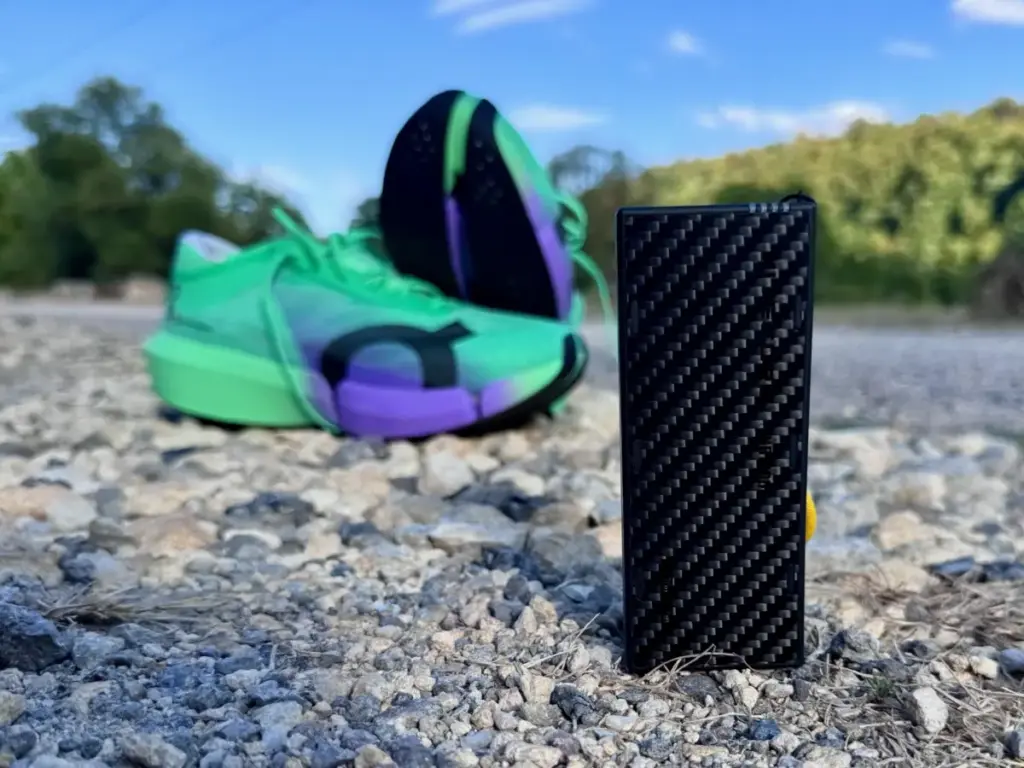
Constructed from rigid carbon-fiber sheets, the outer chassis offers extraordinary structural integrity while keeping weight down. More importantly, the Gen 4 boasts an IPX7 water-ingress rating. This means it can withstand torrential downpours, muddy trail splashes, and even accidental temporary submersion in river crossings—an essential safety baseline for wilderness electronics.
The Interface: Innovation Meets Over-Engineering
Nitecore made several bold design choices regarding the user interface, meeting mixed reviews from purists:

- The Touch Button: Forsaking traditional mechanical clicks, Nitecore opted for a touch-sensitive wake button. While initially viewed with skepticism by reviewers accustomed to tactile feedback, the sensor proved surprisingly reliable, registering inputs cleanly even from wet fingers.
- Knock-to-Wake Feature: Users can double-knock near the top of the battery to illuminate the battery indicators and ambient LEDs—helpful when fumbling with gloves in a dark tent, though testing showed this feature worked roughly 75 percent of the time.
- RGB Accent Lighting: Flowing animation rings around the dual USB-C ports serve as a visual guide in the dark. While undeniably flashy, some ultralight purists may view this as a minor nod back to the "feature creep" Nitecore otherwise avoids. Both the lights and touch systems can be disabled if desired.
- Eco Mode: By executing a long press on the power button, users can toggle between regular mode and a low-draw Eco mode (dropping output to a steady 5W / 5V at 1A). This prevents the power bank from auto-shutting when charging low-current devices like smartwatches, wireless earbuds, or specialized headlamps, while simultaneously reducing thermal waste and conversion loss.
Official Statements and Industry Perspective
Industry analysts and outdoor gear designers have closely monitored the commercialization of silicon-carbon battery cells. Speaking on the integration of advanced anode materials, manufacturing experts note that scaling silicon-carbon technology into consumer electronics requires balancing volumetric efficiency with structural stability during repeated charge-discharge cycles.
"The migration toward silicon-carbon architectures in portable power is no longer confined to flagship smartphones," notes industrial design consultant Marcus Vance. "When brands successfully translate these high-density chemistries into rugged, weather-sealed outdoor gear, they fundamentally shift the weight-to-performance ratio. For backpackers, saving 50 grams without sacrificing watt-hours is the holy grail."
Nitecore positions the Gen 4 not merely as an incremental upgrade, but as an essential tool for minimalist adventurers who demand enterprise-grade reliability in hostile environments. While acknowledging that the price point has climbed steadily—moving from the $64.95 launch price of the Gen 2/Gen 3 eras up to $83.95 for the Gen 4—the company defends the investment through the lens of specialized materials science and manufacturing precision.

Future Outlook: The Next Frontier in Portable Power
The debut of the Nitecore NB10000 Gen 4 signals a broader paradigm shift across the consumer electronics and outdoor equipment markets. As silicon-carbon manufacturing matures and production yields improve, several key trends are expected to shape the future of portable power banks:
- Mainstream Adoption of High-Density Anodes: Expect competitors to rapidly adopt silicon-carbon technology, driving down production costs while pushing standard 10,000mAh capacities below the 130-gram threshold.
- Standardization of Pass-Through Intelligence: Advanced power routing will likely become ubiquitous, allowing power banks to intelligently balance input solar generation with simultaneous high-speed output to multiple devices without generating excessive thermal loads.
- The War on Redundant Interfaces: As user feedback consolidates around the pitfalls of touch-sensitive buttons in wet or freezing conditions, future iterations of adventure tech will likely return to tactile, glove-friendly mechanical controls paired with minimalist status displays.
Conclusion: Is It Worth the Splurge?
At $83.95, the Nitecore NB10000 Gen 4 commands a financial premium two to three times higher than generic, mass-market 10,000mAh power banks. However, for endurance athletes, thru-hikers, and weight-conscious bikepackers, the calculus is clear. Shaving over 50 grams of dead weight from a kit while securing IPX7 weatherproofing, stellar 86.1% energy efficiency, and a robust carbon-fiber shell makes the Gen 4 a peerless investment. For those who live by the ultralight creed, Haribo can indeed be damned—this is the definitive power bank to beat.