Expanding the Library: An Analytical Review of the "No More Robots: Unhinged Indie Anthology" Humble Bundle
Executive Overview
The digital storefront landscape has long relied on curated distribution models to solve a fundamental problem of the modern gaming era: discoverability. For independent developers, breaking through the white noise of thousands of annual releases on platforms like Steam remains an uphill battle. Concurrently, players face an overwhelming surplus of choice coupled with rising individual game price tags. Enter the bundle model—a time-tested mechanism that balances consumer value with bulk promotional reach.
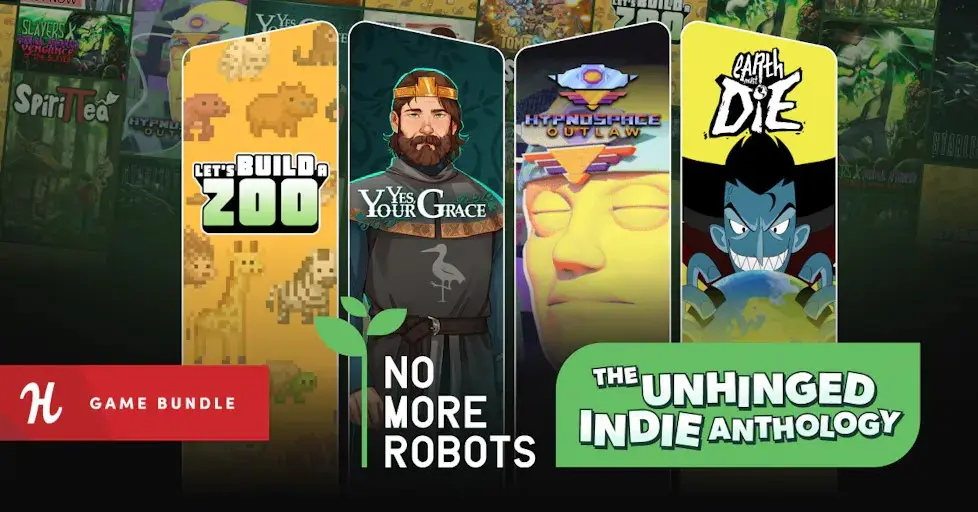
In its latest offering, Humble Bundle has partnered with publisher No More Robots to release the "Unhinged Indie Anthology." Priced at an accessible £10.81 (approximately $13–$14 USD depending on exchange rates), this compilation bundles ten distinct video games alongside one major downloadable content (DLC) expansion. Beyond its sheer volume-to-price ratio, this collection represents a strategic snapshot of contemporary indie game development. It highlights eclectic design philosophies, ranging from systemic management sims and narrative-driven RPGs to retro-inspired boomer shooters and surreal alternate-history simulations.
Furthermore, this release arrives as a notable win for alternative operating system users. Thanks to the continued maturation of Valve’s Proton compatibility layer and SteamOS, every title included in the "Unhinged Indie Anthology" boasts high-level compatibility with Linux and Steam Deck hardware. This analysis will explore the economic mechanics of the bundle, examine the structural curation of No More Robots as a publisher, detail the complete roster of included titles via their respective design frameworks, and evaluate the broader implications of such anthologies for the PC gaming ecosystem.
Supporting Context & Metrics: The Economics and Technology of Modern Bundles
The Curation Strategy of No More Robots
Founded by industry veteran Mike Rose, No More Robots has carved out a distinct niche in the publishing sector. Rather than chasing AAA fidelity or hyper-monetized live-service loops, the label focuses on titles with distinct artistic identities, strong community engagement hooks, and mechanics that invite repeated play.
The economic calculus behind participating in a Humble Bundle is multifaceted for a publisher. While the per-unit revenue share is significantly lower than a direct digital storefront sale, the volume of distribution offers compounding returns:
- Critical Mass and Community Growth: Multiplayer or community-driven games benefit immensely from an instantaneous influx of players.
- Back-Catalog Monetization: For titles that have exited their initial sales launch window, bundles provide a secondary revenue stream that would otherwise remain dormant.
- Ecosystem Cross-Pollination: A player purchasing the bundle for one recognizable title (such as Let’s Build a Zoo or Yes, Your Grace) is systematically introduced to more niche or experimental titles they might otherwise have ignored.
Linux, SteamOS, and the Proton Advantage
A critical dimension of this specific bundle’s reception within the PC community—particularly among publications like GamingOnLinux—is its seamless hardware integration. Historically, Linux gamers faced significant friction when attempting to run indie titles developed primarily with DirectX toolsets or Windows-centric frameworks.
The widespread adoption of Valve’s Proton (a modified version of Wine integrating DirectX translation layers like DXVK and vkd3d) has fundamentally shifted this paradigm. All ten titles and the accompanying DLC in the No More Robots anthology run smoothly under Proton. This technological baseline guarantees that Steam Deck owners and desktop Linux enthusiasts can dive into the collection without troubleshooting compatibility flags, representing an inclusive approach to multi-platform software distribution.

Detailed Chronology: The Games of the "Unhinged Indie Anthology"
To understand the value proposition of the £10.81 bundle, one must examine the individual titles. The collection spans a remarkably diverse spectrum of genres, artistic styles, and narrative tones. Below is a comprehensive breakdown of the games included in the anthology.
1. Earth Must Die
- Genre: Sci-Fi Strategy / Action
- Premise: Players step into the shoes of a defensive planetary ruler tasked with repelling waves of invading human forces ("moronic Terranoids"). It subverts the traditional sci-fi trope where humanity is the plucky underdog defending its home against alien onslaughts, instead placing the player in the role of an aggrieved alien monarch protecting their ancestral domain.
2. Starless Abyss
- Genre: Turn-Based Roguelike Intergalactic Deckbuilder
- Premise: Set against the backdrop of a fallen Earth where science and the occult have merged to face an impending Eldritch threat, players control one of the "Proximae." The title combines traditional deck-building mechanics with tactical, turn-based roguelike progression, demanding rigorous resource management and strategic card synergies to survive deep-space encounters.
3. Let’s Build a Zoo
- Genre: Simulation / Management / DNA Splicing
- Premise: A vibrant, pixel-art management sim that goes far beyond traditional zoo-tycoon tropes. Beyond constructing enclosures and hiring caretakers, the game features a complex DNA-splicing mechanic that allows players to stitch together over 300,000 unique animal combinations. The emergent chaos of managing hybrid fauna provides endless experimental gameplay loops.
4. Spirittea
- Genre: Narrative Life Sim / Management
- Premise: Heavily inspired by classic simulation and adventure titles (with clear nods to Japanese folklore and films like Spirited Away), players manage a run-down bathhouse in a small town crawling with invisible, troublesome spirits. By restoring the bathhouse and brewing specialized teas, players help the spirits unwind while solving local town mysteries.
5. Yes, Your Grace
- Genre: Kingdom Management RPG / Narrative Strategy
- Premise: A grim, atmospheric strategy game where players sit upon the throne of a medieval realm. Balancing limited financial and military resources against an endless queue of petitioners with petty complaints, personal pleas, and existential war threats requires difficult moral choices. Every decision ripples outward, altering the fate of the royal family and the kingdom.
6. Hypnospace Outlaw
- Genre: Alternate-History 90s Web Simulator / Investigation
- Premise: A cultural touchstone of indie design, Hypnospace Outlaw drops the player into a simulated 1990s internet environment viewed via an OS operated by the "Hypnospace Patrol Department." As an enforcer, players comb through early-web aesthetic pages, police copyright infringements, track down computer viruses, and uncover corporate conspiracies in a brilliantly realized nostalgia trip.
7. Slayers X: Terminal Aftermath: Vengeance of the Slayer
- Genre: Retro Boomer Shooter
- Premise: Framed as a passion project built in 1998 by a fictional high schooler (who is now 37 with "life experience"), this is an unhinged, high-octane throwback to classic 90s FPS titles like Doom and Duke Nukem 3D. Featuring seven explosive weapons, excessive blood and gore, highly destructible maps, and an aggressive industrial soundtrack by Seepage & Psyko Syndikate, it is a masterclass in tongue-in-cheek nostalgic design.
8. TombStar
- Genre: Space Western Rogue-like Shooter
- Premise: Blending cosmic vistas with frontier aesthetics, TombStar challenges players to shoot, dodge, cloak, and explode their way across an alien badland dominated by the ruthless Grimheart Gang. Fast-paced twin-stick mechanics and roguelike progression make it a high-intensity action title.
9. Not Tonight + Not Tonight: One Love DLC
- Genre: Dystopian Time-Management RPG
- Premise: Set in an alternate post-Brexit United Kingdom governed by a harsh nationalist regime, players assume the role of "Person of European Heritage #112," working as a bouncer to survive relocation blocks. The game utilizes time-management mechanics inspired by Papers, Please, forcing players to check IDs, manage club capacities, and navigate oppressive socio-political realities. The One Love DLC expands this narrative framework further.
10. Not Tonight 2
- Genre: Narrative Road Trip / Socio-Political Adventure
- Premise: A direct sequel that shifts the scope from a single venue to an entire fractured continent. Following an immigration enforcement arrest, the player’s friends must embark on a desperate road trip across a broken, satirical vision of America to retrieve vital documents. It blends mini-games, dark humor, and pointed social commentary.
Official Statements & Publisher Perspective
While direct press releases accompanying charity and promotional bundles are often formulaic, the ethos of No More Robots remains clearly stamped across this anthology. Publisher representatives and studio heads have frequently noted that the modern indie landscape requires publishers to act as champions of creative risk.
By greenlighting projects as wildly divergent as the 90s web-sleuthing simulation of Hypnospace Outlaw, the crude boomer-shooter nostalgia of Slayers X, and the compassionate cultural management of Spirittea, No More Robots has established an identity rooted in shock-value creativity and deep mechanical engagement. The decision to bundle these specific titles underscores a unified philosophy: indie games do not need to adhere to safe, market-tested formulas to find commercial viability; rather, their strength lies precisely in their unhinged uniqueness.
Future Outlook
The "Unhinged Indie Anthology" serves as a case study in effective digital distribution. As gaming subscription services (such as Xbox Game Pass and PlayStation Plus) continually reshape how consumers access media, standalone curation platforms like Humble Bundle must offer distinct, permanent ownership value to remain competitive.
For approximately £11, consumers gain permanent access to a massive library of critically acclaimed software that would cost exponentially more if purchased individually. More importantly, this bundle acts as a vital discovery engine. As players dive into the chaotic DNA-splicing of Let’s Build a Zoo, the alternate-history web-sleuthing of Hypnospace Outlaw, or the royal resource management of Yes, Your Grace, they are exposed to creative risks that large-scale corporate publishers rarely dare to fund.
Looking forward, as hardware ecosystems like the Steam Deck continue to grow, anthologies optimized for cross-platform play without friction will likely become the gold standard for indie promotion. For Linux users, SteamOS adopters, and digital hoarders alike, the No More Robots bundle is not merely a discount—it is a curated preservation of modern independent gaming’s wildest impulses.