The Sinclair Legacy Returns: Inside the Long-Awaited Launch of Grant Sinclair’s Ultra-Thin GAMERCARD Handheld
Executive Overview: The Dawn of the Ultra-Thin Retro Handheld
In the rapidly saturating landscape of retro gaming handhelds, manufacturers typically compete on raw emulation power, screen resolution, or ergonomic comfort. However, a new contender has emerged from the United Kingdom that rejects the standard design language of modern handhelds entirely.
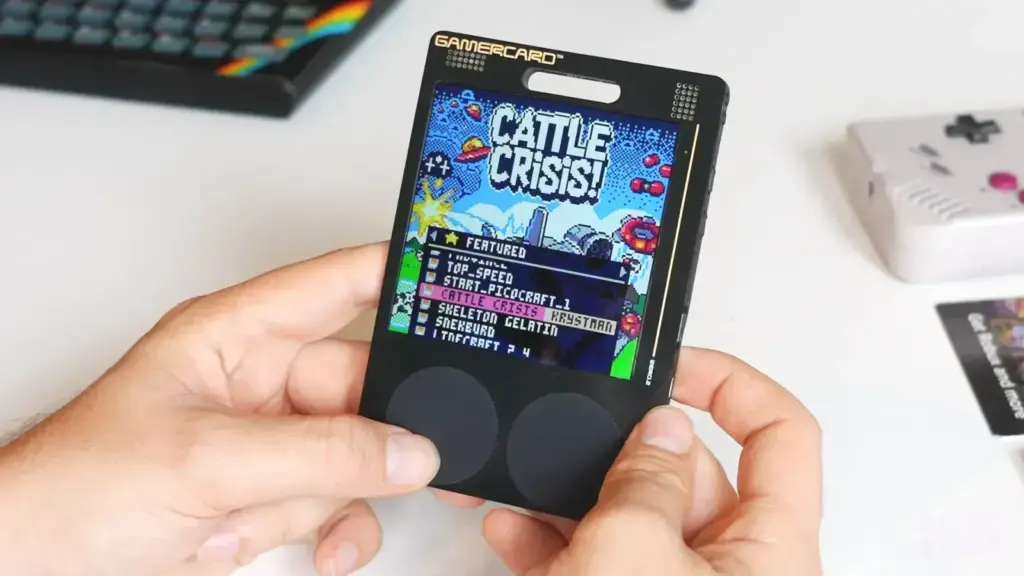
The GAMERCARD, designed by Grant Sinclair—nephew of the legendary British inventor Sir Clive Sinclair—has officially begun shipping to consumers. Boasting a form factor roughly equivalent to a standard credit card, the GAMERCARD represents a radical experiment in hardware miniaturization. Powered by Raspberry Pi architecture, the device aims to bridge the gap between minimalist industrial design and functional retro emulation.
The road to release has been a long one. First previewed as a functional prototype in mid-2025, the GAMERCARD underwent over a year of hardware revisions, community-driven redesigns, and supply chain adjustments before final retail units began landing on reviewers’ and customers’ doorsteps in August 2026.
This investigative report explores the development history of the GAMERCARD, analyzes the engineering hurdles of credit-card-scale computing, evaluates its technical specifications, and assesses its place in a market dominated by mass-produced emulation devices.
Detailed Chronology: From Wales Prototype to Global Shipping (2025–2026)
[Mid-2025] ──> [Late 2025] ──────────> [Early 2026] ──────────> [August 2026]
Prototype      Delay & Redesign        PCB Re-engineering       Retail Shipping
Revealed       (Micro-SD Integration)  & Testing                Commences
The Mid-2025 Breakthrough
The public first caught a glimpse of the GAMERCARD in the summer of 2025. Grant Sinclair invited select industry journalists and retro gaming experts to his home workshop in Wales to test an early, functional prototype.
At the time, the prototype showcased an incredibly slim profile, drawing immediate comparisons to novelty micro-consoles. However, early testers noted several critical limitations:
- Storage Limitations: The initial prototype relied strictly on limited, onboard flash storage, which severely restricted the number of ROMs and custom software packages users could load.
- Software Rigidity: Without an external storage interface, updating firmware or transferring files required complex tethering setups that threatened to alienate non-technical users.
The Delay and the Community-Driven Redesign
Recognizing that a closed-ecosystem micro-console would struggle to find a foothold in the enthusiast market, Sinclair made the difficult decision to delay the planned late-2025 launch.
Rather than rushing a compromised product to market, Grant Sinclair Technologies embarked on an iterative redesign cycle. The primary engineering objective of this delay was twofold:
- Integrate a Micro-SD Card Slot: Fitting a spring-loaded Micro-SD card reader into a chassis only a few millimeters thick required a complete overhaul of the multi-layer Printed Circuit Board (PCB).
- Optimize Power Consumption: The addition of external storage and a redesigned storage controller necessitated recalibrating the device’s power distribution to prevent thermal throttling and battery drain.
August 2026: The Final Rollout
After nearly a year of silence, the refinement phase concluded. In early August 2026, finalized retail packages began arriving at the doorsteps of early backers and media outlets.
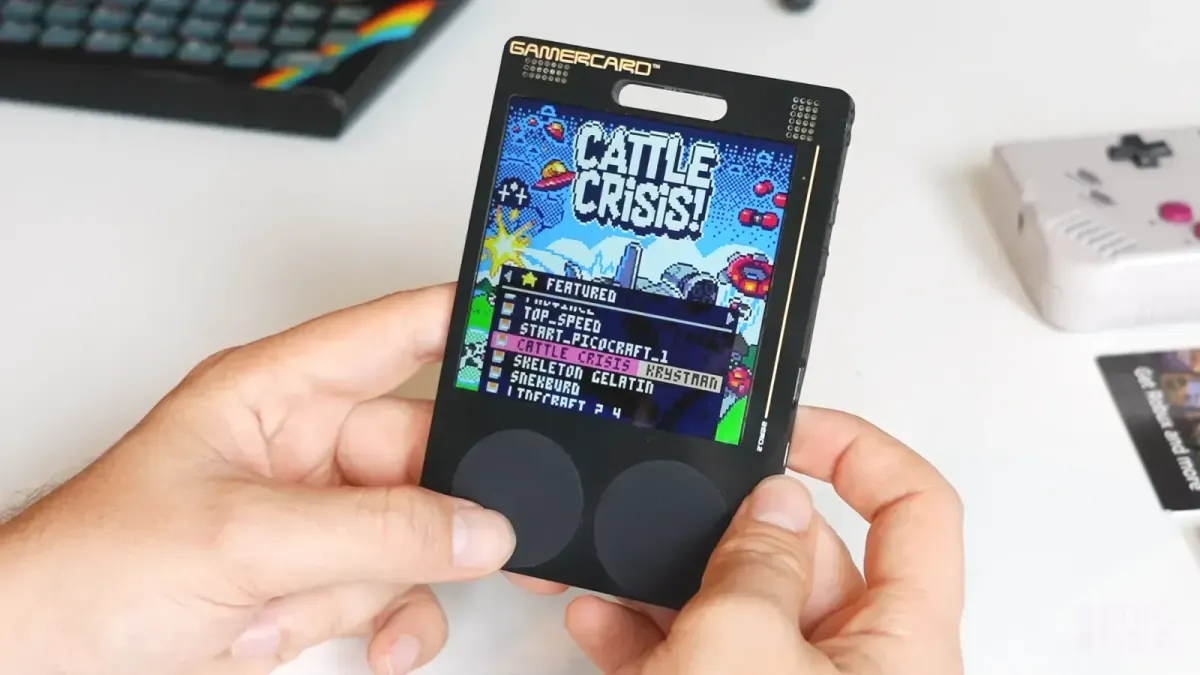
Accompanying the units was an official dispatch note from Grant Sinclair confirming: "We are now starting to ship GamerCard orders."
Despite a slight price increase driven by escalating component costs and the integration of the Micro-SD storage architecture, the device has officially transitioned from an ambitious prototype to a commercially shipping product.
Technical Analysis: Engineering a Console into a Gift Card
Fitting a fully operational computer, display, input system, and power source into a housing the size of a gift card is an extraordinary feat of electrical and industrial engineering. Below is an in-depth breakdown of how the GAMERCARD achieves this form factor.
Silicon and Architecture: The Raspberry Pi Heart
The GAMERCARD leverages the highly versatile Raspberry Pi ecosystem. While the outer shell resembles a novelty card, the interior houses a custom-engineered carrier board designed to interface with Raspberry Pi silicon (referencing the RP2040/Pico micro-architecture family).
+-------------------------------------------------------+
|                       GAMERCARD                       |
|                                                       |
|   +-----------------+            +-----------------+  |
|   |                 |            |  D-Pad / Inputs |  |
|   |   Ultra-Thin    |            |                 |  |
|   |   OLED/LCD      |            |   (Low-Travel   |  |
|   |   Display       |            |   Dome Switches)|  |
|   |                 |            +-----------------+  |
|   +-----------------+                                 |
|                                                       |
|   +---------------------------------------------+     |
|   |  Custom PCB w/ Raspberry Pi RP2040 Silicon  |     |
|   +---------------------------------------------+     |
|                                                       |
|   [Micro-SD Slot]                   [Li-Po Battery]   |
+-------------------------------------------------------+
By utilizing this architecture, the GAMERCARD benefits from a massive, pre-existing library of open-source emulators, micro-games, and custom firmware. However, this architectural choice comes with performance trade-offs. The device is not intended to run high-end 3D consoles; instead, it is optimized for:
- 8-bit consoles (NES, Game Boy, Sega Master System)
- 16-bit micro-adventures (highly optimized SNES and Genesis/Mega Drive titles)
- Fantasy consoles (PICO-8)
- Bespoke indie titles written specifically for micro-controllers
The Storage Breakthrough: Integrating Micro-SD
The defining feature of the retail unit is the side-mounted Micro-SD card slot. In standard handhelds, the card slot is a trivial inclusion. On the GAMERCARD, however, the slot itself represents a significant percentage of the device’s total thickness.
To prevent the chassis from bulging, Sinclair’s team utilized a mid-board mounting technique, cutting a physical notch into the PCB so the card reader sits flush within the board’s profile rather than stacked on top of it.
Display and Input Challenges
- The Screen: The console utilizes an ultra-thin, high-contrast display. Given the small screen real estate, the user interface (UI) has been custom-designed to remain legible at low resolutions, utilizing a clean, pixel-art menu system.
- Tactile Feedback: Standard silicon membrane buttons require too much vertical travel for a card-thin console. The GAMERCARD instead utilizes low-profile metal dome switches, similar to those found on smartwatches or thin flip phones. This provides a distinct, clicky tactile response despite minimal physical movement.
Comparative Context: How the GAMERCARD Fits into the Retro Landscape
To understand the market position of the GAMERCARD, it must be compared to both mainstream retro handhelds and fellow micro-consoles.
| Feature / Metric | Grant Sinclair GAMERCARD | Arduboy FX | Panic Playdate | Miyoo Mini V4 |
|---|---|---|---|---|
| Form Factor | Credit Card (Ultra-Thin) | Credit Card (Thick) | Pocket-Sized Square | Vertical Pocketable |
| Processor | Raspberry Pi-based | ATmega32u4 | Cortex-M7 | ARM Cortex-A7 |
| Primary Input | Ultra-Thin Dome Switches | Tactile Buttons | D-Pad + Crank | D-Pad, Face & Shoulder Buttons |
| Storage | Micro-SD (Added for Retail) | Internal Flash (3MB) | 4GB Flash | Micro-SD |
| Target Audience | Pi Enthusiasts, Collectors | Arduino Developers | Indie Game Lovers | Mainstream Retro Gamers |
| Emulation Limit | 8-Bit / Light 16-Bit | 8-Bit (Bespoke) | None (Bespoke Indie) | Up to PS1 / Nintendo DS |
As the comparison demonstrates, the GAMERCARD does not compete with devices like the Miyoo Mini on raw performance per dollar. Instead, it occupies a unique niche alongside the Arduboy and Playdate—focusing on novelty, ultra-portability, and the sheer novelty of its hardware layout.

The Sinclair Heritage and Philosophical Design
To fully appreciate the GAMERCARD, one must examine the legacy of the Sinclair name. Sir Clive Sinclair was a pioneer of consumer electronics in the United Kingdom, famous for his obsession with miniaturization and accessibility. Products like the ZX Spectrum, the Sinclair Executive (the world’s first slimline pocket calculator), and the TV80 pocket television were all driven by a singular philosophy: make technology smaller, cheaper, and more personal.
       [Sir Clive Sinclair] ─── (Obsession with Miniaturization)
                │
                ▼ (Inspiration)
      [Grant Sinclair Technologies]
                │
                ▼ (Product Design)
      [GAMERCARD Micro-Console]
Grant Sinclair’s GAMERCARD is a direct spiritual successor to this design ethos. It is not designed to be a primary gaming console; it is an industrial design statement.
By stripping away the bulk of modern handhelds, Sinclair challenges the industry’s trajectory of increasingly large, heavy, and complex portable machines. The GAMERCARD is built for the purist who values the intersection of historical lineage, minimalist engineering, and open-source flexibility.
Future Outlook: Artisanal Hardware in a Mass-Produced Era
As the first production run of the GAMERCARD reaches consumers, the retro gaming community faces an interesting transition. The market has long been dominated by Shenzhen-based manufacturers capable of pumping out cheap plastic handhelds at rapid intervals.
The GAMERCARD represents a different segment of the market: artisanal, low-volume, designer hardware.
Market Challenges Ahead
- Pricing Pressures: Due to its low-volume production run and bespoke chassis design, the GAMERCARD carries a premium price point relative to its performance. Convincing casual gamers to choose design over performance remains an uphill battle.
- Software Optimization: While the inclusion of the Micro-SD card slot solves the physical storage bottleneck, the success of the device will ultimately rely on community developers optimizing emulator cores to run efficiently on its micro-architecture.
The Verdict
The GAMERCARD is a fascinating curiosity. It is an unapologetically niche device designed for Raspberry Pi enthusiasts, hardware collectors, and those who harbor a deep nostalgia for the Sinclair legacy of British computing.
By surviving a year-long redesign phase to deliver a highly requested Micro-SD storage upgrade, Grant Sinclair has demonstrated a commitment to hardware refinement that is rare in the fast-paced world of boutique electronics.
Whether the GAMERCARD remains a collector’s novelty or sparks a new trend in ultra-thin micro-computing, its arrival in late 2026 marks a bold, stylish defiance of standard handheld design conventions.