Beneath the Screen: A Critical Investigative Review of In Trusted Hands and the Illusion of Corporate Morality

Executive Overview
In the rapidly expanding ecosystem of niche management and simulation games, developers continuously seek novel, hyper-specific vocations to gamify. From operating power-washing businesses to running roadside motels, the simulator genre thrives on transforming mundane, blue-collar labor into rhythmic, frictionless digital escapism. Enter In Trusted Hands, a shop-management title developed by indie creators that tasks players with running a modest, unassuming mobile phone repair store.
On its surface, the game presents a cozy, low-stakes entrepreneurial fantasy. Customers trickle into your storefront clutching malfunctioning handsets; you scan their devices, diagnose their mechanical ailments, negotiate pricing tiers, order replacement components via a digital storefront, and execute quick-time-event repairs to return the restored tech to its rightful owner. It is an honest, if repetitive, living—until you begin to look closer.
Beneath the sterile veneer of retail capitalism lies a darker, more cynical gameplay loop. In Trusted Hands asks its players to act as gatekeepers of modern digital privacy, offering branching moral pathways that transform a simple repair shop into a hub of digital espionage, blackmail, tax evasion, and illicit data brokerage. Customers leave their personal lives, secrets, and vulnerabilities inside their cracked screens, trusting you with their most intimate data.
Yet, as an investigative exploration of this reviewer’s time with the Xbox version reveals, the title stumbles in its execution. While its mechanical foundations are sound and occasionally addictive, In Trusted Hands suffers from a debilitating lack of friction. The stakes are flattened by overly generous economic balancing, consequence-free ethical transgressions, and a narrative scope that fails to hold the player accountable for their digital trespasses. By day twelve, an astute player can easily amass a small fortune, conquer their debts, and completely exhaust the game’s shallow moral dilemmas.
This comprehensive review explores the mechanics, narrative ambitions, systemic flaws, and ultimate trajectory of In Trusted Hands, analyzing whether this ambitious indie simulator delivers on its provocative premise or collapses under the weight of its own simplification.
Detailed Chronology: A Week in the Life of a Shadowy Retailer
To understand the rhythm and loop of In Trusted Hands, one must trace the arc of a standard gameplay session. The experience begins in humble squalor: a cramped, poorly ventilated storefront, a towering stack of foundational loans, and a singular diagnostic machine that acts as your window into the local populace’s technological woes.
Days 1–3: The Grind of Honest Labor
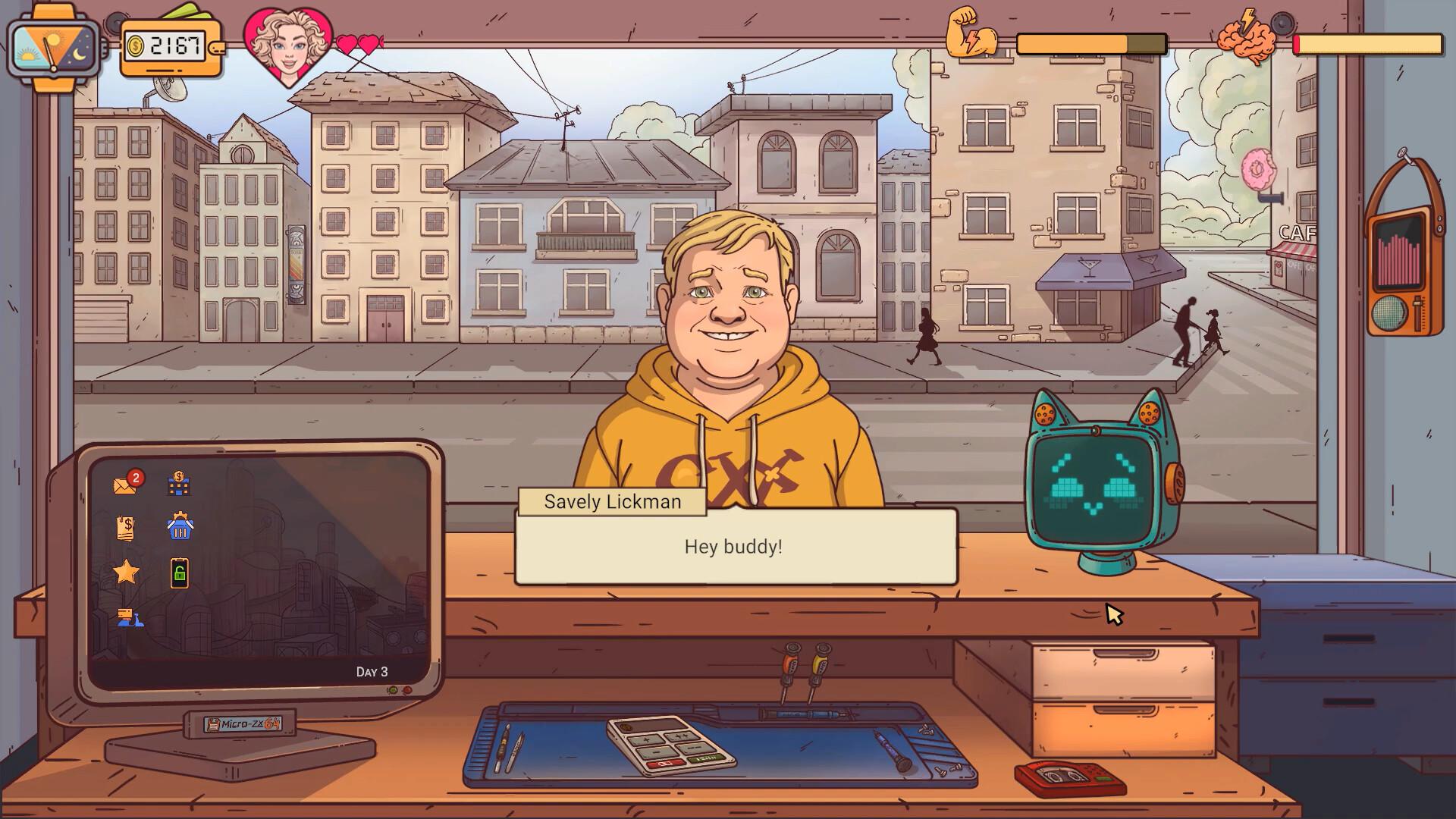
During the opening hours, In Trusted Hands behaves much like any traditional time-management simulator. Patrons line up at the counter, each bearing unique smartphone models afflicted with everything from shattered glass to fried motherboards. Operating the shop requires a delicate balancing act of triage and customer service. Once a phone is scanned, the diagnostic terminal spits out a recommended baseline price. However, the game introduces a rudimentary haggling mechanic: frugal customers balk at high margins and demand discounts, while affluent or desperate patrons are willing to pay a hefty premium.
Once a price is agreed upon, the player retreats to their computer terminal to order the necessary replacement parts. Early on, micro-management rules the day. Every individual order incurs a flat-rate delivery fee, a subtle economic detail that savvy players will quickly weaponize. As this reviewer rapidly discovered, bulk-ordering spare parts across the board is the ultimate key to early-game efficiency; since the shipping toll remains static whether you order one screen or twenty, stocking a diverse inventory of components at once is a masterclass in retail optimization.
When the courier drops off your parcels, the physical repair phase begins. On the Xbox console version, this is reduced to a starkly straightforward mini-game: you wait for a moving line to intersect with a designated green bar and tap a button. Success yields a successfully repaired device and a contented customer; missing the target merely drains a fraction of your daily energy meter. Never once does the repair process feel intellectually taxing or mechanically demanding.
Days 4–7: The Introduction of Compromising Elements
As your bank account grows and your enterprise expands, the game’s true nature begins to manifest. The pedestrian flow of ordinary townsfolk is occasionally interrupted by distinct, accented NPCs. Distinguished by a subtle green aura hovering over their dialogue prompts when they approach the counter, these individuals are persons of interest—figures operating in the murky underworld of local politics, journalism, and petty crime.
These characters do not merely want their phones fixed; they want their targets compromised. They slip you requests to bypass security protocols on specific customer devices. Suddenly, your workbench transforms into an intelligence-gathering station. You are given the agency to hack into personal devices and extract sensitive communications, private photographs, and confidential records.
The game presents you with a tri-directional moral compass disguised as a distribution network:
- The Law: Forwarding hacked data to local police officers to assist in investigations.
- The Press: Leaking scandalous celebrity or corporate scoops to predatory journalists for cash payouts.
- The Underworld: Supplying private images and intimate data directly to malicious stalkers or creeps for illicit financial gain.
In exchange for your digital trespassing, these fixers line your pockets with substantial under-the-table bonuses. Concurrently, the game introduces systemic corporate choices regarding tax compliance. At the conclusion of each business day, players must square their accounts, paying rent, electricity, and official Value Added Tax (VAT). But the game explicitly leaves a loophole: you can routinely opt out of issuing VAT receipts, pocketing the extra cash and committing systematic tax fraud right under the nose of regulatory authorities.
Days 8–12+: The Economic Plateau and Disillusionment
By the end of your first week, the illusion of systemic pressure begins to dissolve entirely. The early-game financial anxiety—the looming specter of debt collection and utility shut-offs—evaporates once you master the margin-to-delivery ratio.
By day twelve, this reviewer sat atop a formidable financial cushion exceeding 10,000 units of in-game currency, alongside a fully stocked warehouse featuring at least one spare component for every smartphone model currently in circulation. The daily rhythm had devolved into an unchallenging mechanical loop: open shop, scan phones, haggle, execute the effortless green-bar repair mini-game, harvest illegal data for shadowy fixers, skip tax payments, and retire to bed with boundless energy reserves.
Because the narrative ramifications of your actions never materialize in a meaningful, punishing way, the weight of being a digital voyeur completely vanishes.
Supporting Context & Metrics: Systems, Platforms, and Performance
To contextualize In Trusted Hands, it is vital to examine its cross-platform design philosophy and technical framework. Developed as a multi-platform release, the title is currently available across PlayStation, Xbox, PC, and Nintendo Switch storefronts. However, the gaming experience varies subtly depending on your platform of choice.
Platform Disparities and Input Mechanics
Reviewing the title specifically on the Xbox console highlights a distinct design philosophy geared toward controller-friendly optimization.
| Feature / System | PC Version | Console / Xbox Version |
|---|---|---|
| Repair Mini-Game | Expanded, multi-step mechanical procedures | Simplified single-button timing prompt (Green Bar) |
| Interface Navigation | Point-and-click precision via mouse | Direct-manipulation thumbstick / button mapping |
| Inventory Management | Rapid drag-and-drop file and part sorting | Streamlined radial and grid selection menus |
| Data Hacking Depth | Multi-layer file exploration and decoding | Automated transfer loops with minimal user friction |
The PC iteration appears to boast a slightly more involved repair suite, featuring deeper diagnostic hurdles and more intricate part-replacement pathways. By contrast, the Xbox port streamlines these interactions to the point of passivity. The single-button green-bar mechanic requires so little cognitive load that it effectively reduces hardware repair to an automated administrative chore.
Economic Balancing and the Lack of Consequence Metrics
From a game design perspective, In Trusted Hands commits a cardinal sin for simulation titles: it removes long-term consequences. In a traditional management game (such as Papers, Please or Frostpunk), player transgressions invite systemic blowback—audits, strikes, societal collapse, or violent crackdowns.
In In Trusted Hands, the metrics tracking your villainy are virtually nonexistent:
- Customer Satisfaction: Reflected merely through generic online store reviews. Despite hacking into phones, leaking private data, and dodging VAT taxes, shop ratings remain remarkably resilient, entirely untethered from your ethical breaches.
- Legal Risk: Tax evasion yields no dramatic IRS raids, asset seizures, or police sirens. You can consistently rob the state blind without facing a solitary audit.
- Social Fallout: Even the game’s rudimentary dating and social elements—where players attend meet-ups to foster relationships—suffer from robotic predictability. Selecting the correct, blindingly obvious dialogue option guarantees a successful romantic reply every single time.
Ultimately, the game’s internal metrics reveal an economic design that scales too steeply. By making capital accumulation effortless within the first ten business days, the developers accidentally strip away the primary motivator that keeps management games engaging: survival.
Official Statements & Developer Intent
While independent development teams often maintain close ties with their communities through patch notes and social media roadmaps, the overarching design ethos behind In Trusted Hands points toward an experiment in mundane roleplay mixed with moral ambiguity.
In promotional materials and overview trailers distributed across digital storefronts, the creators position the game not as a gritty cyberpunk thriller, but as a darkly humorous look at the mundane normalization of surveillance culture. The central hook hinges on a provocative question: How easily do ordinary people compromise their ethics when nobody is watching, and the bills are due?
The developers intended for the storefront to act as a micro-cosm of modern societal complicity—a place where the chaotic demands of digital life intersect with corporate negligence. According to preliminary statements accompanying the title’s multi-platform rollout, the goal was to craft a simulator that juxtaposes the cozy, repetitive comfort of traditional retail games against the unsettling reality of modern data privacy violations.
However, community feedback—echoed heavily in reviews across Steam, Xbox, and PlayStation networks—suggests that while the conceptual foundation of these developer statements struck a chord, the implementation missed its mark. Players noted that the satirical weight of corporate greed and digital voyeurism gets lost because the game treats heavy ethical violations with the same emotional gravity as forgetting to sweep the shop floor.
Future Outlook: What’s Next for In Trusted Hands?
As In Trusted Hands settles into its lifecycle across current-generation consoles and PC, its long-term viability hinges on how the development team chooses to address community critiques. The game possesses a sturdy structural skeleton—a distinct aesthetic, smooth performance across hardware tiers, and an immediately engaging core loop. Yet, it sits firmly in the category of titles that feel like brilliant proof-of-concept builds awaiting a definitive expansion.
Potential Areas for Expansion and Patches
- Deeper Economic Difficulty Tiers: Introducing a "Hardcore" or "Realistic" economic mode that tightens profit margins, increases shipping costs, and scales utility bills would instantly restore the survival tension missing from the current build.
- Consequence Systems for Ethics: To make data hacking and tax evasion feel meaningful, the developers must introduce reactive game systems. Implementing tax audits, disgruntled customers whose private data was leaked demanding legal reparations, or moral crises would elevate the narrative stakes.
- Expanded Console Repair Mechanics: Bridging the gap between the PC and console versions by bringing more intricate, multi-step repair mini-games to Xbox and PlayStation players would combat the passive monotony of the current single-button green-bar system.
- Narrative Branching and Endgames: Establishing a definitive endpoint—such as a major corporate buyout, a federal investigation, or a deep personal fallout with the characters you have exploited—would give players a concrete reason to push past day twelve.
Final Verdict
In Trusted Hands is a fascinating title caught in the crossfire of its own mechanical simplicity. It offers an inviting, smooth-running management experience that successfully captures the meditative satisfaction of retail organization. Unfortunately, by stripping away economic friction and narrative accountability, it transforms its most compelling asset—its dark, morally bankrupt underworld—into a toothless playground where choices carry no weight.
For fans of cozy management simulators looking for a weekend distraction with a quirky premise, In Trusted Hands provides a diverting, low-stress escape. But for those seeking a simulator that truly tests their ethics and challenges their strategic mind, the experience ultimately leaves you staring at a screen, wishing there was far more beneath the surface.