Executive Overview

The puzzle genre has long relied on stark, clinical abstractions—warehouses, sterile grids, geometric blocks, and cold logic. However, developer Miracle Tea has upended this convention with Club Soko, a creative and delightfully chaotic reinvention of the classic Sokoban formula. By transplanting the mechanical rigidity of block-pushing spatial challenges into the suffocating, bass-heavy, and sweaty confines of an underground multi-tiered nightclub, the game delivers an experience that is as atmospheric as it is intellectually taxing.
At its core, Club Soko retains the foundational tenets that defined the genre since its 1981 inception by Hiroyuki Imabayashi: players navigate a grid-based environment, pushing obstacles toward designated targets while adhering to the immutable rule that objects can only be pushed, never pulled. Yet, by personifying these obstacles as eccentric clubbers, rigid security personnel, and overzealous metalheads, Miracle Tea has transformed a sterile mental exercise into a vibrant, sensory-driven escapade. Complete with rubbery cartoon animations, muffled electronic beats thumping through concrete walls, and deeply hidden secrets tucked away from the main dance floors, Club Soko has emerged as a standout title in the modern puzzle landscape.
Detailed Chronology
The genesis of Club Soko stems from a broader industry trend of indie developers seeking to inject personality, narrative texture, and unconventional themes into traditionally dry puzzle subgenres. For decades, Sokoban variants remained tethered to their industrial roots—pushing crates in docks, moving energy cores in sci-fi laboratories, or rearranging stones in ancient ruins.
Miracle Tea’s development cycle pivoted away from these tropes early on, recognizing that spatial puzzles often suffer from cognitive overload. In standard grid-based games, players frequently struggle to retain the distinct, abstract rules assigned to various anonymous icons. By recontextualizing the grid as a crowded dance floor, the design team established an intuitive visual hierarchy. Bouncers naturally repel players; erratic dancers subtly displace them laterally; and high-energy metalheads plow across the screen until halted by an obstruction.
Following its initial announcement and promotional trailers—which highlighted the game’s distinctive felt-pen art style and pulsating auditory backdrop—Club Soko captured the attention of puzzle enthusiasts. The rollout of its launch trailer solidified expectations, showcasing not only the standard progression through tiered dance floors via trapdoors, but also the labyrinthine network of hidden pathways and cryptic secret levels that reward lateral thinking and keen observation.
Supporting Context & Metrics
To understand the genius of Club Soko, one must examine the psychological and mechanical mechanics underpinning the Sokoban genre, and how Miracle Tea cleverly subverts them.
The Anatomy of a Grid
In traditional Sokoban design, levels are evaluated by their "state space complexity"—the number of possible configurations a player can reach. While mathematically fascinating, this often results in visually uninspired puzzles. Club Soko maintains rigorous puzzle design standards while keeping its level footprints relatively compact. This prevents players from feeling overwhelmed, ensuring that failure invites immediate iteration rather than frustration.
The Persona of Obstacles
The game’s brilliance lies in how its mechanics align with its thematic presentation:
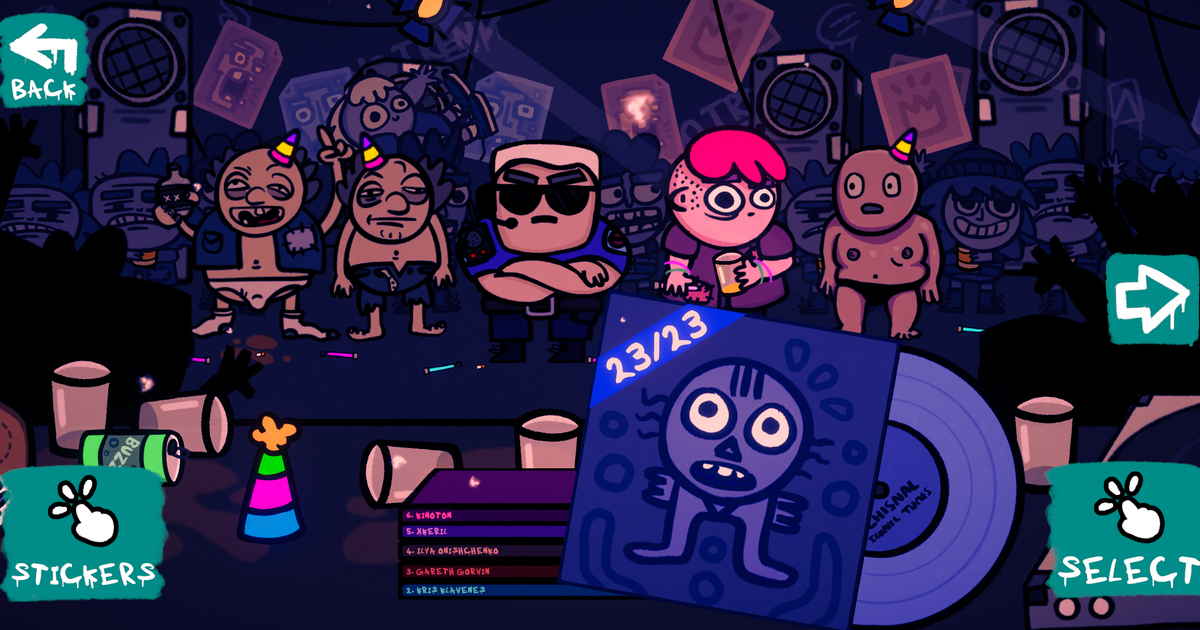
- The Bouncer: Acts as an immovable directional wall, pushing the player away from adjacent squares. This forces players to reverse-engineer puzzles, figuring out how to wedge obstacles to block or manipulate the bouncer’s line of defense.
- The Standard Clubber: Unpredictably nudges the player one square left or right, introducing localized chaos into an otherwise methodical routing plan.
- The Metalhead: Triggers a linear rush across the screen upon contact with the player’s row, requiring environmental objects to act as crash barriers.
- The Mime: Found in the game’s brutal secret levels, these entities mirror every single movement the player makes, doubling the cognitive load and demanding flawless spatial foresight.
Environmental Storytelling and Secrets
Beyond the core gameplay loop, Club Soko excels in environmental storytelling. The sensation of being trapped in a subterranean maze is heightened by audio design that mimics muffled bass lines echoing through masonry. Furthermore, the inclusion of off-grid exploration allows players to slip past the normative bounds of the dance floor, uncovering hidden passages that lead to punishing, high-tier secret chambers. These areas capitalize on the thematic promise of an underground club—a labyrinth of VIP rooms, back alleys, and forgotten utility spaces where anything can happen.
Official Statements
While traditional corporate press releases are sparse for this indie darling, design philosophy statements from the developers and early critical consensus highlight the core ambitions behind Club Soko.
Early development diaries and promotional commentary from Miracle Tea emphasized a desire to strip away the intimidating intellectual elitism often associated with hard-logic puzzle games. "We wanted to build something that felt alive, sweaty, and tactile," notes the design rationale behind the project. "Sokoban games are brilliant brain-teasers, but they can feel cold. By wrapping those mechanics in the chaotic, sensory overload of a nightclub, the player isn’t just solving a grid—they’re surviving a night out."
Reviewers and early adopters have echoed these sentiments, praising the game for successfully bridging the gap between hardcore puzzle mechanics and casual, stylistic immersion. Critics have particularly lauded the animation work, noting that the rubbery physics of the character models inject a layer of physical comedy into what would otherwise be a cerebral exercise in frustration management.
Future Outlook
As Club Soko finds its footing among puzzle aficionados and fans of quirky indie titles, its long-term trajectory points toward an expanding footprint within the spatial puzzle community. The title proves that genres constrained by decades of convention can be revitalized simply by shifting the lens through which players view the grid.
Looking ahead, the success of Club Soko opens exciting doors for Miracle Tea and similar independent developers. The framework established here—combining tight, mathematical puzzle loops with rich, immersive, and humorous thematic skins—serves as a blueprint for future genre-bending experiments. Whether through potential post-launch content updates, community-driven level editors, or spiritual successors exploring other chaotic social environments, Club Soko has redefined what a warehouse crate-pushing simulator can become when you trade the forklift for a pair of dancing shoes and head straight into the bass.