Bridging Generations: Microsoft Launches Official Original Xbox Compatibility Framework for Windows PC
Executive Overview
In a watershed moment for video game preservation and cross-platform architecture, Microsoft has officially initiated the rollout of a native original Xbox emulation framework for Windows PC. The initiative, launching via an early preview program integrated directly into the Windows 11 ecosystem, marks the first time Microsoft has built a first-party, hypervisor-level solution to run software from its debut 2001 home console natively on personal computer hardware.
+-------------------------------------------------------------------------+
|                    MICROSOFT ECOSYSTEM CONVERGENCE                      |
+-------------------------------------------------------------------------+
|  Original Xbox (2001)  --->  Xbox 360 (2005)  --->  Xbox One / Series X|S|
|        ----------- NATIVE EMULATION LAYER -----------/                 |
|                                |                                        |
|                                v                                        |
|                  WINDOWS 11 PC ECOSYSTEM (2024+)                        |
|             (DirectX 12 / Auto HDR / PC Game Pass)                      |
+-------------------------------------------------------------------------+
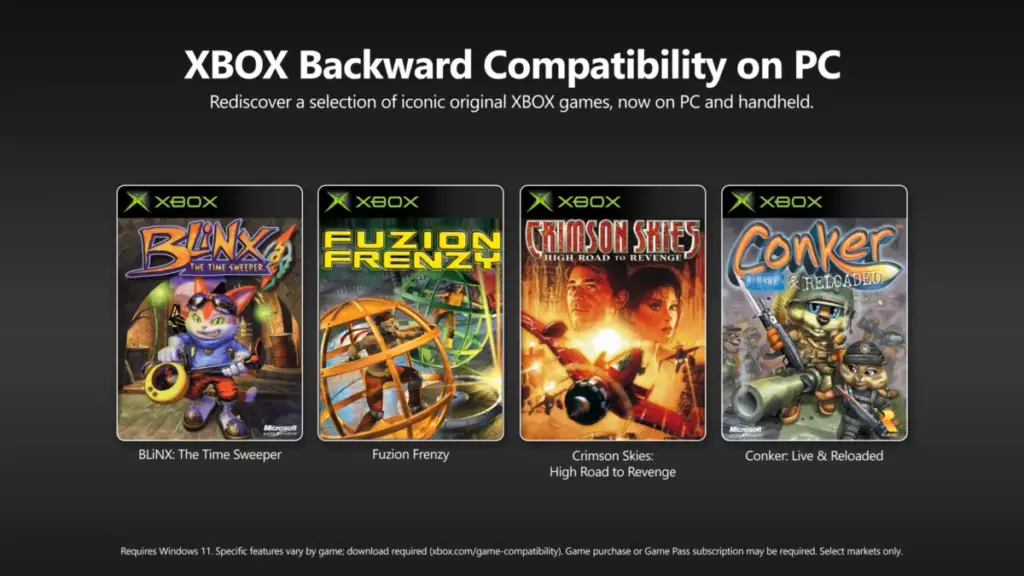
The initial preview release deploys a curated suite of four landmark original Xbox titles, served to consumers through either individual digital storefront purchases or as part of the PC Game Pass subscription catalog. To access the environment, users must be operating on Windows 11, leveraging the operating system’s modern virtual machine platform and advanced graphic API pipelines.
This strategic maneuver serves dual objectives: it drastically expands the addressable market for legacy Xbox intellectual property while positioning Microsoft as an aggressive proponent of software preservation. At a time when physical media access is diminishing and competitive platforms face criticism over fragmented legacy support, Microsoft’s unified architecture model offers a scalable blueprint for back-catalog accessibility across hardware generations.
Detailed Chronology: The Decades-Long March Toward Universal Compatibility
The path to native original Xbox game playback on personal computers spans more than two decades of structural, architectural, and corporate evolution within Microsoft’s gaming division.
2001 -----------------> 2005 -----------------> 2015 -----------------> 2024
Original Xbox Launch    Xbox 360 Era            Xbox One BC Program     PC Emulation Preview
Intel x86/NVIDIA        PowerPC Shift           x86 Hypervisor Layer    Windows 11 Integration
The Architectural Irony (2001–2005)
When the original Xbox debuted in November 2001, its underlying hardware was fundamentally a modified personal computer. Powered by a custom Intel Pentium III Coppermine-based processor (733 MHz) and a bespoke NVIDIA NV20-derived graphics processing unit (NV26/XGPU), the console ran a stripped-down variant of the Windows 2000 kernel alongside an early iteration of DirectX 8.
Despite this shared lineage with PC hardware, software licensing restrictions, custom memory architectures (64MB of unified DDR SDRAM), and proprietary graphics registers prevented native execution on standard Windows PCs for decades.
The PowerPC Era and Emulation Hurdles (2005–2013)
With the launch of the Xbox 360 in 2005, Microsoft pivoted away from x86 architecture to IBM’s PowerPC-based Xenon processor. This dynamic forced Microsoft’s engineering teams to build complex software translation layers to run select original Xbox titles on the Xbox 360.
Because translating x86 instructions to a RISC-based PowerPC architecture was computationally expensive, only a fraction of the original Xbox library received official backward compatibility patches during this era.
The Hypervisor Breakthrough (2013–2017)
The launch of the Xbox One in 2013 returned the brand to x86-64 architecture via AMD APUs. Under the leadership of Phil Spencer and technical leads like Jason Ronald, Microsoft established a dedicated Backward Compatibility Engineering Team.
In 2015, Microsoft shocked the industry by enabling Xbox 360 emulation on Xbox One through a custom virtual machine hypervisor. By late 2017, the team extended this technology to support original Xbox games on Xbox One, applying automatic display upgrades, stable frame rates, and faster storage load times.
The Unified PC Convergence (2018–Present)
As Microsoft shifted its commercial focus toward software service delivery via Xbox Game Pass and cross-platform entitlements via Xbox Play Anywhere, isolating console code to dedicated hardware became an operational bottleneck.
The announcement of official original Xbox software support on Windows 11 represents the culmination of this multi-year effort: bringing console-exclusive legacy assets into the mainstream PC gaming ecosystem without reliance on unofficial, third-party reverse-engineering projects.
Supporting Context & Metrics: Architecture, Game Pass, and Preservation
To understand the scope of Microsoft’s technical push, one must examine the operational parameters, system requirements, and market dynamics driving the initiative.
+------------------------------------------------------------------+
|               PLATFORM COMPARISON: LEGACY SUPPORT                |
+---------------------+---------------------+----------------------+
| Feature             | Microsoft Xbox / PC | Sony PlayStation     |
+---------------------+---------------------+----------------------+
| Native PC Execution | Yes (Windows 11)    | Cloud Streaming Only |
| Purchase Options    | Buy or Game Pass    | PS Plus Premium Tier |
| Enhancement Tech    | Auto HDR / Res Scaling | Minimal Upgrades  |
| Ecosystem Strategy  | Cross-buy Entitlements | Siloed Platform    |
+---------------------+---------------------+----------------------+
Technical Requirements and Infrastructure
The PC emulation framework operates as an extension of the Windows 11 platform, using specific hypervisor features and security primitives to isolate and run legacy binaries securely.
- Operating System Requirement: Windows 11 (build-level integration with Virtualization-based Security).
- API Translation Layer: Converts DirectX 8.0 fixed-function and early programmable shader pipelines directly into DirectX 12 Ultimate calls.
- Enhancements: Native support for modern arbitrary display resolutions (up to 4K), anisotropic filtering, spatial audio processing, and system-level Auto HDR injection.
- Distribution Model: Integrated directly within the Windows Xbox App, backed by Xbox Cloud Sync for cross-save capabilities between PC and Xbox Series X|S consoles.
Market Context: The PC Handheld Expansion
The timing of this release coincides with the rapid expansion of the Windows-based gaming handheld market. Devices such as the ASUS ROG Ally, Lenovo Legion Go, and MSI Claw rely on Windows 11 to run PC libraries.
By delivering low-overhead, native original Xbox emulation to Windows 11, Microsoft effectively turns every Windows PC handheld into an optimized portable Xbox, unlocking vintage software without requiring heavy battery consumption or cumbersome third-party software configuration.
                          +-----------------------+
                          |   WINDOWS 11 ECOSYSTEM |
                          +-----------+-----------+
                                      |
          +---------------------------+---------------------------+
          |                                                       |
          v                                                       v
+-------------------+                                   +-------------------+
|  Desktop / Laptop |                                   |  Handheld PCs     |
|  (4K Scaling /    |                                   |  (ROG Ally,       |
|   Auto HDR)       |                                   |   Legion Go)      |
+-------------------+                                   +-------------------+
Preservation Dynamics: Xbox vs. Competitors
Microsoft’s systemic approach to legacy software preservation stands in stark contrast to broader gaming industry trends:
- Sony Interactive Entertainment: Legacy PlayStation 1, PS2, and PSP titles on modern platforms remain largely gated behind top-tier subscription tiers (PlayStation Plus Premium) or sporadic individual releases. PlayStation 3 titles, bound to the complex Cell Broadband Engine, remain confined to cloud streaming solutions on PC rather than native execution.
- Nintendo: Utilizes a closed, rental-style model tied exclusively to Nintendo Switch Online membership tiers, offering limited software access with zero cross-platform or open-ecosystem purchasing options.
- Microsoft Xbox: Establishes persistent digital rights across generations. Games purchased digitally on an Xbox 360 or Xbox One carry forward to PC where entitlement parity exists, setting a high standard for platform preservation.
Official Statements and Industry Framing
Microsoft executive leadership has positioned the launch as an essential extension of their platform vision, emphasizing long-term code stability and consumer agency.
"Our commitment to the community has always been clear: your games, your saves, and your purchases should move forward with you regardless of device hardware shifts," noted Phil Spencer, CEO of Microsoft Gaming, during a strategic update on platform health. "Bringing our initial Xbox heritage directly to the PC platform via native Windows tools is not just an exercise in nostalgia; it is a fundamental pillar of our software preservation responsibility."
Engineering leads within the Xbox Backward Compatibility team underscored the technical effort required to standardize multi-generational hardware calls on modern PC chips:
"Translating early 2000s low-level GPU hardware calls into modern DirectX 12 pipelines on modern x86-64 microarchitectures presents unique synchronization challenges," explained senior platform engineers. "Our team created a streamlined translation layer that preserves the exact frame-timing, physics loops, and artistic intent of the original software, while benefiting from the raw computational headroom, memory speeds, and display tech of contemporary PC hardware."
Industry analysts have viewed the move through a commercial lens, highlighting how legacy software reinforces the underlying value proposition of PC Game Pass.
"By unlocking low-overhead legacy software for PC users, Microsoft elevates the value proposition of PC Game Pass while reducing software production costs," noted gaming market analysts. "Instead of funding expensive full-scale remasters for minor catalog titles, Microsoft can deploy hyper-optimized native emulation layers that allow their historical library to generate recurring subscription value indefinitely."
Future Outlook and Strategic Implications
The introduction of four original Xbox titles in a preview environment represents the initial phase of a broader multi-platform roadmap.
+--------------------------------------------------------------------------+
|                        FUTURE ECOSYSTEM ROADMAP                          |
+--------------------------------------------------------------------------+
|  Phase 1: Original Xbox Preview on PC (4 Titles, Windows 11)             |
|                                                                          |
|  Phase 2: Expanded Original Xbox Catalog & PC Handheld Optimizations     |
|                                                                          |
|  Phase 3: Potential Xbox 360 Hypervisor Layer on Windows 11              |
|           (Targeting Fable II, Gears of War, Lost Odyssey)               |
+--------------------------------------------------------------------------+
The Xbox 360 Horizon: The Holy Grail of Compatibility
The deployment of an official original Xbox hypervisor on PC immediately raises expectations for the next major architectural hurdle: Xbox 360 emulation for Windows PC.
A substantial volume of classic seventh-generation software—including critically acclaimed titles such as Fable II, Fable III, Gears of War 2, Gears of War 3, Lost Odyssey, and Blue Dragon—remains locked to original hardware or modern Xbox consoles.
                       +-------------------------+
                       |    XBOX 360 ON PC?      |
                       +------------+------------+
                                    |
          +-------------------------+-------------------------+
          |                                                   |
          v                                                   v
+-------------------+                               +-------------------+
| Technical Barrier |                               | High Demand IP    |
| (PowerPC Xenon to |                               | (Fable II/III,    |
|  x86 Translation) |                               |  Gears 2/3)       |
+-------------------+                               +-------------------+
Translating the Xbox 360’s tri-core PowerPC Xenon CPU architecture to modern consumer PCs is significantly more complex than executing original x86 Xbox binaries. However, Microsoft’s internal development of the "Fuego" translation layer for Xbox One proves that the company possesses the proprietary tooling necessary to bring Xbox 360 code to Windows 11.
If Microsoft expands this preview mechanism to encompass seventh-generation console code, it would effectively resolve one of the largest catalog voids in modern PC gaming.
Ecosystem Convergence and Final Thoughts
Microsoft’s deployment of native original Xbox emulation on PC confirms that the boundary between the console and the personal computer has largely evaporated within the Xbox organization. By leveraging Windows 11 as a universal host runtime, Microsoft is ensuring that its media catalog remains functional, accessible, and monetizable indefinitely.
As physical media degrades and legacy console hardware succumbs to component failure, first-party software solutions offer a reliable path forward for preserving gaming history. Microsoft’s latest preview project provides immediate technical value to PC gamers while setting a vital precedent for how platform owners should manage, preserve, and respect their historical software legacies.